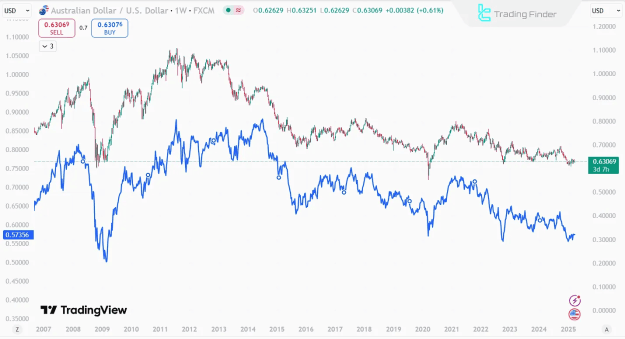


Monitoring currency correlations is fundamental for smart risk control and can assist in validating breakout failures on technical charts.
Tools to Identify Breakouts:
Why Is Currency Pair Correlation Important in Trading?
Recognizing and analyzing currency pair correlations enables traders to implement informed hedging techniques, manage risks precisely, and confirm or invalidate technical breakouts. Below are five key reasons why monitoring currency correlations is essential:
- Avoiding counterproductive trades
- Taking advantage of temporary divergence
- Applying effective hedging strategies
- Validating breakouts via technical confirmations
- Diversifying risk exposure
Note: Use tools like TradingFinder’s Forex Correlation Tool to measure correlation coefficients and identify the strength and direction of pair relationships.
Eliminating Counter Trades
Identifying currency pairs with strong negative correlations helps traders avoid entering conflicting trades simultaneously. Engaging in such trades could nullify both gains and losses.
Example:
Entering a long position in AUD/USD while simultaneously taking a short position in NZD/USD may result in neutralizing both trades due to their often strong positive correlation against USD.
Key Insight:
AUD and NZD frequently exhibit similar behavior against the US Dollar, making correlation tracking vital in decision-making.
Profiting from Temporary Divergences
Occasionally, currency pairs that are normally positively correlated diverge due to unexpected geopolitical, economic, or political events. Traders can benefit from these temporary deviations by entering positions that anticipate the reestablishment of the original correlation.
Example:
During political instability in Germany, EUR/USD may weaken while GBP/USD remains strong. Once stability returns, EUR/USD is likely to resume its typical movement in line with GBP/USD, creating an opportunity for profit through a long position in EUR/USD.
Hedging Positions Effectively
Understanding currency correlations is fundamental in implementing hedging strategies, especially during periods of market uncertainty or geopolitical risk.
Scenario:
In a risk-averse market (e.g., due to war), a trader may:
- Open long positions in gold and a safe-haven currency like the Swiss Franc.
- Simultaneously take a long position in a risk-on asset, anticipating a market recovery.
Outcome:
- If the risk persists: the risk-on trade may hit stop-loss, while the hedging assets (gold, CHF) reach their profit targets.
- If the situation improves: the safe-haven trades may result in losses, but gains from the risk-on position can offset them.
This approach reduces exposure to unpredictable geopolitical outcomes and maintains balanced portfolio risk.
Testing Breakouts and Technical Confirmation
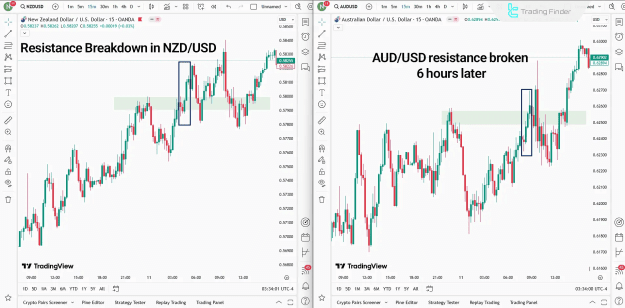
Correlation analysis is valuable for confirming or questioning breakout signals. Traders can validate breakout accuracy by observing how other correlated pairs respond at technical levels.
Example:
NZD/USD breaks a critical support level. To verify this signal:
- Check whether AUD/USD (positively correlated) or USD/CAD, USD/CHF (negatively correlated) also break similar levels.
- If they do, the breakout is confirmed.
- If not, the NZD weakness might be due to country-specific news, indicating a false breakout.
TradingFinder provides helpful indicators to identify false breakouts on platforms like MT4, MT5, and TradingView.
In the chart example, AUD/USD mirrored the resistance breakout seen in NZD/USD within three hours, confirming the trend.
Risk Diversification
Traders can reduce concentration risk by diversifying positions across positively correlated currency pairs.
Example:
A trader bearish on the USD plans to short EUR/USD with a 0.5% account risk. To diversify:
- Short EUR/USD with 0.25% risk
- Short GBP/USD with 0.25% risk
This method spreads exposure. If a Euro-specific risk emerges, the potential loss is limited to only 0.25% of the account rather than the full 0.5%.
Conclusion
Currency pair correlation is a vital concept for Forex traders, offering multiple strategic advantages including:
- Elimination of counterproductive trades
- Capitalization on divergence opportunities
- Strategic risk hedging
- Breakout confirmation through correlation analysis
- Effective risk diversification across related currency pairs
By integrating correlation analysis into a trading strategy, market participants can significantly enhance risk-adjusted returns while avoiding unintentional exposure to overlapping positions.
For a deeper analysis of pairwise correlation coefficients, visit TradingFinder’s Forex Correlation Tool.