

Understanding Kill Zones and the London Session
To effectively interpret the daily trading profile, it is essential to understand Kill Zones, which are designated time periods within each session where significant price activity often occurs. ICT methodology highlights these Kill Zones for their potential in initiating institutional moves.
Key Kill Zones for this analysis:
- London Session Kill Zone
- Winter: 2:00 AM – 5:00 AM EST
- Summer: 3:00 AM – 6:00 AM EST
- New York Session Kill Zone
- 8:30 AM – 12:00 PM EST (both Winter and Summer)
These Kill Zones provide traders with high-probability windows for market reversals, liquidity grabs, and continuation setups.
What is the London Reversal?
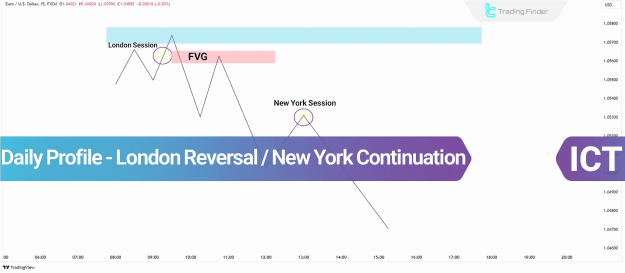
The London Reversal refers to a recurring daily candlestick pattern characterized by an initial price move in one direction during the London session, followed by a reversal that leads to a continuation into the New York session. This behavior often aligns with market structure shifts and liquidity objectives.
Bullish London Reversal
A Bullish London Reversal typically includes the following characteristics:
- Initial price decline during the London session;
- A Market Structure Shift (MSS) signaling the reversal;
- Continuation of upward movement during the New York session, forming a bullish daily candle.
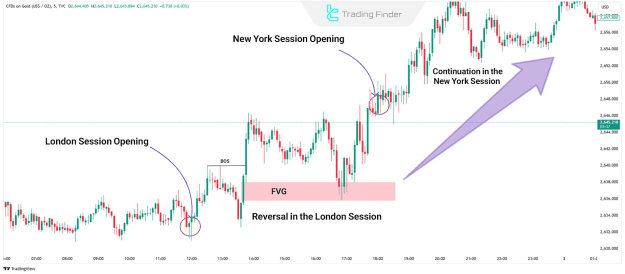
Example: Bullish London Reversal
On a 5-minute XAU/USD chart, a classic bullish reversal pattern can be identified:
- The price moves lower during the London session;
- A reversal occurs near a Fair Value Gap (FVG) or equilibrium level;
- The New York session extends the bullish move, targeting liquidity zones above.
Bearish London Reversal
For Bearish Reversals, traders should observe:
- An initial price rally during the London session;
- A confirmed market structure break to the downside;
- Continued bearish momentum through the New York session, forming a bearish daily profile.
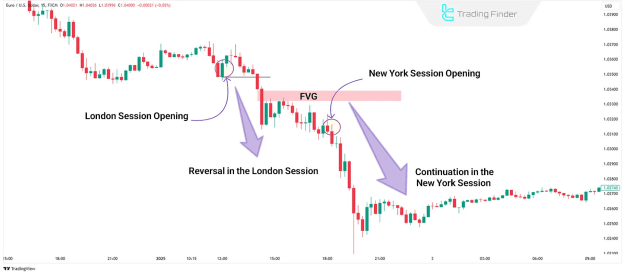
Example: Bearish London Reversal
A 15-minute EUR/USD chart may display the following scenario:
- Price reaches a session high in the London Kill Zone;
- A reversal begins at or near a Fair Value Gap (FVG);
- Bearish price action continues into the New York session, targeting previous lows and liquidity pockets.
Combining the London and New York Sessions for the London Reversal
In many cases, price action during the London session sets up a key level that is later retested during the New York session. This retest often aligns with liquidity targets and serves as a secondary entry point for traders following ICT principles.
Key Considerations for Using the London Reversal Strategy
The effectiveness of the London Reversal strategy depends on precise execution and understanding of institutional price behaviors. Traders should:
- Identify clear market structure shifts (MSS);
- Utilize Order Blocks (OBs) for refined trade entries;
- Set stop-losses at significant swing points, such as the previous day’s high or low;
- Recognize Fair Value Gaps (FVGs) as high-probability entry zones;
- Align their strategy with liquidity engineering concepts and time-sensitive volatility windows.
Conclusion
The London and New York daily profile is a fundamental strategy in ICT trading, enabling traders to capture high-probability moves through structured session analysis. The London Reversal pattern, in particular, plays a vital role in shaping the daily candlestick and offers continued opportunity during the New York session.
By focusing on Kill Zones, market structure shifts, Order Blocks, and Fair Value Gaps, traders can strategically approach intraday price action with increased precision and confidence. Proper risk management and session-based execution are essential for consistently capitalizing on ICT-based trading setups.