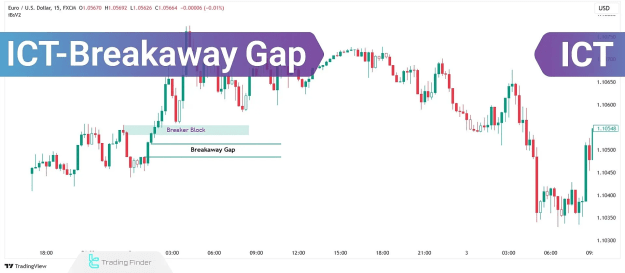


This concept is one of the most powerful yet underutilized tools within the ICT trading methodology and plays a crucial role in advanced Forex education. It offers a framework for systematically identifying low-risk trade setups that go beyond standard FVG techniques, making it an essential component for serious traders seeking to deepen their market knowledge.
Breakaway Gaps in the ICT Trading Model
Key Components of ICT Breakaway Gaps
Three primary elements contribute to the formation of an ICT Breakaway Gap:
- Breaker Block
Serves as the initial structural resistance or support that price encounters upon retracement. When price breaks a significant high and continues upward, the breaker block often halts any downward retracement, maintaining bullish structure. - Inverse Fair Value Gap
Functions as a confirmation of price direction. A bearish FVG, once broken to the upside, becomes a bullish inverse FVG, supporting continued bullish momentum. - Balanced Price Range (BPR)
Forms through the overlap of a bullish and bearish FVG, generating a balanced zone that prevents price reversal. When this holds, it helps establish the Breakaway Gap (e.g., BISI) as a valid continuation structure.
Difference Between Breakaway Gaps and Traditional Fair Value Gaps
While standard Fair Value Gaps are often revisited or filled, Breakaway Gaps signify exceptional momentum that deters immediate re-entry. The critical differentiator lies in their post-formation behavior.
Key attributes of Breakaway Gaps include:
- Sustained movement without price returning to fill the gap
- Confirmation of trend strength and market conviction
- Typically accompanied by high trading volume
Types of ICT Breakaway Gaps
Breakaway Gaps are categorized into two primary forms:
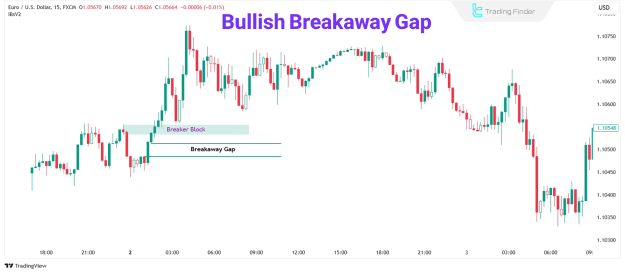
Bullish Breakaway Gap (BISI)
- Occurs when price breaks a significant high with force
- Establishes a bullish price imbalance that is not immediately mitigated
- Indicates strong upward momentum and continuation potential
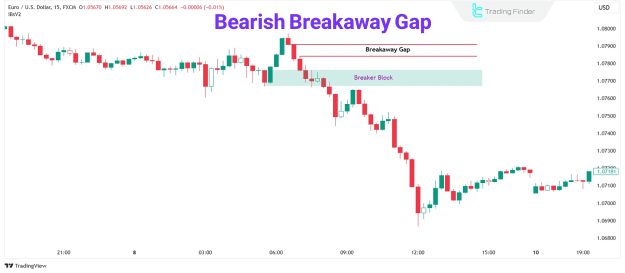
Bearish Breakaway Gap (SIBI)
- Forms when price decisively breaks below a major low
- Creates a bearish price imbalance that deters upward retracement
- Highlights continuation in bearish trend direction
Market Structure and Breakaway Gaps
Understanding market structure is essential to successfully identifying and trading ICT Breakaway Gaps. Several analytical elements support this process:
Premium/Discount Arrays (PD Arrays)
- Define the trading range from significant high to low
- Use Fibonacci levels to determine Premium (>50%) and Discount (<50%) zones
- Identify key structural points like:
- Order Blocks
- Fair Value Gaps
- Breaker Blocks
Order Flow Dynamics
- Analyze behavior within defined liquidity zones
- Monitor for the following:
- Formation of Order Blocks
- Collection of Buy-Side and Sell-Side Liquidity
- Smart Money activity
- Areas of price equilibrium
Price Movement Patterns
- Recognize that valid Breakaway Gaps are usually formed during periods of:
- High volume
- Institutional accumulation/distribution
- Breaks of key support or resistance levels
Multi-Time Frame Analysis for Breakaway Gaps
A multi-timeframe approach provides a broader market context, enhancing the precision and confidence of entries and exits.
Higher Time Frame Bias
- Gaps on Daily or Weekly charts carry more reliability
- Helps avoid short-term market noise and emotional trades
Lower Time Frame Confirmation
- Once a higher-timeframe Breakaway Gap is identified:
- Drill down to M15 or M5 charts for entry confirmation
- Look for minor FVGs and volume alignment
- Confirm continuation with intraday price action
Time Frame Correlation Method
- Maintain consistency in timeframe combinations (e.g., Weekly/Daily for bias, M15/M5 for entry)
- Test over 30–50 trades before adapting strategy
- Observe volume spikes and gap behavior across timeframes to validate setups
Implementation and Risk Management in ICT Breakaway Gap Trading
Entry and Exit Strategy
- Entry Triggers:
- Breakaway Gap confirmed by strong momentum and institutional volume
- Exit Strategy:
- First partial at nearby structure (support/resistance)
- Second at a significant liquidity zone or market structure shift
- Final portion for extended targets
Capital Management Guidelines
- One-Percent Rule:
- Never risk more than 1–2% of account per trade
- Position Sizing:
- Calculated based on stop-loss distance and market volatility
- Leverage:
- Adjust based on session (e.g., London session) and asset class volatility
Stop-Loss Placement
- Below/above the manipulation phase for trend continuation setups
- Set relative to the Breakaway Gap’s structural integrity
- Typical range: 5–10 pips for intra-session trades (e.g., London Open)
- Maintain a minimum 1:2 risk-to-reward ratio for consistent profitability
Conclusion
ICT Breakaway Gaps are specialized unmitigated Fair Value Gaps that emerge after sharp price movements from major highs or lows. Unlike typical FVGs, these gaps indicate a high-probability continuation with minimal retracement.
Mastering the Breakaway Gap strategy requires:
- Understanding the supporting market structure components
- Employing multi-timeframe validation
- Practicing disciplined risk and capital management
By integrating these principles, traders can harness the full potential of ICT Breakaway Gaps as a powerful tool in their trading arsenal.