

Prop Firm DrawDown Protector : Prop Firm Capital Protection Expert MT4 | Forex Money Management: Forex Trade Management Expert MT4 |ICT Concepts Indicator MT4 | Smart Money Concepts Expert MT4| Smart Money Trap Scanner | Get a free Expert Advisor license via Telegram and WhatsApp
Introduction to the Tokyo Trading Session
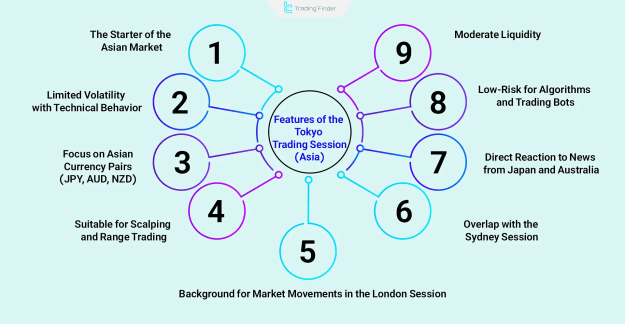
The Tokyo session represents the first of the three major forex sessions to open and continues operating as the London session begins. This Asian trading window runs from 00:00 to 09:00 GMT (12:00 AM to 9:00 AM UTC). Japan maintains fixed trading hours throughout the year as the country does not observe daylight saving time.
Contrary to popular belief, Tokyo isn't Asia's exclusive forex trading center. Both Hong Kong and Singapore capture approximately 7.6% of market share, handling larger volumes than Japan's 4.5% contribution. This distribution makes the term "Asian session" more accurate than specifically "Tokyo session."
Key Characteristics of the Tokyo Session
Moderate Volatility Environment
The Tokyo session typically offers more stable market conditions compared to other sessions, creating an ideal environment for:
- Technical analysis-based strategies
- Lower-risk trading approaches
- Volatility control mechanisms
- Preparation for the London overlap
Asian Range Formation
During early session hours, incoming bank orders and corporate hedging activities significantly increase liquidity. The Asian range that forms during this period becomes crucial for developing breakout or reversal strategies throughout the remaining trading day.
Economic Data Influence
The release of macroeconomic data—particularly Japanese interest rates, Bank of Japan policy decisions, and trade balance figures—serves as the primary volatility driver during this session.
Advantages and Disadvantages
Advantages:
- Regular and predictable price movements
- Suitable conditions for scalping and short-term trading strategies
- Minimal impact from sudden news developments
- Session overlaps with Sydney (beginning) and London (ending)
- Focus on high-liquidity pairs like USD/JPY, AUD/USD, and NZD/USD
Disadvantages:
- Limited volatility for traders seeking strong price movements
- Reduced liquidity in certain major pairs including EUR/USD and GBP/USD
- Potential market lethargy during middle session hours
- Diminished influence on overall market trends
- Possible gap movements or unexpected volatility at session open, particularly on Mondays
Optimal Trading Instruments
High Volatility Pairs:
- EUR/JPY
- AUD/JPY
- NZD/JPY
- GBP/JPY
Lower Volatility Pairs:
- EUR/USD
- GBP/USD
- USD/CHF
- USD/CAD
- EUR/GBP
- AUD/NZD
The Tokyo session demonstrates particular strength in JPY crosses, which maintain greater depth and responsiveness during Asian hours. USD pairs involving AUD and NZD respond more directly to macroeconomic data from China and Australia.
Peak Volatility Periods
The Tokyo session experiences heightened price volatility during specific windows:
- Market opening coinciding with economic data releases
- Overlap period with the Sydney session, particularly in AUD and NZD pairs
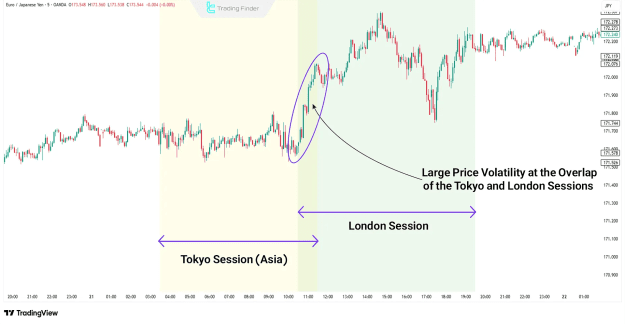
- Overlap with the London session, generating increased trading volumes in EUR/JPY and GBP/JPY
Example Scenario:
The EUR/JPY pair might consolidate within a low-volume range during the Tokyo session's final hours. As London session participants enter the market, order flow accelerates rapidly, potentially triggering breakouts from Tokyo-established ranges. During this overlap window:
- European economic data releases (PMI, inflation figures) act as catalysts
- European banking institutions increase market participation
- Elevated liquidity conditions create explosive 40-70 pip movements in pairs like GBP/JPY or EUR/JPY
This volatility peak typically results from combining Europe's news catalysts with accumulated Asian liquidity.
Economic Data Impact
The Tokyo session responds directly to economic releases from Japan and key Asian economies:
Japanese Data:
- Consumer Price Index (CPI) and Producer Price Index (PPI)
- Bank of Japan policy decisions, particularly Yield Curve Control (YCC)
- Minor interest rate adjustments that can shift global capital flows
Australian Influence:
- Employment data and Reserve Bank of Australia statements
- Primary drivers for AUD pairs and commodity markets
Chinese Indicators:
- Purchasing Managers' Index (PMI) readings
- Trade balance data
- Significant impact on commodity currencies and risk assets
Trading Strategy Implementation
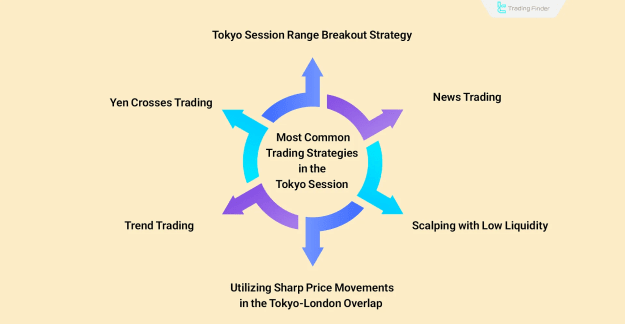
Range Breakout Approach:
The market typically fluctuates within a narrow range at the Tokyo session opening. Traders often define the first hour's high and low levels to prepare for breakout entries, with high-volume breaks frequently initiating the day's trend.
News-Based Trading:
Releases from the Bank of Japan, Japan's trade balance figures, and China's PMI data serve as primary catalysts. These events generate fast, volatile reactions that attract scalpers employing tight stop-loss orders.
Yen Crosses Focus:
Pairs including AUD/JPY, NZD/JPY, and EUR/JPY demonstrate heightened sensitivity to Asian flow. Lower liquidity compared to major pairs often results in accelerated price swings.
Session Overlap Utilization:
The final two hours of Tokyo session overlapping with London's opening boosts liquidity significantly, enabling stronger price movements and validated breakouts.
Japanese Holiday Effects
When Japanese banks and financial institutions close for holidays, the Tokyo session exhibits distinct characteristics:
- Reduced liquidity creating shallower market conditions
- Artificial volatility from diminished institutional participation
- Increased reliance on Chinese and Australian market influences
- Narrow-range trading conditions that may setup false breakout scenarios
Risk Management Considerations
Professional traders implement specific risk management protocols for the Tokyo session:
- Adaptive position sizing based on Average True Range (ATR) and session volatility
- Strategic stop-loss placement beyond liquidity pockets or Asian ranges
- Realistic profit targets of 10-25 pips with 1:1.2 to 1:1.5 risk-reward ratios
- Controlled position frequency to avoid overtrading in lower-volatility conditions
Session Comparison
Tokyo Session:
- Operational hours: 00:00 - 09:00 GMT
- Liquidity level: Low to medium
- Volatility profile: Range-bound with limited movement
- Dominant pairs: JPY, AUD, NZD
- Primary drivers: Japanese, Chinese, and Australian data
- Characteristic strategies: Range trading, low-risk approaches
London Session:
- Operational hours: 07:00 - 16:00 GMT
- Liquidity level: Exceptionally high
- Volatility profile: Wide, volatile movements
- Dominant pairs: EUR, GBP, CHF
- Primary drivers: European and UK economic data
- Characteristic strategies: Scalping, breakout trading
New York Session:
- Operational hours: 12:00 - 21:00 GMT
- Liquidity level: High
- Volatility profile: Elevated, particularly during London overlap
- Dominant pairs: USD, CAD
- Primary drivers: US and Canadian economic releases
- Characteristic strategies: News-driven, trend-following approaches
Supporting Trading Tools
Session Box Indicator:
This specialized tool for MetaTrader platforms enables traders to visualize trading sessions directly on price charts. Key features include:
- Color-coded boxes displaying Asian, European, and US session times
- High and low markers for each session
- Customizable settings for UTC or local time display
- Non-repainting functionality compatible with multiple timeframes
- Support for liquidity and market structure analysis concepts
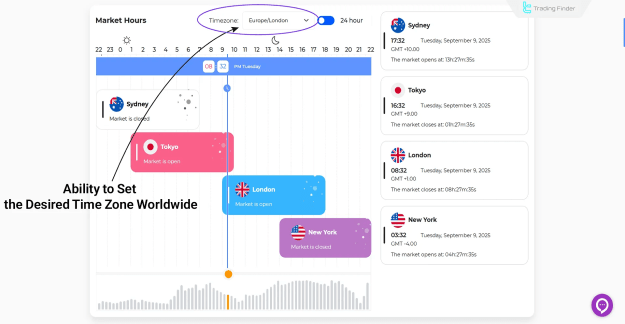
Market Hours Tools:
Dedicated session tracking tools provide real-time information about:
- Current session status (open/closed)
- Countdown timers to session transitions
- Peak volume periods based on user time zone
- Global market open/close synchronization
Japanese Equity Market Hours
The Tokyo Stock Exchange operates during the Tokyo session with following hours:
- Trading commencement: 09:00 AM local time (01:00 GMT)
- Trading conclusion: 03:00 PM local time (07:00 GMT)
During this period, venues including the Tokyo Stock Exchange, Osaka Exchange, and other Japanese financial institutions maintain active trading. Session overlaps with Sydney (early) and London (late) generate increased liquidity and volatility.
Conclusion
The Tokyo session initiates the global forex trading cycle with stable liquidity, controlled volatility, and technically predictable behavior. This trading window provides appropriate conditions for scalping, algorithmic execution, and daily strategy implementation. Accurate understanding of session timing, active currency pairs, and Asian economic news impact remains essential for effective risk management and decision-making throughout the Tokyo session.