

Prop Firm DrawDown Protector : Prop Firm Capital Protection Expert MT5 | Forex Money Management: Forex Trade Management Expert MT4 | ICT Concepts Indicator MT5 |Smart Money Concepts Expert MT5 |Get a free Expert Advisor license via Telegram and WhatsApp
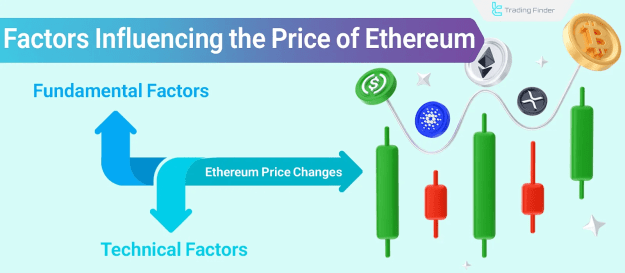
Types of Factors Affecting Ethereum’s Price
1. Fundamental Factors Impacting Ethereum’s Price
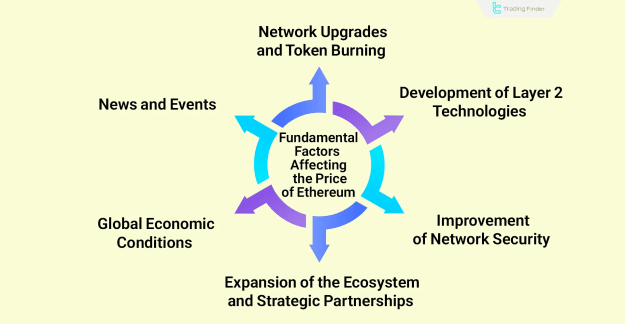
Fundamental factors play a crucial role in Ethereum’s valuation, including staking dynamics, network upgrades, and macroeconomic conditions. Key fundamental drivers include:
- Network Upgrades & Token Burns
- Layer 2 Scaling Solutions
- Enhanced Network Security
- Ecosystem Growth & Strategic Partnerships
- Global Economic Trends
- News & Market Events
Network Upgrades (EIPs & Ethereum 2.0)
Ethereum’s upgrades, such as the transition to Proof-of-Stake (PoS) and EIP-1559, have altered its fee structure, improving user experience. The burn mechanism reduces ETH’s circulating supply, lowering inflation. In some cases, burn rates exceed issuance, creating deflationary pressure that can drive long-term price appreciation.
Layer 2 Scaling Solutions (Arbitrum, Optimism, Starknet)
Layer 2 solutions enhance Ethereum’s scalability, enabling faster and cheaper transactions. This development supports the growth of DeFi, NFTs, and other decentralized applications (dApps), increasing demand for ETH.
Improved Network Security
Regular security upgrades bolster investor confidence by minimizing risks like hacks and exploits. A more secure network reduces volatility triggered by security breaches, stabilizing ETH’s price.
Ecosystem Expansion & Corporate Partnerships
Collaborations with industry giants like Microsoft and JPMorgan strengthen Ethereum’s credibility. Expanding use cases—such as enterprise blockchain adoption and institutional DeFi—further drive demand.
Global Macroeconomic Conditions
Economic stability influences investor behavior. In bullish markets, risk appetite rises, benefiting assets like Ethereum. Conversely, economic downturns may lead to capital outflows from crypto.
News & Market Events
Regulatory developments, exchange listings, and macroeconomic news heavily impact ETH’s price. Security incidents (e.g., exchange hacks) can also trigger short-term volatility.
2. Technical Factors Affecting Ethereum’s Price
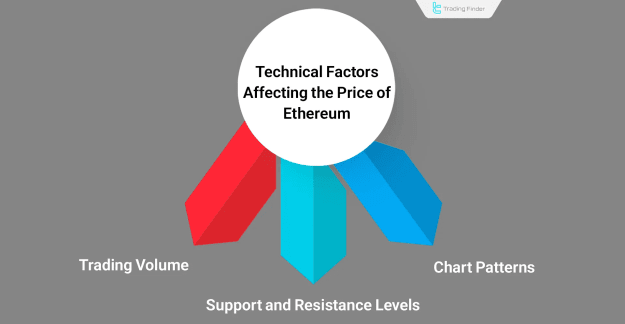
Retail and institutional traders rely on technical analysis (TA) to predict price movements. Key technical factors include:
- Trading Volume
- Support & Resistance Levels
- Chart Patterns (Flags, Candlesticks, Divergences)
Trading Volume
High trading volumes indicate strong market participation, often leading to sustained price trends. Declining volumes may signal weakening momentum, increasing the risk of corrections.
Support & Resistance Levels
These key price zones help traders identify entry and exit points. Breaking resistance can trigger bullish trends, while losing support may lead to further declines.
Chart Patterns & Indicators
Patterns like flags, head-and-shoulders, and moving averages assist in forecasting ETH’s price direction. Traders also use RSI, MACD, and Fibonacci retracements for decision-making.
Ethereum’s Correlation with Bitcoin
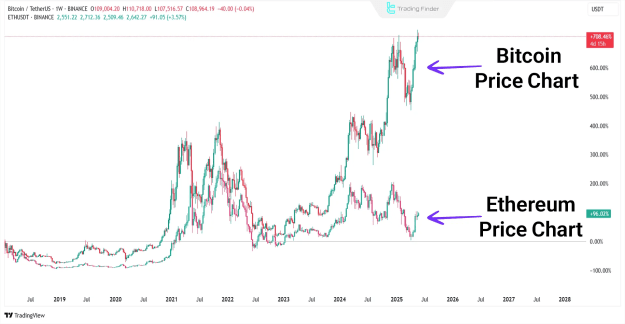
ETH and BTC often move in tandem, but Ethereum can outperform or underperform Bitcoin during specific market cycles. Historically, ETH’s price peaks align with BTC’s bull runs, though divergences occur due to Ethereum’s unique utility.
Impact of Ethereum Spot ETFs on Price
The SEC’s approval of Ethereum spot ETFs allows institutional investors (e.g., BlackRock, Grayscale) to gain direct ETH exposure. Increased institutional participation enhances liquidity and may reduce extreme volatility.
Conclusion
Ethereum’s price is influenced by a mix of fundamental and technical factors, including network upgrades, macroeconomic trends, trading volume, and chart patterns. Both short-term events and long-term developments shape ETH’s valuation, making it essential for investors to monitor these dynamics closely.