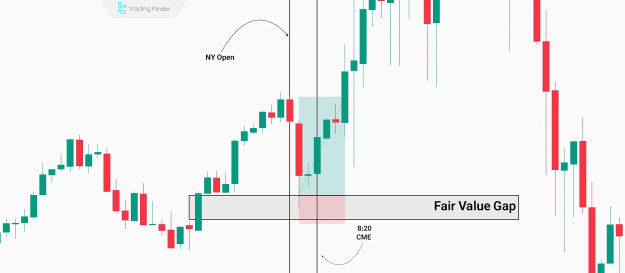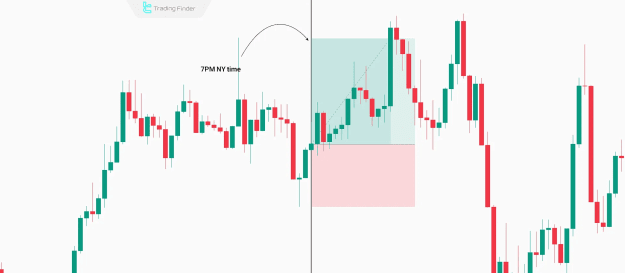


In these conditions, forex education teaches that there is a high likelihood of a liquidity grab below the day's low to fuel upward price movement.
TP & SL Tool: Risk Reward Ratio Calculator RRR MT4 | Prop Firm Protector: Trade Assist Prop Firm Plus TF Expert MT4 | Money Management + DrawDown Protector: Trade Panel Prop Firm Drawdawn Limiter Pro MT4 |Get a free Expert Advisor license via Telegram and WhatsApp
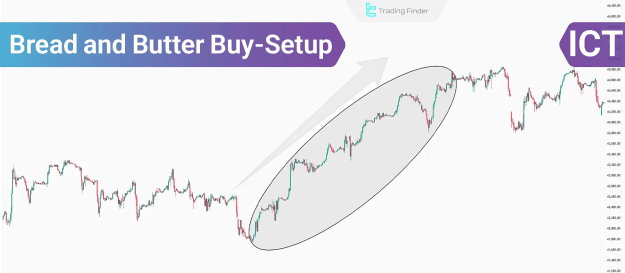
The Bullish Bread and Butter setup within the ICT trading framework identifies optimal buy opportunities by tracking price behaviour under such scenarios.
Advantages and Disadvantages of the Bread and Butter Trading Strategy
This trading strategy aligns trades with the daily bias, improving win probabilities. However, accurate execution requires a solid understanding of liquidity behaviour and extensive trading experience.
Pros and Cons of the ICT Bread and Butter Buy-Setup
- Pros
- Generates multiple signals throughout the day
- Applicable in all three major trading sessions
- Aligns trades with the prevailing daily trend
- Employs multi-timeframe analysis and market structure concepts
- Cons
- Offers a lower risk-to-reward ratio
- Requires advanced understanding of liquidity behaviour
- Relies on specific times of the day for optimal signals
- Each signal’s effectiveness may depend on previous market conditions
IPDA Delivery Algorithm in the Bread and Butter Buy-Setup
Unlike the bearish variant, the Interbank Price Delivery Algorithm (IPDA) in the Bread and Butter Buy-Setup functions through two models:
- Offset Accumulation
- Re-Accumulation
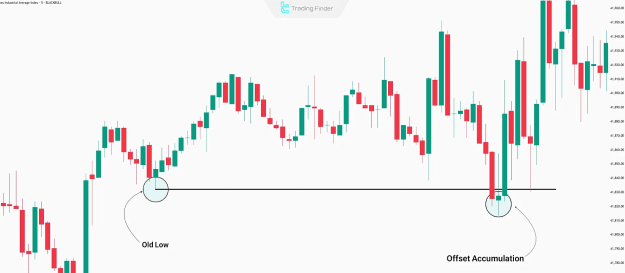
Offset Accumulation
In this model, IPDA drives price below a significant support level, triggering old stop-losses on buy positions and inviting new buyers at lower prices.
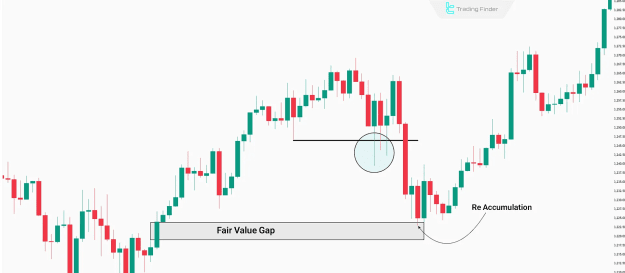
Re-Accumulation
This model targets high-liquidity areas such as Fair Value Gaps (FVGs). It drives prices to these zones, inducing fear among high-price buyers and forcing them to exit at losses, creating favourable entry conditions for smart money.
Entry Signals in the ICT Bread and Butter Buy-Setup
The bullish Bread and Butter setup generates entry signals during the London, New York, and Asian sessions.
London Session Entry
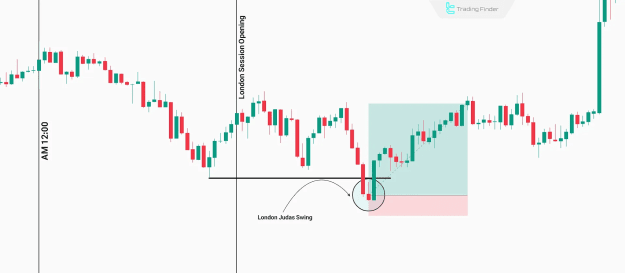
When the HTF trend is bullish, the Low of the Day (LOD) is often formed during the London session. Before this, a short-term bearish retracement may occur around 0:00 GMT (New York midnight).
Following this retracement, a London Judas Swing typically forms below the previous low. Once confirmed, traders can enter buy trades targeting the next premium array.
New York Session Entry
After the LOD is confirmed in London, American traders often continue the bullish movement.
Note: If the price has reached a higher-timeframe premium zone, further upside during the New York session is less probable.
To enter in New York, traders should identify discount zones. At session open, the NY Judas Swing can be detected. When price reaches a discount zone and forms the Judas Swing, a buy signal is generated targeting the premium zone.
Note: CME Commodity Market opens at 8:20 AM, increasing volume and volatility.
Asia Session Entry
If the bullish trend is confirmed during the London and New York sessions, entering a buy position before the Asia session opens (7:00 PM New York time) is reasonable.
Due to low volume during this period, take profit should be limited to 15–20 pips as the market typically ranges.
Key Characteristics of the ICT Bread and Butter Buy-Setup
The ICT Bread and Butter Buy-Setup is designed for day trading, using ICT principles to identify short-term buy entries across major sessions.
Key Characteristics:
- Trade duration: 1 to 2 hours
- Target per trade: 30 to 50 pips
- Analysis timeframe: 5-minute (M5) chart
- Number of trades per day: 1 to 3 setups
- Risk-to-reward ratio: dependent on market structure
- Capital risk per trade: 0.5% to 1%
Conclusion
Applying the ICT Bread and Butter Buy-Setup requires confirmation of bullish market direction on higher time frames (1-hour and 4-hour charts).
Thus, the Bullish Bread and Butter setup within ICT trading is suitable for day traders aiming for 30 to 50 pip price movements per trade.