

TP & SL Tool: Risk Reward Ratio Calculator RRR MT4 | Prop Firm Protector: Trade Assist Prop Firm Plus TF Expert MT4 | Money Management + DrawDown Protector: Trade Panel Prop Firm Drawdawn Limiter Pro MT4 |Get a free Expert Advisor license via Telegram and WhatsApp
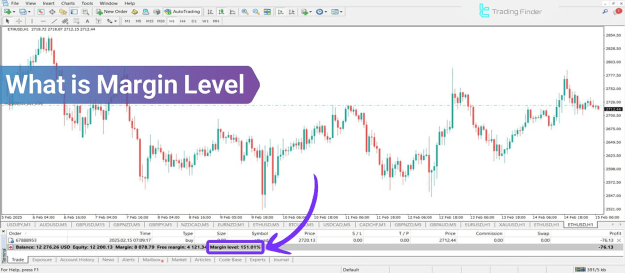
What Is Margin Level?
The Margin Level directly reflects a trader's financial health within the market. An increasing Margin Level indicates greater liquidity and a favorable environment for opening additional trades. Conversely, a decreasing Margin Level signals heightened risk, potentially leading to a margin call or, in severe cases, a stop-out initiated by the broker. Professional traders consistently monitor this indicator to avert critical scenarios and dynamically adjust their trading strategies based on fluctuations.
The Margin Level Calculation Formula
Trading platforms provide an automated display of the Margin Level, which is a key metric for evaluating the liquidity available for new trade entries.
The formula for calculating Margin Level is:
Margin Level = 100% × (Equity / Used Margin)
It's important to note that if there are no open trades, the Margin Level will be zero. An increasing Margin Level inherently signifies more Free Margin to engage in new trades.
Example 1: Margin Level Calculation for a Long Position on EUR/USD
Let's illustrate with an example:
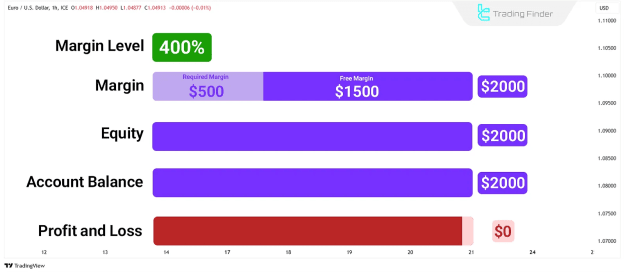
- Account Balance: $2,000
- Intended Trade: Buy 1 mini lot (10,000 units) on EUR/USD
Step-by-Step Calculation:
- Required Margin Calculation: Assuming a 5% margin requirement, the Used Margin is calculated as:
- Trade Value × Margin Percentage = Required Margin
- $10,000 × 0.05 = $500
- Equity Calculation:
- Account Balance + Floating P/L = Equity
- $2,000 + $0 = $2,000
- Margin Level Calculation:
- Margin Level = (Equity / Used Margin) × 100%
- Margin Level = ($2,000 / $500) × 100% = 400%
A Margin Level exceeding 100% indicates sufficient flexibility for a trader to initiate new positions in the forex market.
Example 2: Margin Level Calculation with a Losing Trade on EUR/USD
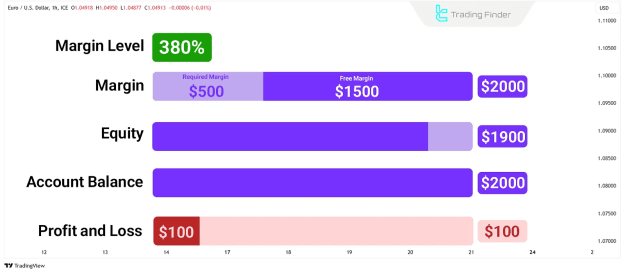
Consider a scenario where, following the previous example, the account incurs a $100 floating loss after opening the position.
Recalculation:
- Required Margin Calculation: The required minimum margin remains 5%, so the Used Margin is:
- Trade Value × Margin Percentage = Required Margin
- $10,000 × 0.05 = $500
- Equity Calculation:
- Account Balance + Floating P/L = Equity
- $2,000 - $100 = $1,900
- Margin Level Calculation:
- Margin Level = (Equity / Used Margin) × 100%
- Margin Level = ($1,900 / $500) × 100% = 380%
Margin Call and Stop Out Based on Margin Level
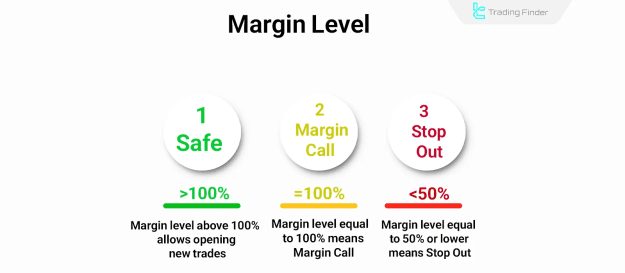
The Margin Level directly dictates the occurrence of a Margin Call or a Stop Out.
- A Margin Call is triggered when the Margin Level falls to 100%. At this point, the trader is restricted from opening new trades and must either close existing positions or deposit additional funds to continue trading.
- Should the Margin Level decline further to a critical threshold (typically 50% or less), the broker will automatically close some open trades to rebalance the Margin Level. This automated process is known as a Stop-out.
Illustrative Example:
- Suppose Equity is $400 and Used Margin is $400.
- Margin Level = ($400 / $400) × 100% = 100%
- In this scenario, the broker will prevent new trades from being opened.
- If the floating loss increases and Equity drops to $200:
- Margin Level = ($200 / $400) × 100% = 50%
- At this level, the broker initiates the closing of positions, triggering a Stop Out.
Conclusion
The Margin Level in Forex stands as a pivotal metric for effective capital risk management, guiding traders in making informed and strategic trading decisions.
- A Margin Level above 100% signifies ample flexibility for entering new trades.
- A Margin Level at 100% indicates a margin call, restricting the trader from opening new positions.
- A Stop-out is initiated if the Margin Level reaches 50% or less, leading to the automatic closure of positions by the broker.
Continuous monitoring of the Margin Level and a thorough understanding of its fluctuations are indispensable for preventing significant losses and enhancing overall trading effectiveness in the forex market.