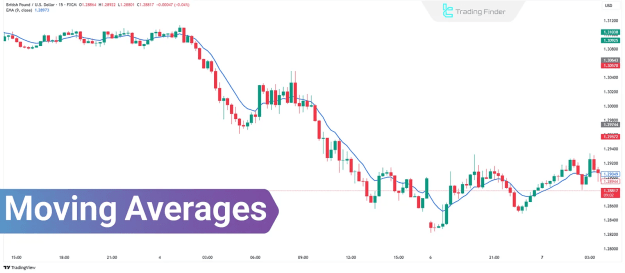


As a core component of Forex Education , MAs are widely utilized in various financial markets, including Forex, equities, and cryptocurrencies. They assist traders in identifying market direction, reducing price noise, and determining favorable entry and exit points.
TP & SL Tool: Risk Reward Ratio Calculator RRR MT4 | Prop Firm Protector: Trade Assist Prop Firm Plus TF Expert MT4 | Money Management + DrawDown Protector: Trade Panel Prop Firm Drawdawn Limiter Pro MT4 |Get a free Expert Advisor license via Telegram and WhatsApp
Advantages and Disadvantages of Moving Averages
Advantages:
- Straightforward and easy to interpret
- Helps filter short-term price fluctuations and noise
- Applicable across different timeframes for more comprehensive analysis
Disadvantages:
- May produce misleading signals in sideways or range-bound markets
- Often lags behind actual market turning points
- Less effective during volatile conditions due to delayed reaction
Types of Moving Averages
There are two primary types of moving averages used in technical analysis:
Simple Moving Average (SMA)
The Simple Moving Average (SMA) calculates the arithmetic mean of closing prices over a specified number of periods. For instance, a 50-period SMA adds the closing prices of the last 50 candles and divides the total by 50. This type of moving average responds gradually to price changes and is mainly used for long-term trend analysis.
Exponential Moving Average (EMA)
The Exponential Moving Average (EMA) assigns more weight to recent price data, enabling quicker responsiveness to market movements. Due to this feature, it is particularly useful for short-term traders and scalpers who require timely signals.
Key Differences Between SMA and EMA
- Sensitivity to Price Changes: EMA is more sensitive compared to SMA.
- Lag Time: EMA offers quicker signals with less delay.
- Use Case: SMA is ideal for long-term analysis, while EMA is preferred in short-term trading strategies.
Choosing the Right Time Frame for Moving Averages
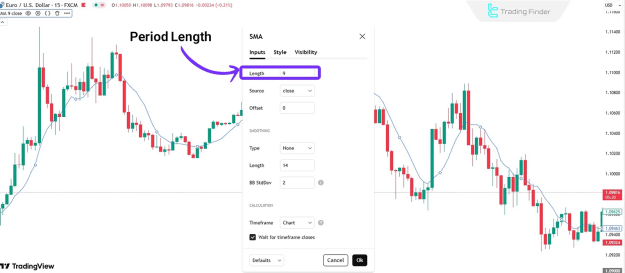
One of the most critical elements in applying moving averages effectively is selecting the appropriate period length. The period refers to the number of candlesticks or price bars over which the average is computed.
Period Settings in Moving Averages
- Short-Term MAs (e.g., 10 or 20 periods): Provide faster signals and are more reactive to price changes. Suitable for intraday or swing traders.
- Long-Term MAs (e.g., 50 or 200 periods): Offer smoother curves and better reflect macro trends. Commonly used by position traders and investors.
The optimal period selection should align with the trader’s strategy, risk tolerance, and time horizon.
Practical Applications of Moving Averages
Moving Averages are versatile tools used for a variety of analytical purposes:
Trend Identification
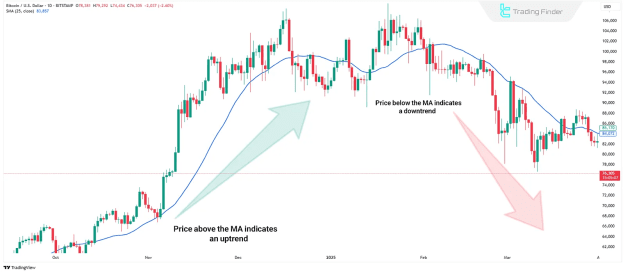
- When the price remains above the MA, it typically indicates a bullish market.
- When the price trades below the MA, it signals a bearish market condition.
Buy and Sell Signals
Moving Average crossovers are widely adopted as a trading signal:
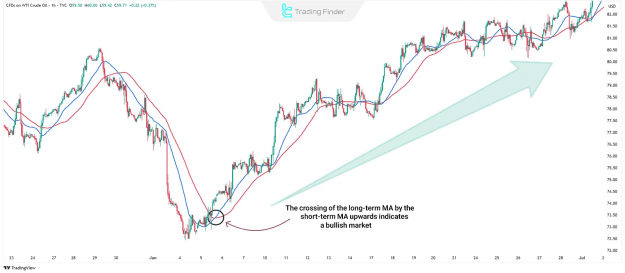
- A buy signal occurs when a short-term MA crosses above a long-term MA.
- A sell signal is triggered when a short-term MA crosses below a long-term MA.
This crossover method helps traders identify trend shifts and momentum changes.
Dynamic Support and Resistance
In trending environments, MAs often act as dynamic support or resistance levels. During uptrends, the MA may serve as a support zone. In downtrends, it may act as a resistance level.
Multi-Timeframe Confirmation
Moving Averages behave differently across various timeframes. Utilizing MAs in multiple timeframes can offer traders a broader perspective:
- If the price is above the MA on the higher timeframe but below it on the lower timeframe, it may indicate a temporary retracement or a strategic buying opportunity at a discounted price.
Conclusion
Moving Averages (MAs) are essential tools in technical analysis that assist traders in identifying prevailing trends, filtering out market noise, and developing systematic trading strategies. Although simple in construction, they play a crucial role in trend analysis, crossover signals, and multi-timeframe strategies.
However, like all technical indicators, MAs are not foolproof and should be used in conjunction with other tools and market context for improved accuracy. Whether in Forex, stock, or crypto markets, moving averages remain a cornerstone of disciplined and informed trading.