

When these concepts are combined with the Inverted Fair Value Gap (IFVG), traders can effectively spot hidden liquidity zones, reduce risk exposure, and take advantage of smart money order absorption in the market.
TP & SL Tool: Risk Reward Ratio Calculator RRR MT4 | Prop Firm Protector: Trade Assist Prop Firm Plus TF Expert MT4 | Money Management + DrawDown Protector: Trade Panel Prop Firm Drawdawn Limiter Pro MT4 |Get a free Expert Advisor license via Telegram and WhatsApp
Understanding MSS and CISD in the ICT Framework
What Is Market Structure Shift (MSS)?
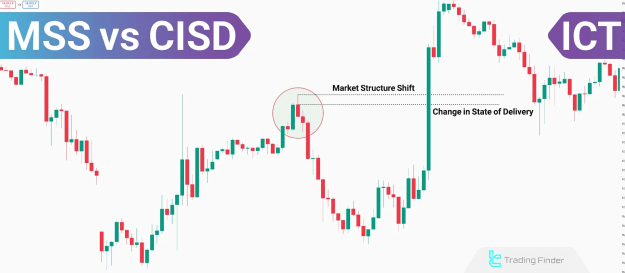
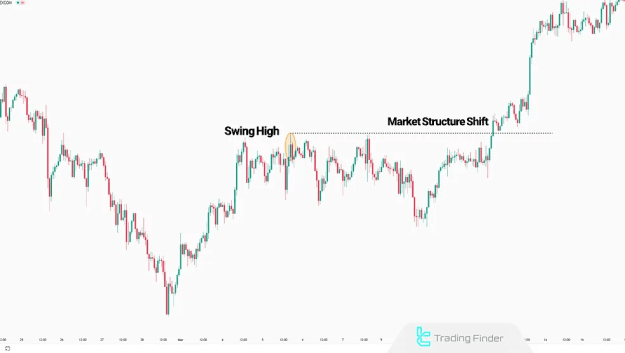
Market Structure Shift occurs when price breaks a significant swing high or swing low, indicating a shift in the current trend direction. This concept is a core part of ICT-style trading, marking the end of a previous trend and the beginning of a new phase in the market.
- Indicates medium-term trend reversals
- Confirmed by a break of structure with displacement
- Generally occurs after liquidity is taken on a higher timeframe
What Is Change in State of Delivery (CISD)?
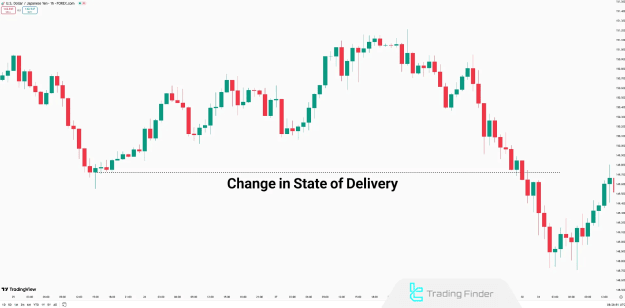
Change in State of Delivery (CISD) refers to a temporary interruption or reversal in the flow of price delivery. It usually appears following consolidation zones, liquidity grabs, or order block formations, and acts as an early signal of potential price correction against the current trend.
- Reflects short-term corrections and internal imbalances
- Often occurs prior to a Market Structure Shift
- Indicates momentary disruption in supply/demand equilibrium
MSS vs. CISD: Key Distinctions
Understanding the core differences between MSS and CISD allows traders to accurately distinguish trend continuation setups from correction-based opportunities. Below is a comparison of their main characteristics:
- CISD reflects short-term moves; MSS drives medium-term shifts
- CISD levels are formed from open/close price points; MSS is identified via wick breaks
- CISD is more suitable for scalping or short-term trades; MSS supports swing trade setups
- CISD often occurs during market opens or news releases; MSS typically aligns with London/New York overlaps
- CISD offers frequent but lower risk-reward setups; MSS provides higher R/R but fewer trades
Combining MSS, CISD, and IFVG for Strategic Entry
Integrating MSS, CISD, and the Inverted Fair Value Gap (IFVG) provides a structured methodology for identifying low-risk, high-probability entry zones. This approach leverages both market structure and liquidity analysis.
Step 1: Identify Market Structure Shift (MSS)
- Begin with higher timeframe (HTF) analysis to determine daily directional bias
- Confirm breaks of swing highs/lows with strong displacement candles
- Ensure structure change aligns with liquidity sweep and volume shifts
Step 2: Spot the CISD (Change in State of Delivery)
- Look for interruption of delivery flow, especially after consolidations
- Confirm price reaction and imbalance as an indication of short-term correction
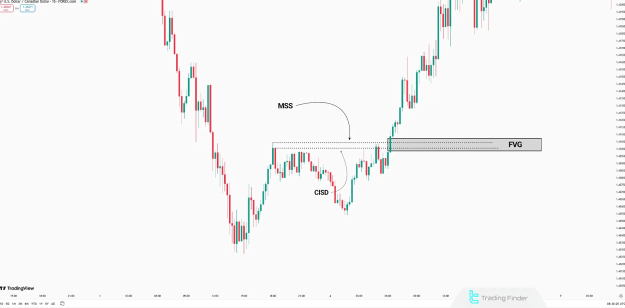
- CISD often forms before MSS is validated and offers early entry potential
Step 3: Locate the Inverted Fair Value Gap (IFVG)
- IFVG represents a price imbalance formed after a displacement move
- Acts as an optimal entry zone and provides a strategic stop-loss placement
- Wait for price retracement into the IFVG following MSS and CISD formation
Step 4: Define Entry Strategy
- Low-Risk Entry: Wait for price to reach IFVG zone with candlestick confirmation or mitigation block touch
- High-Risk Entry: Enter immediately upon identifying MSS/CISD/IFVG confluence, accepting a higher probability of invalidation
Step 5: Stop-Loss and Take-Profit Management
- Stop-Loss: Place just below the IFVG or recent swing low/high, avoiding areas of liquidity pools
- Take-Profit: Target the next liquidity zone, fair value gap, or previous market inefficiency
Example Setup: Trading with MSS, CISD, and IFVG
- Determine daily bias using higher timeframes
- Observe CISD as a reaction point, typically post-consolidation
- Confirm MSS via swing break and displacement move
- Identify IFVG as entry zone, aligning with liquidity sweep
- Execute low-risk trade with defined stop-loss and profit zones
Conclusion
By mastering the distinctions between Market Structure Shift (MSS) and Change in State of Delivery (CISD), traders gain an edge in identifying both trend reversals and short-term corrections.
When combined with Inverted Fair Value Gap (IFVG), these concepts offer a powerful framework for precise market entries, reduced risk exposure, and liquidity-driven trade setups.
This method, rooted in the ICT methodology, enhances both trade timing and risk management by anchoring decisions in structure, delivery flow, and institutional liquidity dynamics.