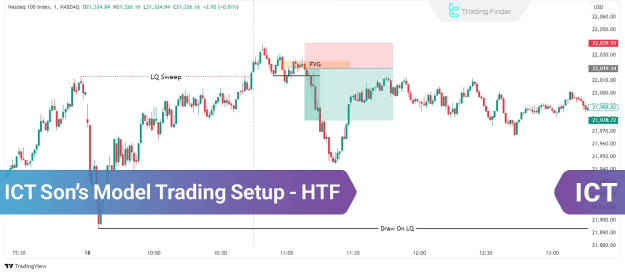


This strategy incorporates core ICT (Inner Circle Trader) principles, including Liquidity Analysis, Market Structure, and Precision Entry Techniques, making it a powerful tool for Forex Education and cryptocurrency trading. By focusing on higher time frames, traders can develop a deeper understanding of price action, identify key liquidity zones, refine entry points, and improve risk management—all essential skills for consistent long-term results in Forex markets.
TP & SL Tool: Risk Reward Ratio Calculator RRR MT5 | Prop Firm Protector: Trade Assist Prop Firm Plus TF Expert MT5 | Money Management + DrawDown Protector: Trade Panel Prop Firm Drawdawn Limiter Pro MT5 |Get a free Expert Advisor license via Telegram and WhatsApp
Key Steps of the ICT Son’s Model – HTF Strategy
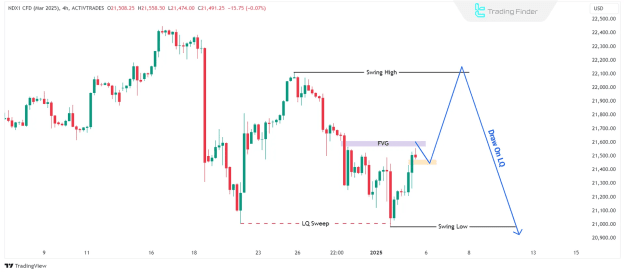
#1 Identifying Draw On Liquidity (DOL)
The first step involves analyzing liquidity zones on the 1-hour or 4-hour charts to determine the Draw On Liquidity (DOL) direction.
Critical Aspects of DOL:
- Key Levels: Mark previous highs and lows, Fair Value Gaps (FVGs), and swing points where price may reverse.
- Internal vs. External Liquidity: Price typically moves from internal liquidity (recent highs/lows) to external liquidity (deeper swing points).
By identifying these zones, traders can anticipate potential reversal areas where institutional orders may be placed.
#2 Liquidity Sweep Confirmation
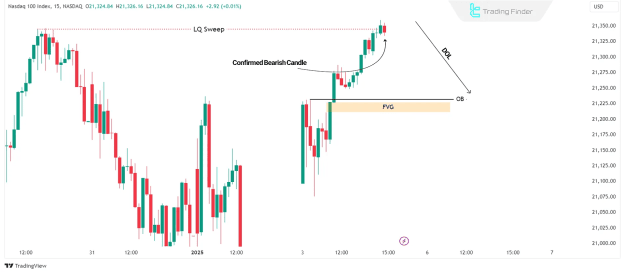
After determining the DOL direction, traders switch to the 15-minute chart to confirm a Liquidity Sweep.
Bullish & Bearish Confirmation:
- Bullish Setup: Wait for a bullish candle close after price sweeps a swing low.
- Bearish Setup: Look for a bearish candle close following a swing high sweep.
This step ensures alignment with the higher time frame bias before executing trades.
#3 Entry Techniques Using Fair Value Gaps (FVGs)
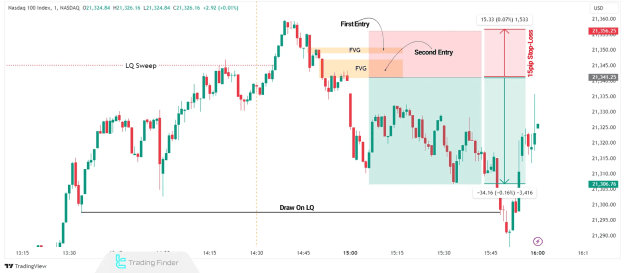
Once the Liquidity Sweep is confirmed, traders refine entries using Fair Value Gaps (FVGs) on lower time frames.
Entry Process:
- After a Liquidity Sweep, switch to the 1-minute or 5-minute chart.
- Wait for an FVG formation (a three-candle imbalance) as a potential entry zone.
- Enter the trade in the direction of the HTF bias once price reacts to the FVG.
This method increases entry precision while aligning with the broader market structure.
#4 Risk Management Guidelines
Proper risk management is essential for long-term success in trading.
Key Risk Rules:
- Risk-to-Reward Ratio: Maintain a 1:1 or 1:2 ratio to ensure profitability.
- Stop Loss Placement: For indices like NASDAQ or S&P 500, use a 15-20 point stop loss to account for volatility.
By adhering to these rules, traders protect capital while maximizing high-probability setups.
Conclusion: Mastering the ICT Son’s Model – HTF Strategy
The ICT Son’s Model – HTF Trading Strategy provides a structured, high-probability approach for traders focusing on 1-hour and 4-hour charts.
By combining liquidity analysis, market structure, and precision entries, traders can improve their win rate and consistency in forex and crypto markets.
For optimal results, always backtest the strategy, follow strict risk management, and remain disciplined in execution.