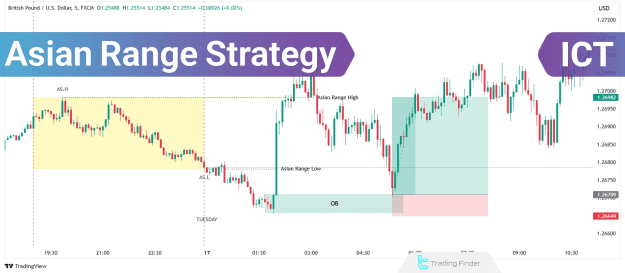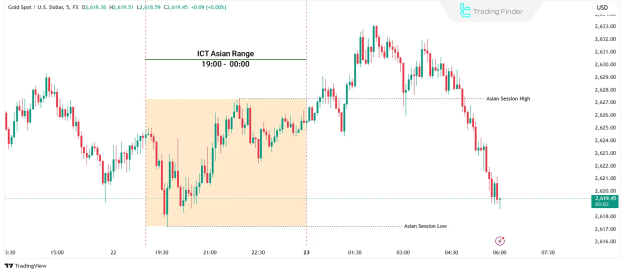


Key Characteristics of the Asian Range Strategy
- Timeframe: 7 PM to midnight New York time.
- Key Levels: Identification of the highest (high) and lowest (low) prices within the Asian session.
- Purpose: The Asian Range provides insights into potential market direction, liquidity, and volatility for later sessions.
Why Is the Asian Range Important?
Understanding the Asian Range offers several advantages:
- Early Market Insight – Sets the tone for the trading day, helping traders anticipate bullish or bearish sentiment.
- Liquidity Indicators – Reveals where institutional traders are placing orders, offering clues about future price movements.
- Volatility Prediction – The range helps gauge expected volatility in the London and New York sessions.
- Risk Management – Provides clear levels for stop-loss and take-profit placement.
How to Trade Using the ICT Asian Range Strategy
Step 1: Identify the Asian Range
- Monitor price action between 7 PM and midnight New York time.
- Mark the highest and lowest price levels (Asian High & Asian Low).
Step 2: Analyze Breakouts & Market Context
- Watch for breakouts above the Asian High or below the Asian Low.
- Align trades with the broader market trend (Daily Bias) for higher accuracy.
Step 3: Execute Trades Based on Confirmation
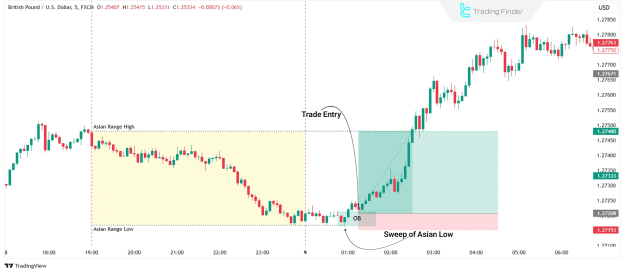
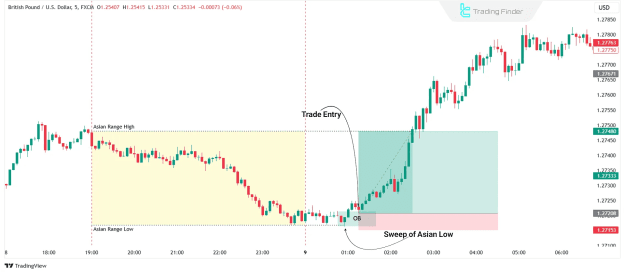
- Bullish Scenario: If price sweeps the Asian Low and reverses, look for buy entries above the Asian High.
- Bearish Scenario: If price sweeps the Asian High and reverses, consider sell entries below the Asian Low.
ICT Asian Range Strategy in Bullish Conditions
- Draw the Range: Extend the Asian High and Low into future sessions.
- Look for Dips: In an uptrend, wait for price to sweep the Asian Low (liquidity grab).
- Entry Confirmation:
- Buy when price reclaims the midnight New York open after sweeping the Asian Low.
- Alternatively, enter when price breaks above the Asian High with confirmation.
- Market Structure Shift (MSS): A bullish reversal pattern strengthens the trade setup.
ICT Asian Range Strategy in Bearish Conditions
- Draw the Range: Extend the Asian High and Low for reference.
- Look for Rallies: In a downtrend, watch for price to sweep the Asian High (trapping buyers).
- Entry Confirmation:
- Sell when price drops below the midnight New York open after sweeping the Asian High.
- Alternatively, enter when price breaks below the Asian Low with confirmation.
- Market Structure Shift (MSS): A bearish reversal confirms the downtrend continuation.
Complementary Strategies for the Asian Range
1. Breakout Strategy
- Trade breakouts above the Asian High or below the Asian Low.
- Use volume analysis to confirm strength.
2. Fair Value Gap (FVG) Strategy
- Identify imbalances (FVG) near the Asian Range for high-probability entries.
3. Indicator Confluence
- Combine with RSI, MACD, or Moving Averages for additional confirmation.
- Analyze multiple timeframes for stronger trade setups.
Risk Management in the Asian Range Strategy
- Position Sizing: Adjust trade size based on account risk tolerance.
- Stop-Loss Placement: Set stops beyond the Asian High/Low for logical exits.
- Risk-Reward Ratio: Aim for at least 1:2 to ensure profitability.
Key Tips for Improving the Asian Range Strategy
- Use Confluence – Combine with other ICT concepts like Order Blocks or Liquidity Pools.
- Monitor Volume – Unusual volume spikes validate breakout/reversal signals.
- Keep a Trading Journal – Track performance to refine the strategy over time.
Conclusion
The ICT Asian Range Strategy is a powerful price-action-based approach that leverages the Asian session’s high and low to predict future market movements. By identifying key levels, analyzing breakouts, and incorporating market structure shifts, traders can enhance their decision-making process.
For optimal results, combine this strategy with liquidity analysis, FVG, and proper risk management to maximize trading success.