

Understanding and applying these profiles—core components of advanced Forex education—enable traders to recognize repetitive price behaviors and optimize trade entries, exits, and risk management with greater precision.
These profiles offer critical insights into market structure, liquidity pools, and institutional price action under varying market conditions.
What Are ICT Intraday Profiles?
ICT Intraday Profiles analyze price behavior throughout the trading day, with a primary focus on the London session. These profiles help traders identify consistent price patterns and key institutional levels, enabling more informed decision-making.
By using ICT Intraday Profiles, day traders can take advantage of short-term price movements to capture precise entry points, manage drawdown effectively, and identify profit targets aligned with premium/discount PD Arrays and higher-timeframe liquidity.
Sell Profiles During the London Session
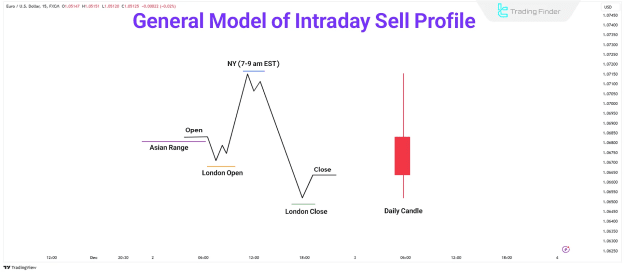
A bearish ICT Intraday Profile typically unfolds with a price rally above the daily open, followed by a sharp reversal. The rally sets a potential sell entry, particularly when price reaches key zones such as a bearish order block or an unfilled Fair Value Gap (FVG) on a higher timeframe.
These setups often lead to a reversal during the New York session, with price eventually targeting bullish order blocks, Turtle Soup setups, or closing ranges.
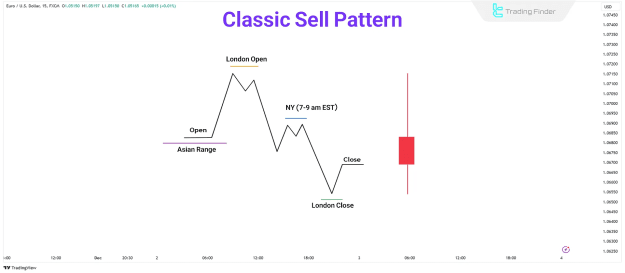
ICT Intraday Sell Profile: Classic Sell Day Model
On classic bearish days, the market forms an early high during the London session, which is followed by a sell-off culminating in the low of day near the London Close. Subsequently, price retraces and challenges the initial London high, completing a cycle that aligns with the dominant higher-timeframe trend.
Key Features:
- Early high formation during London
- Bearish trend alignment
- Price reversal near London Close
- Retest of initial high
ICT Intraday Sell Profiles: London Session Scenarios
There are two primary sell profile models within the London session:
- London Normal Protraction Sell Profile
- London Delayed Protraction Sell Profile
Both require a bearish directional bias, but differ in their execution timing and setup dynamics.
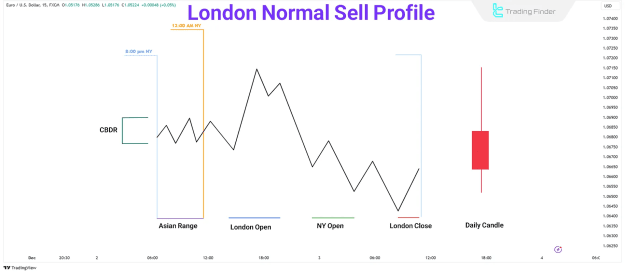
London Normal Protraction Sell Profile
This profile is a high-probability bearish setup when certain key criteria are met:
- CBDR Range: Less than 40 pips
- Asian Session Range: Between 20 to 30 pips
- Initial Rally: Starts after 12:00 AM (New York time) and continues until around 2:00 AM
- Judas Swing: Price movement of 1–2 standard deviations above CBDR before reversing
Execution Guidelines:
- Maintain a bearish outlook based on higher-timeframe analysis
- Confirm all ICT criteria (CBDR, Asian Range, timing)
- Identify Market Structure Shift (MSS) after price breaks above CBDR
- Enter short in the premium zone
- Place stop-loss above the session high
- Target discount PD Arrays or sell-side liquidity
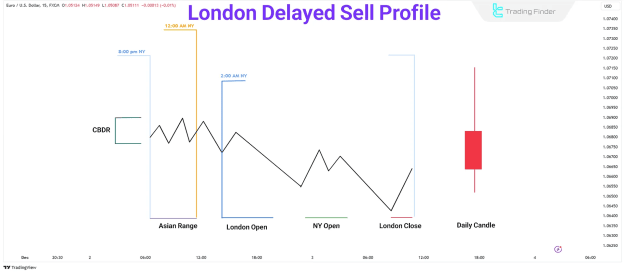
London Delayed Protraction Sell Profile
This setup applies when price does not rally immediately after 12:00 AM. Instead, the market continues lower until approximately 2:00 AM before forming a retracement rally.
Key Characteristics:
- Flexible CBDR: No strict pip requirement
- Protraction Delay: Rally begins after 2:00 AM (New York time)
Execution Guidelines:
- Observe market from 12:00 AM to 2:00 AM
- Mark recent ICT range
- Wait for a retracement to premium PD Arrays
- Look for MSS confirmation
- Enter sell trades with stop-loss above recent high
- Target sell-side liquidity or discount zones
Buy Profiles During the London Session
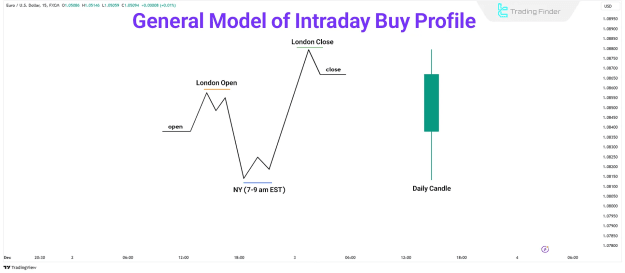
The bullish version of ICT Intraday Profiles initiates with a drop below the daily open, forming a potential buy entry. The price then reverses and targets bearish order blocks, unfilled FVGs, or liquidity zones on a higher timeframe.
These setups often signal New York session reversals and offer opportunities for strategic long entries aligned with higher-timeframe trend continuation.
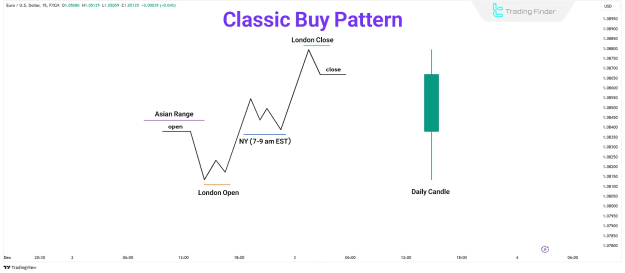
ICT Classic Buy Day Model
On a classic bullish day, price creates an early low during the London session, followed by a rise that peaks during the New York session (often at or near the London Close). Price may then pull back to revisit the initial London low.
This profile is most effective when it follows a consolidated market range and aligns with a bullish higher-timeframe trend.
ICT Intraday Buy Profiles: London Session Scenarios
There are two primary buy profile models during the London session:
- London Normal Protraction Buy Profile
- London Delayed Protraction Buy Profile
Both require a bullish market outlook, with differing setups based on market timing.
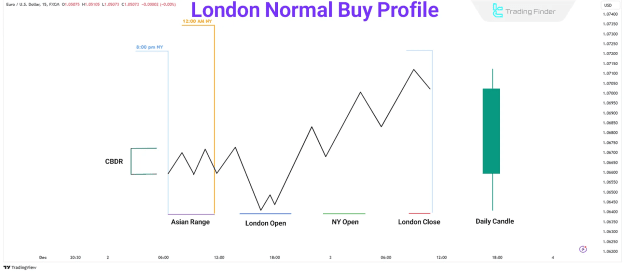
London Normal Protraction Buy Profile
This bullish profile is triggered under specific market conditions:
- CBDR: Less than 40 pips
- Asian Session Range: Between 20 to 30 pips
- Initial Decline: Begins after midnight (New York time) and continues until 2:00 AM
- Protraction Phase: Drop of 1–2 standard deviations below CBDR before reversing
Execution Guidelines:
- Start with a bullish bias
- Confirm key metrics: CBDR, Asian range, and timing
- Look for MSS on lower timeframes (5-minute or lower)
- Enter long in discount zone
- Stop-loss placed below London low
- Take profit at premium PD Arrays or liquidity pools
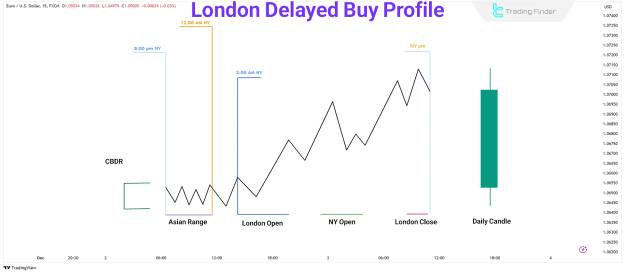
London Delayed Protraction Buy Profile
Applicable when the market does not decline after midnight, but resumes the bullish trend after 2:00 AM.
Key Characteristics:
- CBDR Flexibility: Works with both wide and narrow CBDRs
- Delayed Protraction: Price begins bullish expansion post-2:00 AM
Execution Guidelines:
- Monitor market behavior between 12:00 AM and 2:00 AM
- Use 2:00–3:00 AM window as backup setup zone
- Analyze daily chart for directional bias
- Use intraday tools (e.g., vertical lines at 12:00 AM and 2:00 AM) to track price behavior
- Look for discount entries and MSS confirmation
Conclusion
Whether employing the normal or delayed protraction models, ICT Intraday Profiles provide a robust tactical structure for executing high-probability trades during the London session.
A clear understanding of CBDR, Asian session range, time-based price movements, and market structure shifts is essential for successful implementation.
These profiles empower traders to align intraday setups with institutional price delivery models, enhancing precision and consistency in day trading strategies.