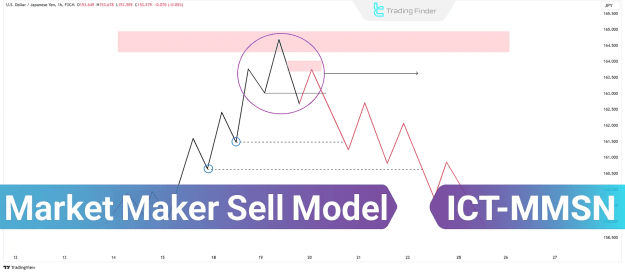


What is the ICT Market Maker Sell Model?
The ICT MMSM demonstrates how price evolves from a bearish condition under selling pressure to a bullish scenario, revealing key entry points for buyers. By understanding this transition, traders can better interpret trend reversals and market structure shifts.
Key Components of the ICT Market Maker Sell Model
The model comprises the following essential phases:
1. Original Consolidation
- Price fluctuates within a defined range
- Establishes a consolidation zone or range-bound structure
2. Engineering Liquidity
- Higher lows (HLs) form during a short-term uptrend
- These HLs create liquidity pools targeted by institutional price moves
3. Smart Money Reversal
- Upon reaching a high-timeframe PD Array, price transitions from a buy-side to a sell-side environment
- Marks the beginning of the bearish leg
4. Liquidity Hunt
- Price aggressively sweeps prior lows created during liquidity engineering
- It then retraces toward the original consolidation zone
5. Key Zones
- Fair Value Gap (FVG): Identifies imbalanced areas for optimal trade entries
- Liquidity Levels: Includes previous highs/lows, where institutional orders are likely to be executed
How to Identify the ICT Market Maker Sell Model
To effectively identify the ICT MMSM, traders should observe these characteristics:
- Consolidation followed by liquidity engineering
- Temporary bullish retracements
- Entry into a bearish PD Array in higher timeframes
- Market structure shift confirming bearish continuation
- Liquidity sweep followed by a return to the consolidation range
How to Trade the ICT Market Maker Sell Model
Follow these principles to trade the ICT MMSM effectively:
1. Identify Bearish Market Structure
- On higher timeframes (e.g., H4, Daily), confirm a bearish trend marked by Lower Highs (LH) and Lower Lows (LL)
2. Locate Liquidity Below Price
- Identify previous lows as liquidity targets
- These areas act as magnet zones for price movement
3. Observe a Temporary Buy Program
- In lower timeframes (e.g., M15 or M30), monitor for a bullish retracement
- This move pushes the price into a significant bearish PD Array on the higher timeframe
4. Confirm Bearish Bias on Higher Timeframes
- Look for:
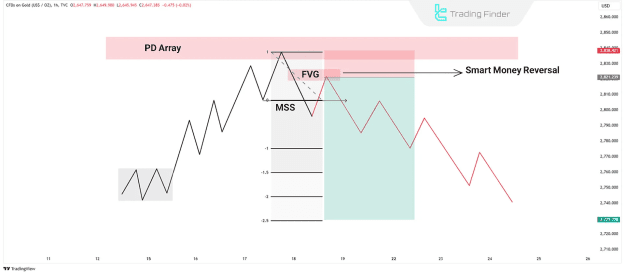
- Market Structure Shift (MSS) – Break of a significant low
- SMT Divergence – Discrepancy between related assets indicating a weakening trend
5. Enter the Sell Trade
- After confirmation, wait for a retracement into the Fair Value Gap (FVG)
- Enter a sell position once the bearish market structure is validated
6. Set a Stop Loss
- Place your stop-loss 10 to 20 pips above the last swing high prior to the market structure shift
7. Define a Profit Target
- Use the Fibonacci tool:
- Measure from the highest point of the Smart Money Reversal to the lowest point of the Market Structure Shift
- Apply a range of 1 to -2.5 for TP levels
- Alternatively, aim for previous lows or liquidity pools as profit-taking zones
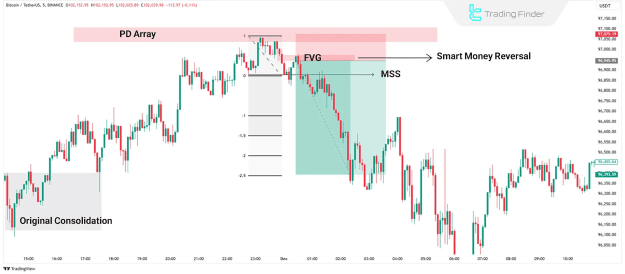
Market Maker Sell Model Example
Schematic Representation
A typical 5-minute Bitcoin (BTC) chart may display:
- An initial bullish retracement
- Entry into a bearish zone
- Market Structure Shift and liquidity sweep
- Continuation toward lower liquidity levels
Key Considerations Before Using the ICT Sell Model
- Higher Timeframe Bearish Structure: Ensure Daily or Weekly charts exhibit a clear bearish trend
- Daily Bias Confirmation: Daily price action must align with the bearish narrative and target key liquidity levels
- Short-Term Bullish Moves: Expect temporary uptrends in lower timeframes (M15–M30) before the continuation of the larger downtrend
- These moves often serve to engineer liquidity before institutional selling resumes
Conclusion
The ICT Market Maker Sell Model is a high-probability trading strategy that enables traders to capitalize on institutional price movements. By focusing on:
- Bearish structure in higher timeframes
- Liquidity zones and PD Arrays
- Clear confirmations such as Market Structure Shifts and Fair Value Gaps
...this model enhances entry accuracy, optimizes risk management, and improves overall trading performance.