

What Are Premium and Discount Zones?
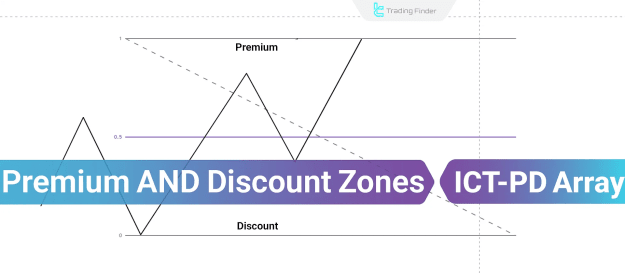
In the context of ICT (Inner Circle Trader) methodology, Premium and Discount Zones offer a structured way to define fair value within a specific price range:
- Discount Zones: These are price levels in the lower 50% of a given range, often considered ideal for initiating buy positions or taking profit on sell positions.
- Premium Zones: These refer to the upper 50% of the range, suitable for initiating sell positions or taking profit on buy positions.
By applying this concept, traders can pinpoint value areas where smart money is likely to operate.
Key Advantages of the PD Array
Utilizing the PD Array offers several benefits for both novice and experienced traders:
- Clear Buy and Sell Zones: The model segments price into actionable zones, highlighting the most favorable levels for market entry.
- Enhanced Timing: Emphasizes buying in Discount Zones during bullish trends and selling in Premium Zones during bearish conditions.
- Improved Accuracy: Combines multiple ICT tools for more reliable entry and exit signals.
- Higher Probability Setups: Filters out low-quality trades, allowing traders to focus on high-probability scenarios.
Types of ICT PD Array Tools
The ICT framework integrates several core tools to strengthen the analysis and refine trade execution:
- Fair Value Gap (FVG): Highlights imbalances in price efficiency.
- Inversion Fair Value Gap: Identifies hidden order blocks within the price structure.
- Order Block: Represents zones where large institutions are likely to initiate positions.
- Breaker Block: Marks recovery zones after failed breakouts.
- Mitigation Block: Indicates areas where price returns to balance prior inefficiencies.
- Unicorn Pattern: A unique ICT analytical model.
- New Week Opening Gap (NWOG): Captures institutional moves early in the week.
- New Day Opening Gap (NDOG): Detects shifts in daily liquidity profiles.
Identifying Premium and Discount Zones
To properly define these zones, use the Fibonacci retracement tool with the following configuration:
- Start: 1.0
- Equilibrium: 0.5
- End: 0.0
Steps:
- Apply the Fibonacci tool from the recent high to low (or vice versa).
- The 0.5 level marks the equilibrium (mid-point of the range).
- Prices above 0.5 are categorized as the Premium Zone.
- Prices below 0.5 are designated as the Discount Zone.
Practical Application of the PD Array
Traders can apply the PD Array within different market structures:
Bullish Scenario
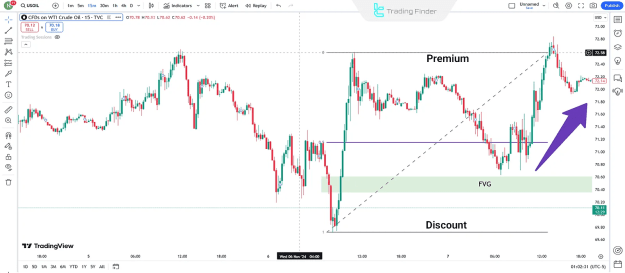
- When the market trend is upward and the price reaches the Discount Zone, consider initiating a Buy position.
Bearish Scenario
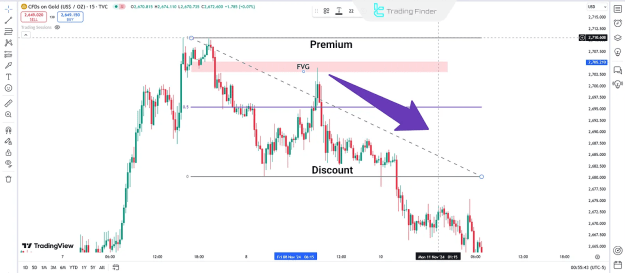
- If the market structure shifts downward and the price enters the Premium Zone, this presents a Sell opportunity.
Best Timeframes for Analysis
Different timeframes serve different purposes in PD Array trading:
- Daily Timeframe: Establish the overall market bias and trend direction.
- 15-Minute & 5-Minute Charts: Ideal for identifying precise intraday entry points.
Suitable Markets for the PD Array Strategy
Originally tailored for major equity indices such as NASDAQ (NQ Futures) and S&P 500, the strategy has shown versatility across other markets:
- Forex Markets: Especially effective on major pairs like EUR/USD and GBP/USD.
- Precious Metals: Proven success in trading instruments like XAU/USD (Gold).
Executing Buy Trades in the PD Array
- Use higher timeframes (1D, 4H) to determine the dominant trend.
- If the market trend is bullish and the current price is within the Discount Zone, deploy ICT tools to validate the uptrend and initiate Buy positions.
Executing Sell Trades in the PD Array
- Use the same higher timeframe strategy to assess overall direction.
- In bearish market conditions, when price enters the Premium Zone, leverage ICT confirmations to initiate Sell positions.
Advanced Tips for Effective Use of PD Array
- Multi-Timeframe Confluence: Synchronize multiple timeframes to strengthen trade setups.
- Market Structure Alignment: Confirm trades with the prevailing trend and price action.
- Tool Confluence: Combine multiple ICT tools such as FVGs and Order Blocks for better confirmation.
- Trend Identification: Stay aligned with macro and micro trends to maintain consistency.
Conclusion
The ICT PD Array presents a structured, rules-based methodology for identifying value areas within financial markets. By combining strategic tools with disciplined execution, this approach empowers traders to operate with enhanced confidence, reduce risk, and pursue consistent profitability.