

TP & SL Tool: Risk Reward Ratio Calculator RRR MT4 | Prop Firm Protector: Trade Assist Prop Firm Plus TF Expert MT4 | Money Management + DrawDown Protector: Trade Panel Prop Firm Drawdawn Limiter Pro MT4 |Get a free Expert Advisor license via Telegram and WhatsApp
Introduction to the ICT 20 Pips a Day Strategy
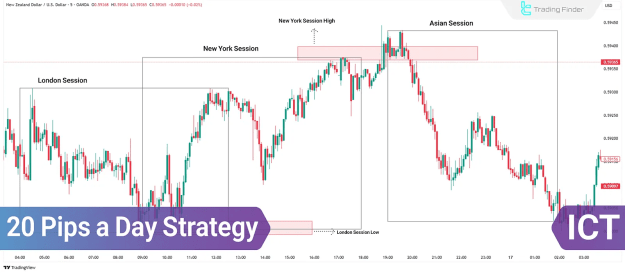
The primary objective of this strategy is to capture a minimum of 20 pips daily by leveraging liquidity raids and market structure shifts (MSS). Unlike strategies that rely on price prediction, this approach is based on observable market behavior and real-time liquidity dynamics.
This scalping technique operates best on lower timeframes, such as the 5-minute and 1-minute charts, making it suitable for intraday traders seeking precision and defined trade opportunities.
Advantages of the ICT 20 Pips a Day Strategy
- Simple Execution: Easily applicable using lower timeframe charts (M5 and M1).
- Daily Profit Potential: Designed to consistently generate 20 pips in a trading day.
- Risk-to-Reward Management: Typically enforces a 1:1 risk/reward ratio.
- Dynamic Position Handling: Provides opportunities to hold partial positions for extended profits.
- Session-Specific Focus: Optimized for Asia and New York session trading windows.
How to Use the ICT 20 Pips a Day Strategy
The strategy is executed during two major trading windows—Asia and New York sessions—each offering distinct liquidity profiles and setup conditions.
Executing the Strategy During the Asia Session
Trading Window: 8:00 PM – 12:00 AM (New York Time)
During the Asian session, price often reacts to liquidity zones created in the previous New York session. These reactions can result in short-term reversals or directional moves.
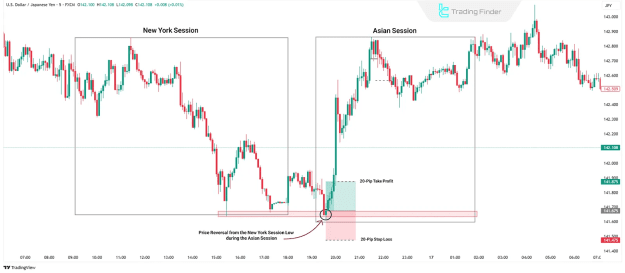
Buy Scenario – Asia Session
- Identify short-term lows formed at the end of the New York session on the 5-minute chart.
- Wait for a brief sweep of these lows (liquidity grab).
- Switch to the 1-minute timeframe and monitor for price rejection or a market structure shift (MSS).
- Upon confirmation, enter a long position.
- Set stop-loss 20 pips below entry and take-profit 20 pips above.
- If the market continues favorably, consider trailing or holding a partial position.
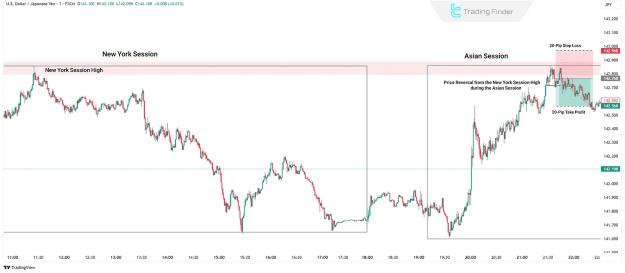
Sell Scenario – Asia Session
- Identify short-term highs established during the New York session.
- Watch for a price break above these highs, signaling a liquidity raid.
- Confirm a reversal with MSS or strong rejection on the 1-minute chart.
- Enter a short position with a 20-pip stop-loss and 20-pip take-profit.
Executing the Strategy During the New York Session
Trading Window: From the New York session open to approximately 10:00 AM (New York Time)
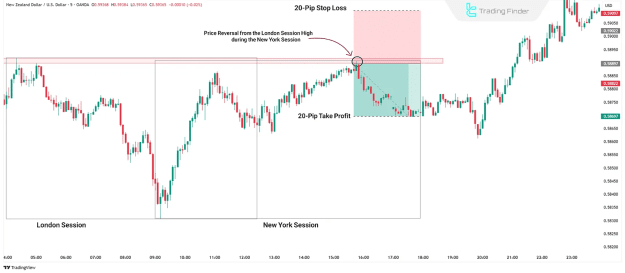
The New York session often presents a retracement or reversal after the London session sets the daily high or low, offering high-probability scalping conditions.
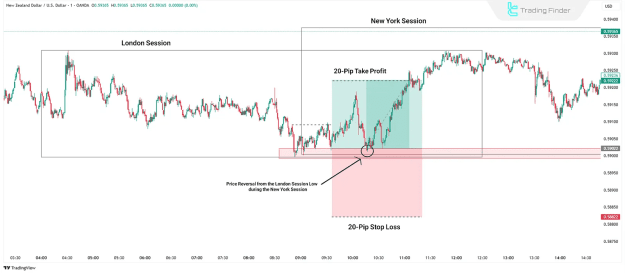
Buy Scenario – New York Session
- Confirm that the London session has created the daily low.
- On the 5-minute chart, identify short-term lows forming post-New York open.
- Wait for a liquidity raid below these lows.
- Validate entry with MSS or rejection on the 1-minute chart.
- Enter a long position with a 20-pip stop-loss and take-profit.
Sell Scenario – New York Session
- Ensure the London session has set the daily high.
- Observe short-term highs formed in early New York trading.
- Look for a liquidity grab above those highs.
- Confirm reversal via price rejection or MSS on the 1-minute chart.
- Enter a short trade with a defined stop-loss and take-profit of 20 pips.
Additional Tips for Success with ICT 20 Pips a Day Strategy
- Analyze Market Conditions: Always evaluate broader trends, market sentiment, and potential news catalysts.
- Use Multi-Timeframe Analysis: Incorporate higher timeframes (H1, H4) to validate the market’s directional bias.
- Emphasize Risk Management: Set appropriate stop-losses and use calculated position sizing to manage risk effectively.
- Maintain Discipline: Avoid impulsive entries. Execute trades only when all conditions are aligned and clearly visible.
Conclusion
The ICT 20 Pips a Day Strategy offers a structured and systematic approach to intraday trading. By focusing on liquidity grabs, market structure shifts, and precise entry timing across key trading sessions, traders can build a strategy rooted in real market behavior.
This method stands out for its clarity, session-specific logic, and ability to provide repeatable daily trade setups, making it an effective tool for disciplined and technically-driven traders.