

TP & SL Tool: Risk Reward Ratio Calculator RRR MT4 | Prop Firm Protector: Trade Assist Prop Firm Plus TF Expert MT4 | Money Management + DrawDown Protector: Trade Panel Prop Firm Drawdawn Limiter Pro MT4 |Get a free Expert Advisor license via Telegram and WhatsApp
Trading the Asian Session Dealing Range Using PO3
The Asian session offers unique conditions such as lower volatility and frequent price consolidation, making it a favorable environment for executing the ICT PO3 strategy. These characteristics help reveal the footprints of smart money, allowing traders to anticipate future moves.
What Is the Asian Trading Session?
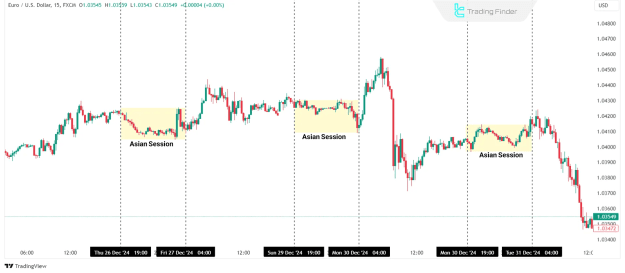
The Asian trading session is one of the three primary Forex market sessions, alongside the European and North American sessions. It generally runs from 07:00 PM to 04:00 AM (New York time), with the Tokyo market playing a dominant role.
Key Characteristics of the Asian Session:
- Lower Volatility: Compared to other sessions, price movement is typically subdued, which suits strategies designed to detect early-stage setups with minimal market noise.
- Consolidation Behavior: This session often acts as a prelude to the European session, where accumulation phases form and future breakout directions are hinted at.
- Asian Kill Zone (A-KZ): A notable time window from 19:00 to 22:00 EST, where liquidity and trading activity temporarily increase.
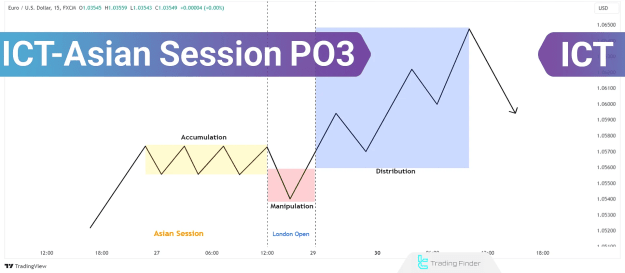
The ICT PO3 Concept (Power of Three)
The Power of Three (PO3) setup is a core ICT trading concept, representing a sequence of three market phases:
- Accumulation
- Manipulation
- Distribution
Accumulation Phase
During the early stages of the Asian session, institutional traders often start building positions in a controlled, low-volatility environment.
Key Observations:
- Markets usually remain within a defined range.
- Support and resistance levels provide structure to potential breakout zones.
Manipulation Phase
This phase involves false breakouts orchestrated by market makers to mislead retail traders. It typically occurs toward the latter half of the Asian session or into the early European session.
Key Indicators:
- Liquidity grabs near critical price levels.
- Volume anomalies that expose fake moves.
- Swift reversals after support or resistance is breached.
Distribution Phase
Once manipulation concludes, smart money distributes positions, often aligning with the European session’s opening. This leads to stronger directional moves and possible trend reversals.
Notable Signs:
- Authentic breakouts beyond consolidation zones.
- Emergence of trend continuation or potential reversals.
- Greater volatility as new market participants engage.
Applying the ICT Asian Session PO3 Strategy: A Step-by-Step Guide
To execute the PO3 strategy effectively within the Asian session, follow a structured process rooted in ICT methodologies.
Step 1: Define Market Bias Using the Daily Bias Concept
- Analyze higher timeframes (Daily or H4) to determine the overall trend.
- Identify market structure, order blocks, or mitigation blocks.
- Assess the previous day’s candlestick to detect potential turning points.
Step 2: Mark Key Levels Prior to the Asian Session
- Identify support and resistance zones aligned with the daily bias.
- Use H1 or H4 timeframes to define actionable levels.
- Prepare for trading activity in the Asian Kill Zone timeframe.
Step 3: Monitor Price During the Asian Session
- Detect the accumulation range early in the session.
- Watch for candlestick formations like pin bars or engulfing candles as signs of accumulation or manipulation.
- Pay attention to false breakouts near key zones to identify manipulation.
Step 4: Prepare for the Distribution Phase
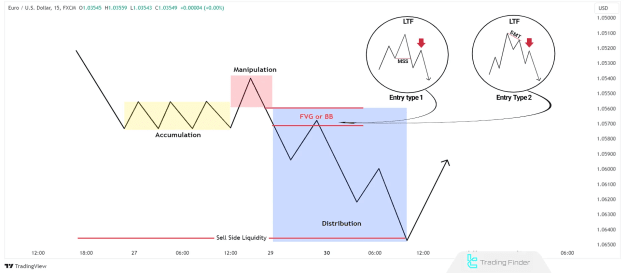
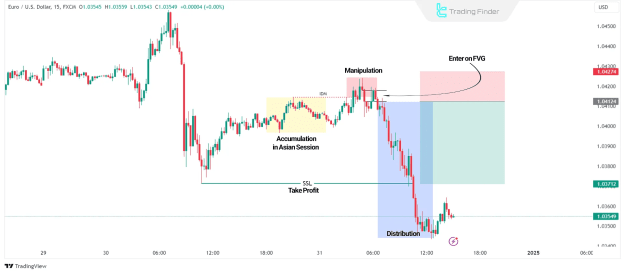
- If price breaks out, analyze breaker blocks or mitigation zones for entry opportunities.
- Confirm setups based on market structure and alignment with daily bias.
- Consider pullback entries for favorable risk-reward setups.
Step 5: Execute Trades and Manage Risk
- Place stop-loss orders just beyond the range of the accumulation phase.
- Set take-profit targets based on higher timeframe levels.
- Manage trades by scaling out or adjusting stops as price action evolves.
Step 6: Review and Optimize Your Strategy
- Log all trades, including entry price, stop-loss, timeframe, and outcome.
- Conduct post-trade analysis to refine execution and decision-making.
- Evaluate which phases of the PO3 you navigated well and where improvement is needed.
Conclusion
The ICT Asian Session PO3 Strategy is a powerful tool for traders aiming to exploit structured price movements within the quieter hours of the Forex and crypto markets. By understanding the Accumulation, Manipulation, and Distribution phases and applying them within the unique environment of the Asian session, traders can significantly improve their edge.
This strategy not only enhances early market analysis but also provides a seamless transition into more volatile sessions, positioning traders for optimal entries and risk-managed exits.