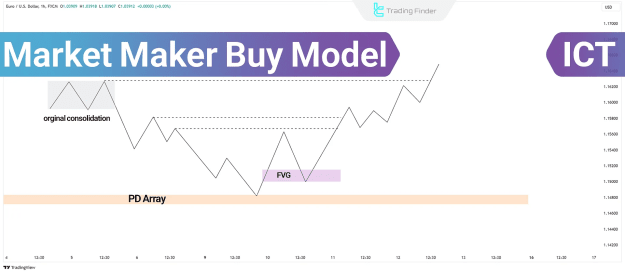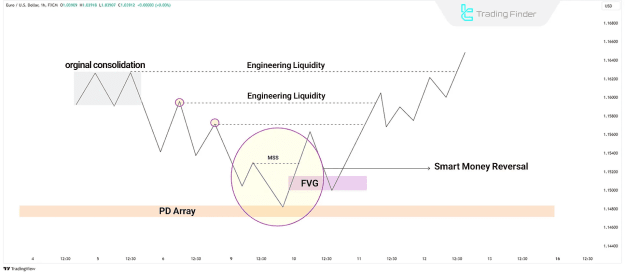


It explains how price transitions from a bearish key zone (sell-side liquidity) to a bullish key zone (buy-side liquidity) within PD Arrays. This concept is essential in forex education, enabling traders to understand liquidity shifts and improve trade timing for better entries and risk management.
This model helps traders identify high-probability entry points, set tight stop losses, and effectively capitalize on market reversals and continuation patterns.
How Does the Market Maker Buy Model Work?
The MMBM demonstrates the shift from bearish market conditions (dominated by selling pressure) to bullish conditions (where buyers take control). By analyzing this transition, traders can:
- Detect trend reversals early.
- Identify optimal entry points near key zones.
- Manage risk with precise stop-loss placement.
Key Conditions for Trading the MMBM
Before applying the Market Maker Buy Model, traders should confirm the following:
Higher Timeframe Uptrend – The daily/weekly charts should show an upward trend (Higher Highs & Higher Lows).
Liquidity Above Price – Previous highs act as liquidity targets, attracting price movement.
Short-Term Bearish Pullback – In lower timeframes (15M/30M), a temporary sell-off occurs before price resumes the uptrend.
Core Components of the ICT Market Maker Buy Model
1. Consolidation Phase
Price moves within a defined range, forming an initial consolidation zone before a directional move.
2. Lower High Formation
During a downtrend, price creates Lower Highs, which later act as liquidity pools for buyers.
3. Trend Reversal Confirmation
A shift from bearish to bullish occurs when price reaches a higher-timeframe PD Array level, signaling a Buy-Side takeover.
4. Liquidity Absorption
Price sweeps previous highs (liquidity zones) before retracing back into the initial range.
5. Key Trading Zones
- Fair Value Gaps (FVGs) – Imbalanced zones offering optimal entries.
- Liquidity Zones (PDH/PDL) – Critical levels where price reacts strongly.
Step-by-Step Guide to Trading the MMBM
Step 1: Confirm Bullish Market Structure
- Check higher timeframes (4H/Daily) for an established uptrend (Higher Highs & Higher Lows).
Step 2: Identify Liquidity Above Price
- Locate previous highs where liquidity is likely to be targeted.
Step 3: Wait for a Short-Term Sell-Off
- In lower timeframes (15M/30M), observe a bearish pullback into a Bullish PD Array zone.
Step 4: Confirm Bullish Reversal
- Look for a Break of Structure (BOS) and SMT Divergence to confirm upward momentum.
Step 5: Enter the Trade
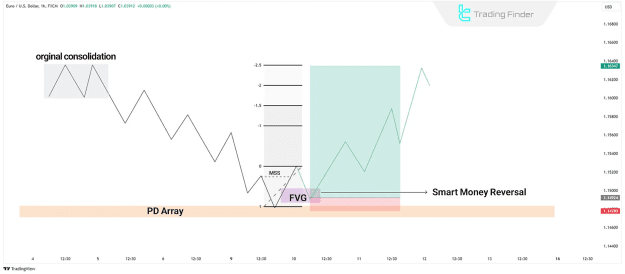
- Buy when price retests an FVG and confirms a Bullish BOS.
Step 6: Set Stop Loss
- Place stop loss 10-20 pips below the last swing low before the BOS.
Step 7: Take Profit
- Use Fibonacci extensions (1.0 – 2.5) from the lowest reversal point.
- Alternatively, target previous highs or higher-timeframe liquidity zones.
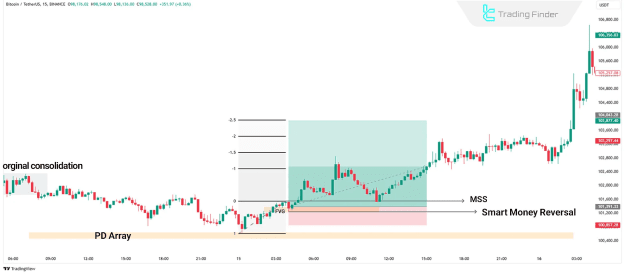
Example: Bitcoin 15-Minute Chart
(A practical illustration of the MMBM in action, showing bullish structure and key entry points.)
Conclusion
The ICT Market Maker Buy Model (MMBM) is a powerful strategy for identifying bullish reversals and continuation patterns. By combining:
Market Structure Shifts (MSS)
Liquidity Analysis
Fair Value Gaps (FVGs)
Traders can minimize risk and maximize profitability in trending markets.