

Within this structured environment, the trading journal emerges as a critical analytical and managerial tool. It serves to systematically document every decision, the logical reasoning behind entries and exits, and the trader’s emotional responses during market activity.
Consistent and meticulous recording of this data is fundamental for conducting in-depth performance analysis. It illuminates strategic weaknesses and highlights any deviations from the predefined trading plan, providing a clear roadmap for improvement.
Prop Firm DrawDown Protector : Prop Firm Capital Protection Expert MT5 |Forex Money Management: Forex Trade Management Expert MT5 | ICT Concepts Indicator MT5 |Smart Money Concepts Expert MT5 | Smart Money Trap Scanner | Get a free Expert Advisor license via Telegram and WhatsApp
What is a Prop Trading Journal?
A proprietary trading journal is a specialized method of documentation and performance analysis designed explicitly for traders operating within prop firms.
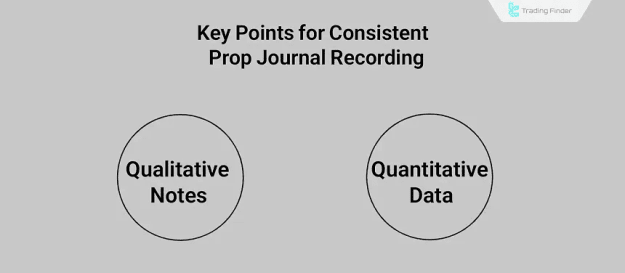
This journal transcends basic trade logging by capturing a complete picture of each transaction. It records quantitative details like entry time, volume, and price, alongside qualitative data such as the reasoning behind decisions and the trader's emotional state.
Its key distinction from a regular trading journal lies in its expanded scope. While profit and loss are tracked, a prop journal also meticulously monitors compliance with specific company rules, adherence to allowable risk percentages, and overall performance stability metrics.
The Role of the Journal in a Prop Trader’s Success
Success in the competitive landscape of proprietary trading is not defined by isolated wins. It is achieved through sustained profitability combined with behavioral consistency and analytical discipline. The trading journal is the cornerstone tool for cultivating this success.
By precisely recording every trade detail, a trader can objectively assess their compliance with critical company mandates, including:
- Maximum daily drawdown
- Maximum account loss limits
- Profit targets
This practice allows for the identification of behavioral or strategic deviations before they escalate into costly errors or rule violations.
Regular journaling fosters a stable, repeatable decision-making pattern. It acts as a vital barrier against emotionally-driven decisions following periods of sudden loss or irrational exuberance during gains.
This disciplined process facilitates a crucial mindset shift—from reactive, emotional responses to proactive, analytical problem-solving. Consequently, a trader's performance during firm evaluations becomes more reliable, predictable, and professional.
Essential Components of a Prop Trading Journal
An effective prop journal must be comprehensive, covering not just trades but also performance evaluation criteria, psychological factors, and rule compliance. Here are the essential categories:
- Trade Execution Data
This forms the quantitative foundation. Record the symbol, trade direction (Buy/Sell), timeframe, exact entry/exit points, position size, risk amount in dollars, and the final profit or loss. - Proprietary Firm Rules Compliance
This is the unique core of a prop journal. Dedicate space to track your daily drawdown against the limit, your proximity to the maximum loss rule, progress toward profit targets, and the risk percentage per trade relative to the allowed maximum. - Decision Logic & Strategy
Evaluate the quality of your decisions by documenting the entry reason, the specific setup type used, any multi-timeframe confirmations, and the prevailing market conditions (e.g., trending, ranging, high volatility). - Trading Psychology & Emotional State
Analyze your behavior by noting your mental state before entry, your emotional reactions during periods of high volatility, and your feelings immediately after closing the trade. This is key for developing psychological stability. - Performance Analysis Metrics
Use your data to calculate key metrics like win rate, average profit/loss per trade, risk-to-reward ratio (R:R), and your personal maximum drawdown. These indicators measure performance stability. - Feedback & Improvement Plan
This is your correction tool. Clearly note any violated rules, identify recurring mistakes, document review results, and formulate a concrete plan for performance improvement in future evaluations.
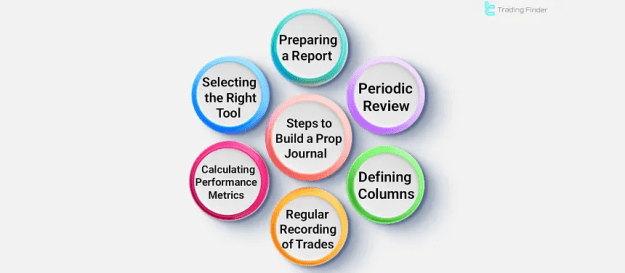
Steps to Build Your Prop Trading Journal
Designing a functional prop journal requires ensuring all performance indicators and firm rules are easily trackable. Follow these structured steps:
- Selecting the Right Tool
Begin by choosing your platform. Excel or Google Sheets offer flexibility and are excellent starting points. For advanced, automated analytics, performance charts, and error tracking, consider specialized software like TradeZella, Edgewonk, or TraderSync. - Defining Columns Based on Prop Rules
Structure your journal around your firm's requirements. Create specific columns for date, symbol, risk per trade, daily drawdown level, profit target progress, and margin usage percentage. This alignment is crucial for self-auditing compliance. - The Discipline of Consistent Logging
Data must be entered immediately after each trade or trading session. Prompt recording ensures accuracy and prevents cognitive bias or forgotten details. Do not neglect the qualitative notes on rationale and psychology. - Calculating Performance Metrics
Implement formulas to automatically compute your win rate, risk-to-reward ratio, total drawdown, and average daily profit. These metrics are the language of professional evaluation in prop environments. - Conducting Periodic Reviews and Analysis
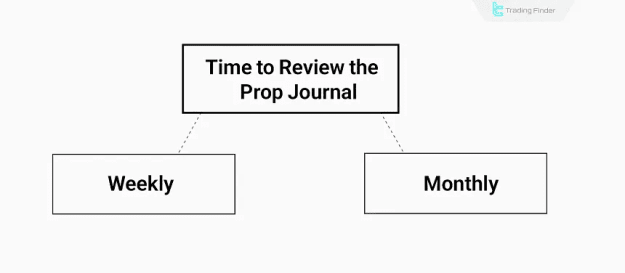
Schedule weekly or end-of-phase reviews. Analyze your trades to identify profitable patterns and, more importantly, recurring mistakes. Ensure this analysis is driven by hard data, not subjective feelings or selective memory. - Preparing Professional Evaluation Reports
Organize your journal to allow for easy extraction of summary reports and performance charts. These reports serve as objective evidence of your discipline and stability for account managers during funding or scaling evaluations.
The Tangible Benefits of a Prop Trading Journal
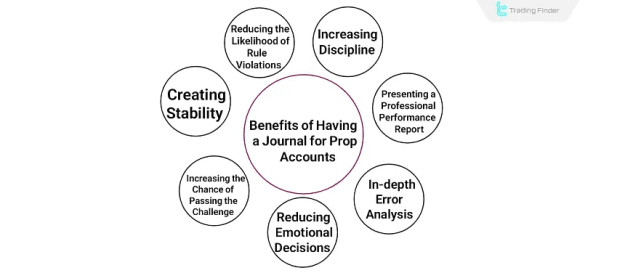
Maintaining a dedicated journal for prop accounts transforms it from a simple log into a powerful performance control tool. Its benefits are multi-faceted and directly impact a trader's career longevity and success.
- Increases Chance of Passing the Challenge Phase
Consistent recording aligns your behavior with company standards, helping you identify and correct mistakes before they lead to rule violations. - Creates Stability in Trading Performance
Continuous data analysis fosters consistency, reduces behavioral fluctuations, and helps maintain a rational outlook during both winning and losing streaks. - Reduces Emotional Decisions and Mental Errors
Reviewing recorded emotional patterns teaches you to manage irrational reactions, leading to decisions based on logic and pre-defined strategy. - Enables In-Depth Error Analysis and Pattern Recognition
Statistical evaluation of your trades exposes the true weaknesses and strengths within your strategy, allowing for data-driven optimization. - Provides Professional Reports to the Prop Firm
A well-structured journal presents an accurate, documented image of your discipline, making you appear more reliable and professional to evaluators. - Enhances Discipline and Self-Control
The act of recording each trade before or immediately after execution reduces impulsivity and encourages stricter adherence to risk management rules. - Reduces the Likelihood of Rule Violations
Daily monitoring of stop-losses and key metrics through the journal provides an early warning system, allowing for corrective action before breaching risk thresholds. - Builds Firm Trust and Trader Credibility
Accuracy, continuous analysis, and transparent reporting demonstrate accountability and professionalism, building trust with the firm for potential capital allocation increases.
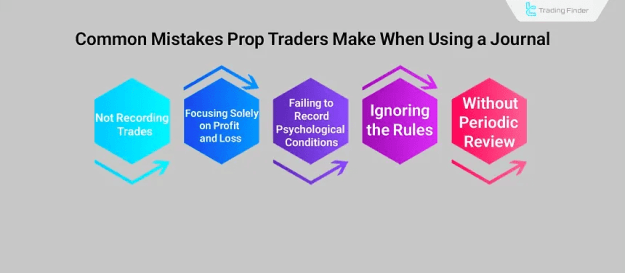
Common Pitfalls to Avoid with Your Prop Journal
Improper use can severely diminish a journal's effectiveness. Be vigilant against these common mistakes:
- Not Recording Trades Due to Fear of Mistakes
Omitting losing trades creates cognitive bias and prevents you from learning from your most important lessons. - Focusing Solely on P&L While Ignoring Entry Reasons
A journal limited to financial results hinders strategic development and leads to the repetition of logical errors. - Failing to Record Psychological and Behavioral Conditions
Neglecting to log emotions leaves a blind spot in your analysis, obscuring the critical link between mindset and performance. - Disregarding Firm Rules During Analysis
Reviewing performance without the context of your firm's specific drawdown and risk limits is an analytical error inconsistent with the prop trading reality. - Using the Journal Without Periodic Review
A journal that is only written but never read is merely an archive. Without scheduled review, you cannot identify patterns, errors, or improvement points, halting your development.
Practical Example: The Journal in Action
Consider a prop trader who records three consecutive small losses. A weekly journal review reveals a common thread: all three entries were made without confirmation from the higher timeframe, violating their own strategy.
The trader adds a multi-timeframe confirmation rule to their checklist. The following week, this correction leads to two well-executed, profitable trades.
This simple example demonstrates how the journal uncovers hidden, systematic errors and facilitates measurable, data-driven improvement.
Conclusion
In the world of proprietary trading, long-term success is not a product of luck or a single brilliant strategy. It is built on the trader's ability to analyze data objectively and control their behavior relentlessly.
The precise recording and regular analysis fostered by a dedicated trading journal establish clear decision-making rules and prevent the repetition of expensive mistakes. It institutionalizes order, consistency, and mental discipline, forming the bedrock of a stable, professional performance pattern.
Ultimately, the prop trading journal empowers you to take full responsibility for your trading evolution, managing your career not on emotion, but on empirical evidence and disciplined reflection.