

Prop Firm DrawDown Protector : Prop Firm Capital Protection Expert MT5 | Forex Money Management: Forex Trade Management Expert MT4 | ICT Concepts Indicator MT5 |Smart Money Concepts Expert MT5 |Get a free Expert Advisor license via Telegram and WhatsApp
Problems in Digital Financial Systems Before Bitcoin
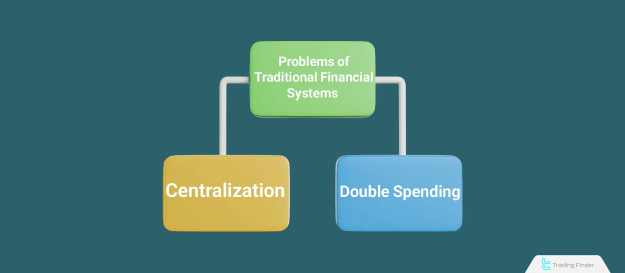
Prior to the invention of Bitcoin, digital financial systems faced two major challenges:
- Centralization
- Double Spending
To execute secure transactions, users had to rely on trusted intermediaries, such as banks or financial institutions. These central entities acted as both validators and record keepers. Although this reduced the risk of fraud, it created bottlenecks and a dependency on institutions with the power to restrict, censor, or delay transactions.
What Problems Did Bitcoin Aim to Solve?
Bitcoin was specifically designed to address the following core issues in traditional financial systems:
Centralization
- Central authorities had control over transaction validation, user access, and record management.
- Trust was placed in a single entity, increasing the risk of data manipulation and censorship.
- Centralization limited the accessibility of financial services and increased exposure to systemic failures.
Double Spending
- Digital assets could be duplicated and spent multiple times without proper oversight.
- Without a centralized ledger, distinguishing between original and duplicated transactions became difficult.
- This flaw made digital currencies unreliable without an overseeing intermediary.
Bitcoin’s Solution to Centralization and Double Spending
Satoshi Nakamoto’s creation of Bitcoin introduced a decentralized model that removed the need for third-party validation. Bitcoin employs a Distributed Ledger Technology (DLT) — commonly known as the blockchain — which resolves the issues mentioned above.
Key Features of Bitcoin’s Approach:
- Peer-to-peer transaction model eliminates the need for intermediaries.
- All transaction records are permanently stored and updated on a decentralized network.
- Consensus mechanisms, such as Proof-of-Work, ensure the integrity of the data.
How Does Bitcoin’s Distributed Ledger Work?
The blockchain, as a form of distributed ledger, records every transaction in a transparent and immutable manner.
- All nodes on the Bitcoin network maintain a copy of the blockchain.
- Each transaction is verified through consensus protocols before being added to the chain.
- Data synchronization across thousands of nodes ensures accuracy and prevents tampering.
- Users can independently verify and audit the entire history of transactions at any time.
This system ensures that no single entity has control over the network, effectively solving the issues of centralization and double spending.
Additional Problems Solved by Bitcoin
Bitcoin not only resolved technical issues like double spending but also addressed broader structural problems within traditional financial systems.
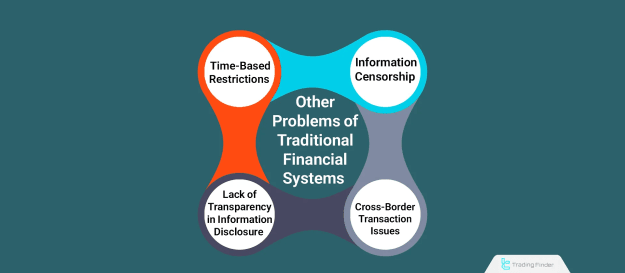
Issues in Traditional Finance:
- Censorship of financial activity by centralized institutions
- Restricted access due to working hours, location, or legal barriers
- High fees and complexities associated with cross-border transactions
- Lack of transparency in how funds are managed or moved
Bitcoin’s Advantages:
- Censorship Resistance: Information cannot be manipulated or removed since it's stored on a decentralized network.
- 24/7 Accessibility: Bitcoin can be used any time, anywhere, without intermediaries.
- Borderless Transactions: Bitcoin transactions are not limited by national borders or banking hours.
- Full Transparency: Every transaction is recorded publicly, ensuring accountability.
How Does Bitcoin Prevent Inflation?
Unlike fiat currencies, which can be printed in unlimited quantities by central banks, Bitcoin is designed with a fixed supply:
- Maximum supply is limited to 21 million BTC.
- No central authority can alter or increase this limit.
- Deflationary model increases scarcity and protects value over time.
- Halving events reduce block rewards over time, ensuring a controlled issuance rate.
This structure protects Bitcoin from inflationary pressures often caused by excessive money printing in traditional economies.
Conclusion
Traditional financial systems rely on centralized authorities to prevent double spending and validate transactions. However, this reliance introduces vulnerabilities, including censorship, manipulation, restricted access, and inflation.
Bitcoin offers a decentralized alternative by leveraging a distributed ledger to record and verify transactions across a global network of nodes. This system not only eliminates the double-spending issue but also provides a transparent, censorship-resistant, and inflation-proof method of transacting value.
By removing the need for intermediaries and offering a transparent, immutable, and borderless financial system, Bitcoin represents a foundational shift in how value is exchanged and secured in the digital age.