

TP & SL Tool: Risk Reward Ratio Calculator RRR MT5 | Prop Firm Protector: Trade Assist Prop Firm Plus TF Expert MT5 | Money Management + DrawDown Protector: Trade Panel Prop Firm Drawdawn Limiter Pro MT5 |Get a free Expert Advisor license via Telegram and WhatsApp
What Is a Flip in Market Structure?
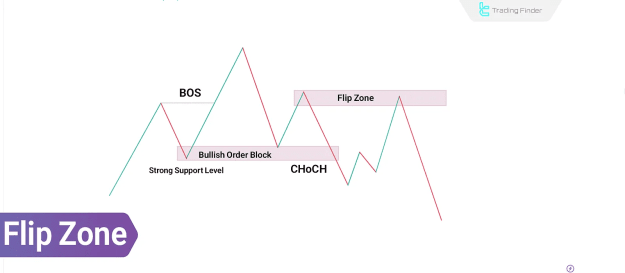
A Flip occurs when a key supply or demand zone, after an initial price reaction, is broken decisively and transitions into its opposite type (supply becomes demand, or vice versa). Unlike a Change of Character (CHoCH), which merely indicates a structural shift via highs and lows, a Flip requires three simultaneous conditions:
- Initial price reaction to a supply or demand zone.
- Clear break of that zone with strong momentum.
- Formation of an Imbalance or Fair Value Gap (FVG) at the breakpoint.
Key Insight:
- Every Flip is a CHoCH, but not every CHoCH is a Flip because a valid Flip requires a confirmed zone break with imbalance.
Types of Flip Patterns in Market Structure
Flip patterns are categorized into two main types based on trend behavior:
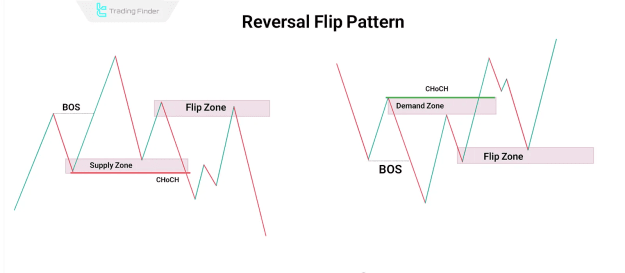
1. Reversal Flip Pattern
A Reversal Flip signals the end of a trend and the beginning of a new one in the opposite direction.
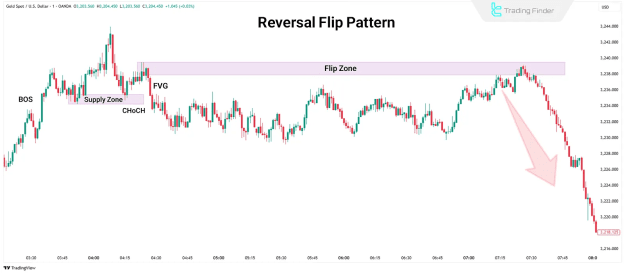
Bearish Reversal Flip (Uptrend to Downtrend)
- Price forms higher highs (HH) and higher lows (HL).
- Enters a higher-timeframe supply zone but fails to make a new high.
- Breaks the previous demand zone, converting it into a supply Flip Zone.
- Confirms the start of a bearish phase.
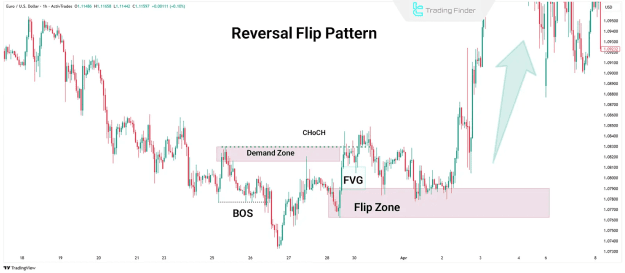
Bullish Reversal Flip (Downtrend to Uptrend)
- Price forms lower lows (LL) and lower highs (LH).
- Enters a higher-timeframe demand zone but fails to make a new low.
- Breaks the previous supply zone, converting it into a demand Flip Zone.
- Confirms the start of a bullish phase.
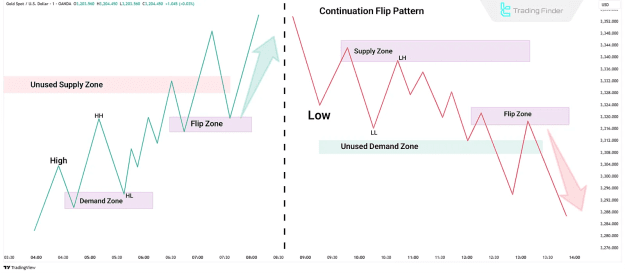
2. Continuation Flip Pattern
A Continuation Flip indicates trend persistence, where price breaks an opposing zone mid-trend and establishes it as new support/resistance.
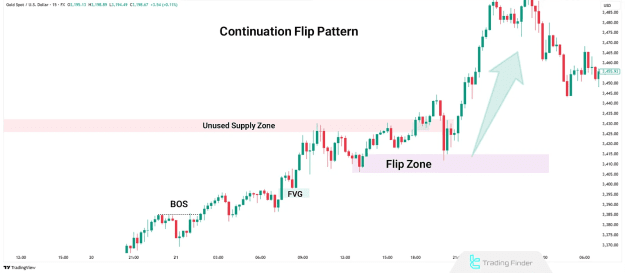
Bullish Continuation (Supply to Demand Flip)
- In an uptrend, price enters a supply zone but breaks through with strong momentum.
- Leaves behind an Imbalance or FVG, creating a demand Flip Zone.
- Acts as a buying zone for trend continuation.
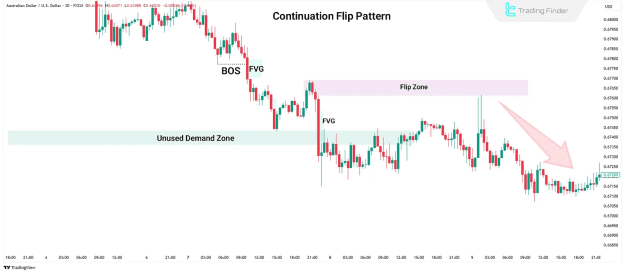
Bearish Continuation (Demand to Supply Flip)
- In a downtrend, price enters a demand zone but breaks it without reversal.
- Converts the zone into a supply Flip Zone, confirming seller dominance.
- Provides a short-entry opportunity in line with the trend.
How to Identify and Trade Flip Zones
Step 1: Identify Key Zones in Higher Time Frames
- Focus on higher timeframes (HTF) where institutional supply/demand zones are more reliable.
- A broken demand zone becomes a supply Flip Zone.
- A broken supply zone becomes a demand Flip Zone.
Step 2: Confirm Break with Strong Impulse & Imbalance/FVG
- The break must be decisive, with strong momentum and an FVG/Imbalance.
- This confirms institutional participation and increases the likelihood of a retest.
Step 3: Marking the Flip Zone
- Locate the trigger candle (the candle initiating the break).
- Draw a rectangle covering its high and low.
- A strong breaker candle with a clear gap enhances validity.
Step 4: Trading the Flip Zone
- Use limit orders inside the Flip Zone for optimal entries.
- Bearish Reversal Flip → Sell Limit in the supply Flip Zone.
- Bullish Reversal Flip → Buy Limit in the demand Flip Zone.
- Stop Loss (SL): Just beyond the Flip Zone.
- Take Profit (TP): Based on new market structure.
Note: Flip Zones are single-use—once tested, they lose effectiveness.
Conclusion
In ICT and Smart Money Concepts (SMC), a Flip is a powerful tool for detecting institutional shifts in market control. Unlike a CHoCH, which only signals structural change, a Flip confirms a liquidity shift through zone breaks and imbalances.
By distinguishing between Reversal and Continuation Flips, traders can align with institutional order flow, enhancing trade accuracy. Proper identification requires HTF analysis, strong break confirmation, and strategic entry execution.
Mastering Flip Levels provides a competitive edge in price action trading, offering high-probability setups rooted in Smart Money behavior.