

TP & SL Tool: Risk Reward Ratio Calculator RRR MT5 | Prop Firm Protector: Trade Assist Prop Firm Plus TF Expert MT5 | Money Management + DrawDown Protector: Trade Panel Prop Firm Drawdawn Limiter Pro MT5 |Get a free Expert Advisor license via Telegram and WhatsApp
What Are Elliott’s Corrective Waves?
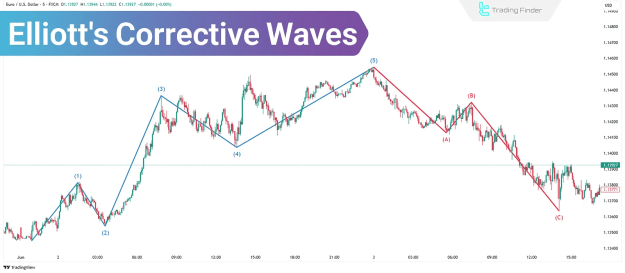
Corrective Waves are price movements that oppose the main trend. They partially retrace the price action of the Motive Wave but do not fully reverse the trend. Instead, they represent temporary pauses or pullbacks before the trend resumes.
Advantages and Disadvantages of Corrective Waves
Advantages
- Provide optimal entry points in line with the main trend.
- Help forecast potential trend continuations.
- Indicate the strength and health of the prevailing trend.
Disadvantages
- Complex to identify due to multiple pattern variations.
- Uncertainty in retracement depth.
- Risk of false signals without proper analysis.
- Require advanced tools and expertise for accurate interpretation.
Types of Corrective Waves
Corrective Waves are categorized into two main types based on their structure:
1. Time Corrections
Time-based corrections unfold over extended periods, leading to wider price ranges on the chart. These corrections often involve prolonged sideways movements rather than sharp retracements.
2. Price Corrections
Price Corrections occur quickly, often within shorter timeframes, and are characterized by sharper retracements. These corrections are further divided into distinct patterns:
- Zigzag
- Flat
- Triangle
- Combined Corrections
Zigzag Corrective Wave
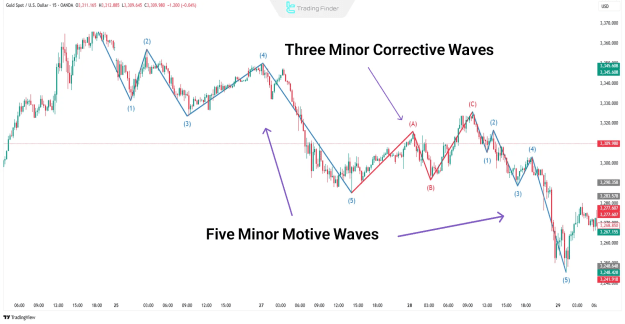
The Zigzag pattern is a sharp, three-wave corrective structure (A-B-C) that moves strongly against the main trend.
Structure:
- Wave A & C: Five-wave Motive patterns.
- Wave B: Three-wave corrective move.
Zigzags often indicate deep market pullbacks and strong reversal points before the trend resumes.
Flat Corrective Wave
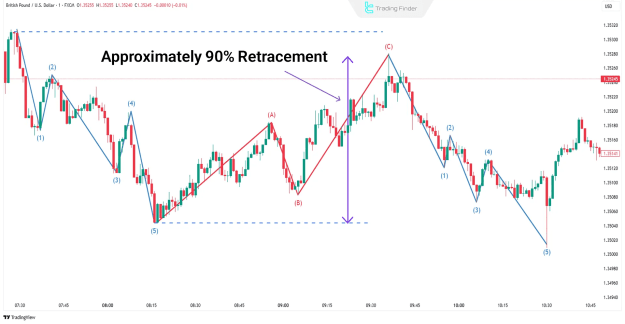
Flat corrections appear as sideways movements, indicating a temporary pause in the trend.
Structure:
- Wave A & C: Can consist of 3 or 5 sub-waves.
- Wave B: Typically retraces about 90% of Wave A.
This pattern suggests consolidation before the continuation of the primary trend.
Triangle Corrective Wave
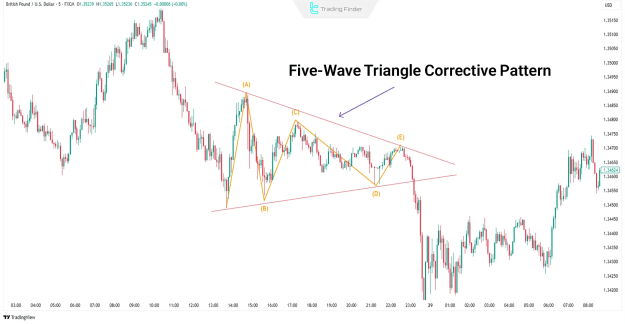
Triangles form during consolidation phases and consist of five overlapping waves (A-B-C-D-E) within converging trendlines.
Characteristics:
- Acts as a continuation pattern.
- Breakout from the triangle often resumes the main trend.
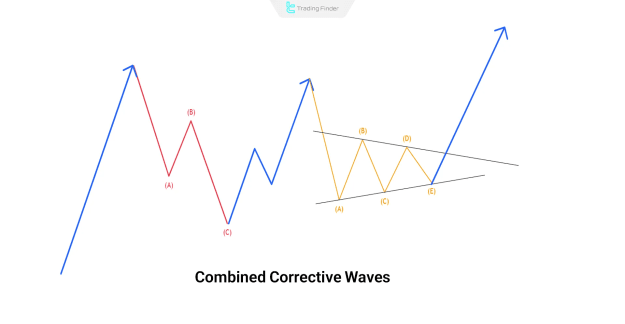
Combined Corrective Waves
When multiple corrective patterns appear together, they form complex structures linked by an intervening wave (X). These combinations can include two or three different corrective formations.
Rules of Corrective Waves
Despite their complexity, Corrective Waves follow key rules:
- They never fully retrace the preceding Motive Wave.
- Typically form a three-wave structure (A-B-C).
- Wave B cannot exceed the start of Wave A.
- Wave B is always a corrective structure, not an impulsive one.
Difference Between Corrective and Motive Waves
Corrective Waves
- Move against the main trend.
- Consist of 3 sub-waves (A-B-C).
- Exhibit weaker momentum.
- Form over longer durations.
- Represent trend pauses or pullbacks.
Motive Waves
- Align with the main trend.
- Comprise 5 sub-waves (1-2-3-4-5).
- Show strong momentum.
- Develop quickly.
- Indicate the primary trend direction.
Conclusion
Elliott’s Corrective Waves appear in various forms but always move counter to the primary trend. These patterns, typically structured as A-B-C, do not reverse the trend but instead set the stage for its continuation. Understanding these waves enhances a trader’s ability to identify high-probability entry points and assess market trends effectively.