

TP & SL Tool: Risk Reward Ratio Calculator RRR MT4 | Prop Firm Protector: Trade Assist Prop Firm Plus TF Expert MT4 | Money Management + DrawDown Protector: Trade Panel Prop Firm Drawdawn Limiter Pro MT4 |Get a free Expert Advisor license via Telegram and WhatsApp
Formula of Williams %R
The calculation for Williams %R is:
Williams %R = (Highest High – Close) / (Highest High – Lowest Low)
Definitions of formula components:
- Highest High: Maximum price recorded within the selected period (commonly 14 candles)
- Lowest Low: Minimum price observed in the same period
- Close: Closing price of the current candle
Advantages and Limitations of Williams %R
Before integrating Williams %R into your trading methodology, it is crucial to assess its advantages and limitations:
Advantages
- Provides rapid trading signals
- Straightforward to interpret and apply
- Compatible with other technical indicators to strengthen analysis
Limitations
- May generate false signals during strong market trends
- As a leading indicator, it is prone to premature signals without additional confirmation
Williams %R Oscillation Parameters
The indicator operates within a fixed range:
- Values fluctuate between 0 and -100
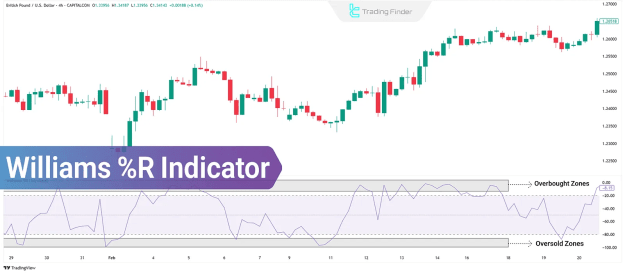
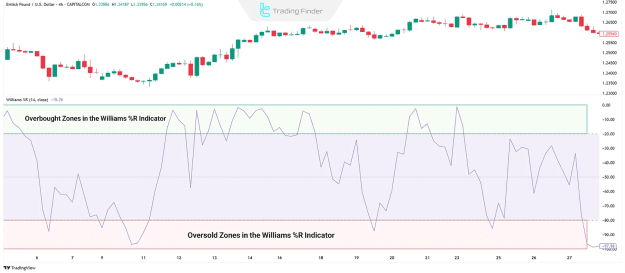
- Readings from 0 to -20 indicate overbought conditions
- Readings from -80 to -100 indicate oversold conditions
Practical Applications of Williams %R in Trading
Detecting Overbought and Oversold Conditions
The fundamental application of Williams %R is identifying market extremes:
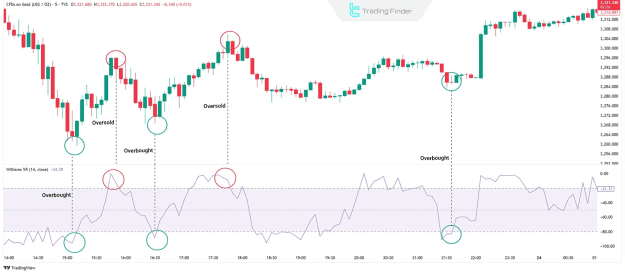
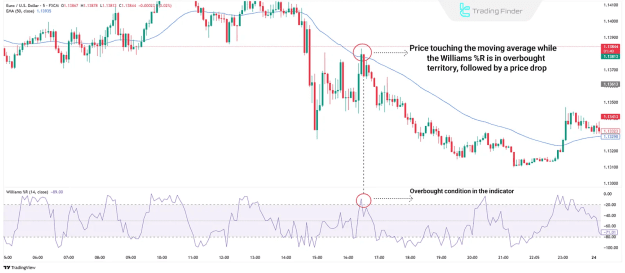
- When the reading rises above -20, it suggests an overbought market, indicating a potential price correction or bearish reversal.
- When the reading falls below -80, it reflects an oversold market, signalling the possibility of a bullish reversal.
Generating Reversal Signals
Crossing into or out of overbought and oversold zones provides potential reversal signals:
- A sell signal occurs when the indicator falls below -20
- A buy signal is indicated when the reading rises above -80
Confirming Existing Trends
Professional traders often utilise Williams %R to validate ongoing market trends:
- In uptrends: Frequent oscillation between -20 and -50 supports bullish continuation.
- In downtrends: Consistent movement between -50 and -80 confirms bearish market strength.
Williams %R-Based Trading Strategies
Employing Divergence Analysis
Divergence between Williams %R and price action is a powerful strategy:
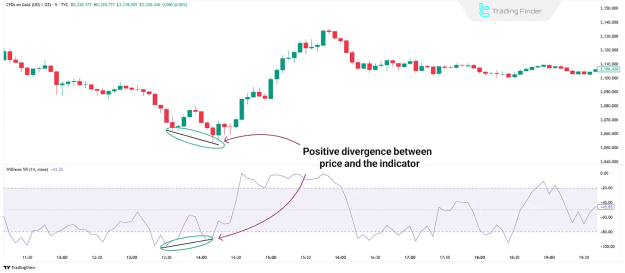
- Positive Divergence: When price forms a lower low but Williams %R forms a higher low, it indicates potential bullish reversal.
- Negative Divergence: When price creates a higher high but Williams %R shows a lower high, it suggests possible bearish reversal.
Integrating Moving Averages
Combining Williams %R with Moving Averages enhances strategic decisions:
- In uptrends (price above 50-period MA): Focus on buy signals generated by Williams %R.
- In downtrends (price below 50-period MA): Act only on sell signals to align with prevailing market direction.
Effective Usage Guidelines for Williams %R
To maximise its reliability, apply the following recommendations:
- Adjust period settings: Although the standard is a 14-period, testing other periods such as 9 or 21 may yield optimal results depending on the market asset.
- Incorporate price action analysis: Confirm Williams %R signals with candlestick patterns and support/resistance zones to filter false entries.
- Verify with volume: Signal strength increases when accompanied by volume surges supporting the directional bias.
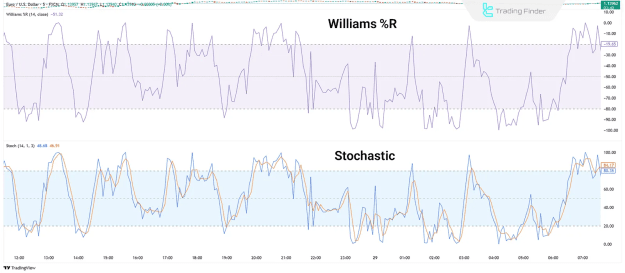
Williams %R vs. Stochastic Oscillator: Key Differences
Despite their functional similarities, distinct differences exist:
- Range: Stochastic Oscillator ranges between 0 and 100, whereas Williams %R ranges from 0 to -100.
- Responsiveness: Williams %R tends to react more swiftly to price fluctuations.
- Indicator structure: Williams %R features a single reversed line, while the Stochastic Oscillator displays two lines (K and D) for signal generation.
Conclusion
The Williams %R indicator serves as a robust momentum oscillator for identifying overbought and oversold market conditions. Its strategic integration with price action, volume analysis, and trend confirmation enhances trading precision. Employing this tool alongside comprehensive technical frameworks empowers traders to navigate market reversals and trend continuations effectively.