

TP & SL Tool: Risk Reward Ratio Calculator RRR MT4 | Prop Firm Protector: Trade Assist Prop Firm Plus TF Expert MT4 | Money Management + DrawDown Protector: Trade Panel Prop Firm Drawdawn Limiter Pro MT4 |Get a free Expert Advisor license via Telegram and WhatsApp
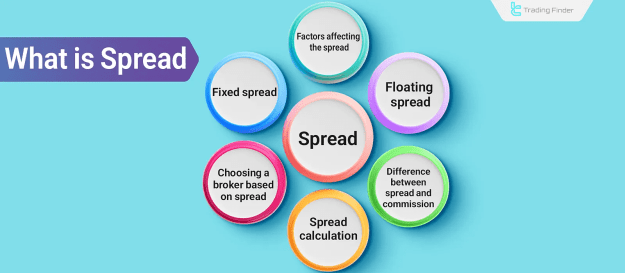
What is Spread?
Definition of Spread in Forex
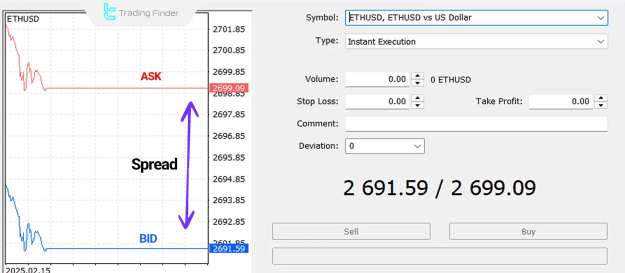
Spread is defined as the gap between the bid price (buy price) and the ask price (sell price) of a currency pair. The bid price indicates the maximum price that a market participant is willing to pay to buy an asset, while the ask price reflects the minimum price at which the asset is offered for sale at that moment.
- The difference between these two prices is known as the bid-ask spread.
- Spread represents the cost a trader incurs when opening or closing a trade.
Bid and Ask Prices in Spread Calculation
- Bid price: The price a broker offers to buy an asset.
- Ask price: The price at which a broker sells an asset.
Spread effectively serves as a hidden fee embedded within the price difference, even for accounts without direct commission charges. It is measured in pips and varies depending on market conditions, broker types, and account categories.
How to Calculate Spread
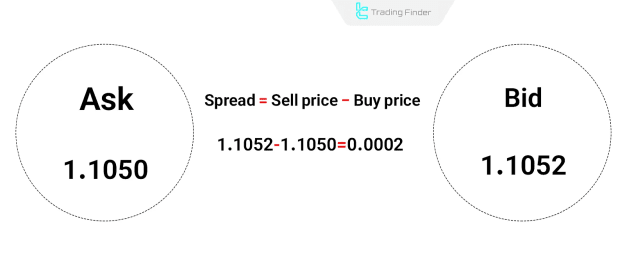
Spread is calculated using the formula below:
- Ask Price – Bid Price = Spread
Example:
If the EUR/USD pair has:
- Ask: 1.1052
- Bid: 1.1050
Then the spread is:
- 1.1052 – 1.1050 = 0.0002 (2 pips)
Factors Influencing the Size of Spread
Several elements affect the spread in Forex trading:
- Liquidity: Higher trading volumes generally lead to tighter spreads.
- Market volatility: Increased volatility widens spreads due to imbalanced buy and sell orders.
- Broker policy: Brokers may widen spreads to manage risk or restrict certain trading strategies.
- Market activity levels: Currency pairs have varying spreads depending on trading sessions.
- Account type: ECN accounts often offer lower spreads combined with fixed commissions.
Types of Spreads in Forex
Fixed Spread
Fixed spreads maintain a predetermined difference between bid and ask prices under normal market conditions. They are suitable for traders requiring cost predictability in their strategies.
- Advantages:
- Provides certainty of transaction costs.
- Suitable for strategies needing precise risk management (e.g., tight stop-losses).
- Disadvantages:
- Typically higher than floating spreads during low volatility.
- Can widen temporarily during major economic releases or market openings.
Floating Spread
Floating spreads vary in real-time according to market supply and demand. They are commonly offered in ECN and STP accounts, where pricing reflects direct quotes from liquidity providers.
- Advantages:
- Can start from 0.1 pip in normal conditions, reducing trading costs.
- Reflects actual market conditions, promoting transparency.
- Ideal for ECN accounts with direct execution models.
- Disadvantages:
- Can widen significantly during high volatility or low liquidity periods.
- Includes fixed commissions alongside variable spread costs.
- Requires constant monitoring to avoid adverse cost impacts.
What is Zero Spread?
Brokers often advertise zero spread accounts for marketing purposes. However, in practice:
- A minimal difference always exists between bid and ask prices.
- Some platforms display zero spread due to rounding to five decimal places, but a fractional spread remains in the sixth decimal.
- No trade is free from spread costs, even if minimal.
Viewing Spread in MetaTrader
Using Order Window
The spread can be observed as the gap between bid and ask prices when placing orders.
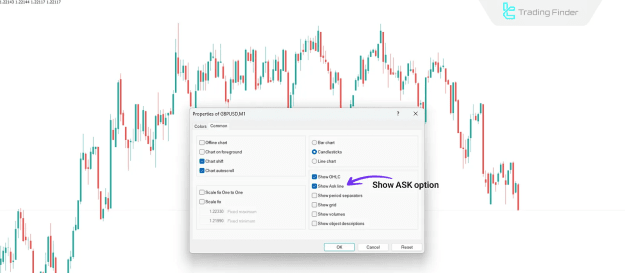
Displaying Ask Price on Chart
- Right-click the chart.
- Select "Properties."
- In the "Common" tab, enable the "Show Ask line" option.
Checking Contract Specifications
- Right-click the instrument in "Market Watch."
- Select "Specification" to view spread type.
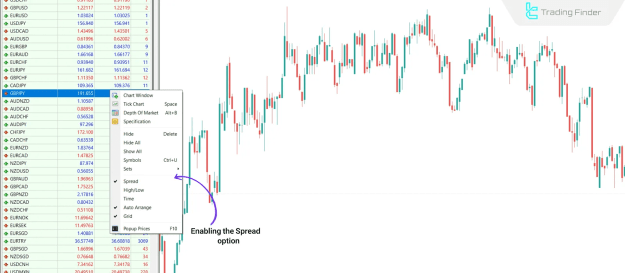
- Alternatively, enable spread display in "Market Watch" for direct observation.
Impact of Spread on Trading Strategies
Scalping
- Involves multiple trades targeting minimal price movements.
- Requires very low spreads to maintain profitability.
- ECN accounts with raw spreads are essential for scalping efficiency.
Day Trading
- Includes opening and closing positions within the same day targeting 20–50 pip movements.
- Lower spreads improve net gains, especially in high-frequency trading approaches.
Swing Trading
- Positions remain open for days to capture larger market swings exceeding 100 pips.
- Spread costs are minor compared to swap charges in this strategy.
Position Trading
- Involves long-term trades based on macroeconomic trends.
- Spread has minimal influence due to the large pip targets, with greater focus on swap rates and broker reliability.
Spread Versus Commission
Spread and commission are distinct components of trading costs:
- Spread: Implicit cost built into bid-ask price differences, fluctuating with market conditions.
- Commission: Explicit, fixed fee per trade or lot, remaining stable regardless of market volatility.
Key Distinctions
- Spread is embedded within quoted prices; commission is displayed separately.
- Commission-based accounts (e.g., ECN) often offer lower spreads with transparent fees.
Conclusion
Spread remains a fundamental trading cost that influences strategy profitability in Forex. A comprehensive understanding of fixed and floating spreads, their influencing factors, and their differences from commissions enables traders to align their strategies effectively with market conditions and broker offerings, ensuring realistic and optimal trading outcomes.