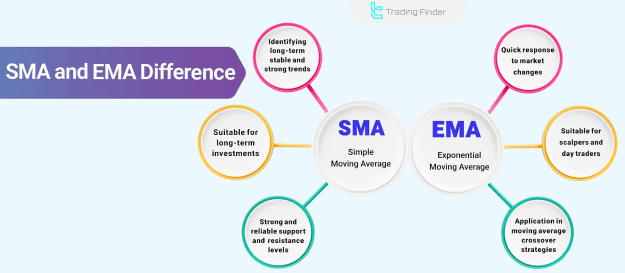


- The Exponential Moving Average (EMA) reacts quickly to short-term fluctuations, making it ideal for short-term strategies and scalping in forex education and trading.
The Simple Moving Average (SMA) responds more slowly to price changes and is commonly used for long-term and mid-term analyses in forex education to identify broader market trends.
TP & SL Tool: Risk Reward Ratio Calculator RRR MT4 | Prop Firm Protector: Trade Assist Prop Firm Plus TF Expert MT4 | Money Management + DrawDown Protector: Trade Panel Prop Firm Drawdawn Limiter Pro MT4 |Get a free Expert Advisor license via Telegram and WhatsApp
Important Considerations When Using Exponential and Simple Moving Averages
Simple Moving Average (SMA)
The Simple Moving Average (SMA) calculates the average price over a defined time period, presenting the market trend in a smooth, linear form.
- Each data point carries equal weight, meaning all candlesticks or closing prices influence the SMA equally.
- This characteristic results in a slower response to rapid market movements, creating a smoother trend line.
Primary Applications of SMA
- Long-term trend analysis
- Identifying overall market structure
SMA Calculation Formula
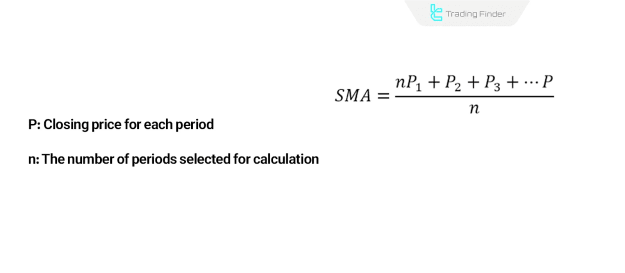
The SMA is calculated by summing the closing prices over a specified number of periods and dividing by the total number of periods.
- Simple Moving Average Calculation: Equal weight is applied to each price data point within the selected period.
Advantages and Disadvantages of SMA
Advantages:
- Effective for long-term investments
- Useful for identifying stable trends
- Easy for beginner traders to understand
- Suitable for identifying strong support and resistance levels
Disadvantages:
- Slow response to sudden market changes
- Ineffective in highly volatile markets
- Incapable of detecting trend strength
- Generates signals with a delay
Exponential Moving Average (EMA)
The Exponential Moving Average (EMA) applies greater weight to recent price data, focusing on the most current market behaviour.
- Unlike the SMA, the EMA emphasises newer data points, making it more sensitive to short-term price changes.
- Due to its fast response to market movements, the EMA is widely used in short-term trading strategies, scalping, and precise entries on lower timeframes.
EMA Calculation Formula
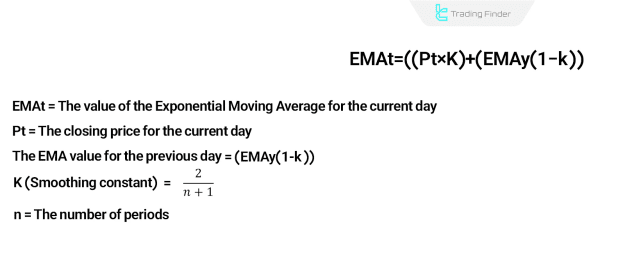
The EMA calculation is more complex compared to the SMA, as it assigns greater weight to the most recent prices.
- Exponential Moving Average Calculation: Heavier emphasis is placed on recent data to reflect current market conditions more accurately.
Advantages and Disadvantages of EMA
Advantages:
- Rapid response to sudden price movements
- Ideal for scalping and day trading
- Effective in moving average crossover strategies
Disadvantages:
- More complex to calculate and use effectively
- Prone to generating false signals in weak trends
- Requires precise calibration for different strategies and indicators
Comparison of SMA and EMA
When comparing SMA and EMA, differences arise in their efficiency, optimal timeframes, calculation methods, and suitable market conditions:
Simple Moving Average (SMA):
- Efficiency: Best for identifying long-term trends
- Timeframes: More effective on higher timeframes
- Calculation Method: Equal weighting of all data points
- Market Type: Suitable for stable, trending markets
Exponential Moving Average (EMA):
- Efficiency: Best for identifying short-term trends
- Timeframes: More effective on lower timeframes
- Calculation Method: Heavier weighting of recent data
- Market Type: Suitable for volatile and fast-moving markets
Optimal Timeframes for SMA and EMA
- SMA is optimal for higher timeframes, such as one-hour, four-hour, and daily charts, due to its smoother and slower reaction.
- EMA is optimal for lower timeframes, such as 30-minute, 15-minute, 5-minute, and 1-minute charts, due to its responsiveness to quick price changes.
Conclusion
In technical analysis:
- Simple Moving Average (SMA) is preferred for long-term trend identification and assessing overall market direction, given its stable and smooth behaviour.
- Exponential Moving Average (EMA) is suited for short-term strategies where fast responses to market fluctuations are critical for effective decision-making.