

TP & SL Tool: Risk Reward Ratio Calculator RRR MT4 | Prop Firm Protector: Trade Assist Prop Firm Plus TF Expert MT4 | Money Management + DrawDown Protector: Trade Panel Prop Firm Drawdawn Limiter Pro MT4 |Get a free Expert Advisor license via Telegram and WhatsApp
Importance of Position Size in Forex
The position size in forex trading determines the potential gain or loss on each trade. It is directly linked to risk management strategies and is calculated using the trader’s chosen Stop Loss, Take Profit, and Risk-to-Reward Ratio.
Calculating Forex Position Size
Accurate calculation of position size requires knowledge of the pip value and lot types in forex trading accounts.
Lot Types and Pip Values
- Standard Lot: Equals 100,000 units; approximately $10 per pip
- Mini Lot: Equals 10,000 units; approximately $1 per pip
- Micro Lot: Equals 1,000 units; approximately $0.10 per pip
- Nano Lot: Equals 100 units; approximately $0.01 per pip
Essential Data for Calculation
To calculate position size, traders need:
- The exact dollar amount they are willing to risk per trade
- The distance in pips between the entry point and the Stop Loss
- The pip value for the selected lot type
Forex Position Size Formula
Using these data points, traders can determine the appropriate volume for their trades. For ease, tools like the TradingFinder Position Size Calculator provide fast and precise calculations.
Methods for Choosing Position Size
Selecting the ideal position size depends on the trading strategy, timeframe, psychological factors, and market conditions.
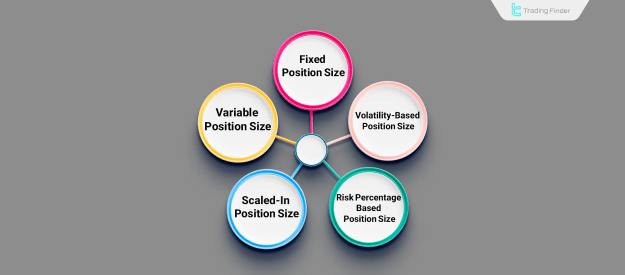
Fixed Position Size
- Uses a constant trade volume irrespective of Stop Loss distance or risk percentage
- Simple and quick to implement
- May increase account risk significantly in trades with wider Stop Losses
Risk Percentage-Based Position Size
- Allocates a fixed percentage of the trading account (commonly 2%) for each trade
- Offers structured risk management
- Requires calculations that can cause missed trade entries if not executed promptly
Variable Position Size
- Adjusts trade volume based on the quality of trade setups and current market conditions
- Provides flexibility and potential for higher returns
- Demands strategic expertise, as errors can increase account-level risk
Scaled-In Position Size
- Suitable for swing trading or position trading strategies with multiple entry and exit points
- Allows partial entries to avoid missing opportunities
- May result in unused volumes, limiting overall profits
Volatility-Based Position Size
- Relies on volatility indicators such as ATR to determine Stop Loss levels
- Adjusts position size to market volatility for better alignment
- Enhances the risk-to-reward ratio but can be risky in short-term strategies due to indicator error rates
Risks of Neglecting Position Sizing
Failure to apply proper position sizing leads to:
- Increased likelihood of margin calls
- High account volatility and unstable growth
- Emotion-driven trading decisions
- Lack of strategy consistency
- Long-term capital depletion
Benefits of Effective Position Sizing
Applying correct position sizing techniques ensures:
- Controlled and managed risk in each trade
- Consistency in implementing trading strategies
- Alignment of trade volume with market volatility
- Improved risk-to-reward ratios
- Reduced emotional interference in decision-making
Conclusion
Position sizing is at the heart of risk management in forex trading. Incorrect position size decisions result in inconsistent returns and greater account volatility. Adopting methods such as volatility-based sizing provides traders with the flexibility to adapt to changing market conditions while maintaining disciplined capital management.