

TP & SL Tool: Risk Reward Ratio Calculator RRR MT5 | Prop Firm Protector: Trade Assist Prop Firm Plus TF Expert MT5 | Money Management + DrawDown Protector: Trade Panel Prop Firm Drawdawn Limiter Pro MT5 |Get a free Expert Advisor license via Telegram and WhatsApp
Critical Aspects of GDP Measurement
- Only final goods and services are counted to prevent double-counting of intermediate products.
- Exclusions: Unreported economic activities (illegal goods), second-hand transactions, unpaid domestic work, and volunteer services are not included.
- Geographical scope: GDP only considers production within national borders, regardless of ownership. For example, a German car manufactured in the U.S. contributes to U.S. GDP, not Germany's.
GDP vs. GNP: Key Distinctions
Gross National Product (GNP)
GNP measures the total economic output of a nation's citizens, whether production occurs domestically or abroad. For instance, if a Japanese company operates a factory in Brazil, its output contributes to Japan's GNP but Brazil's GDP.
Core Differences Between GDP and GNP
- GDP focuses on production within a country’s borders, making it a measure of domestic economic activity.
- GNP tracks income generated by a country’s residents and businesses worldwide, indicating national economic influence.
A nation with significant overseas investments may have a higher GNP than GDP, while a country dependent on foreign enterprises may see the opposite.
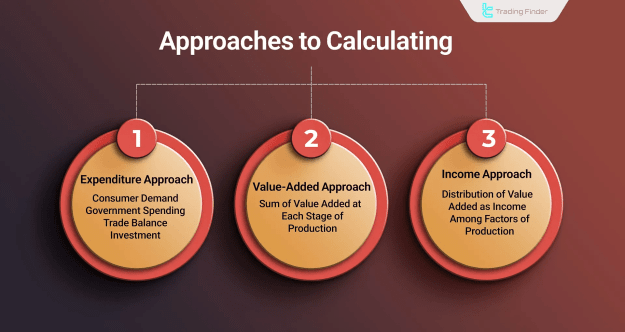
Methods of Calculating GDP
Economists use three primary approaches to compute GDP:
1. Expenditure Approach
This method aggregates total spending in the economy:
- Consumption (C): Household expenditures on goods and services.
- Investment (I): Business spending on capital goods.
- Government Spending (G): Public sector outlays.
- Net Exports (X-M): Exports minus imports.
Formula:
GDP = C + I + G + (X − M)
2. Value-Added Approach
This technique sums the value added at each production stage, ensuring intermediate goods are not double-counted.
3. Income Approach
GDP is derived by totaling all incomes earned from production, including wages, corporate profits, and taxes.
Negative Growth and Recessions
A decline in GDP for two consecutive quarters signals a recession, leading to:
- Increased risk aversion in financial markets.
- Potential monetary policy interventions (e.g., interest rate adjustments).
Why Real GDP Matters
Since nominal GDP includes inflation distortions, Real GDP (inflation-adjusted) provides a clearer picture of economic growth.
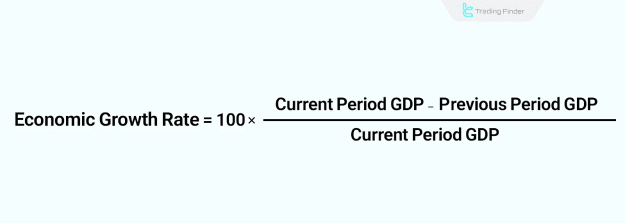
Economic Growth Rate Calculation
Economic Growth Rate = ((GDP in Current Period−GDP in Previous Period) / GDP in Previous Period) × 100
Final Insights
GDP remains the foundation of economic analysis, shaping monetary policy and investment strategies. By distinguishing between nominal and real GDP, analysts can better evaluate true economic progress. Whether examining domestic output or global economic ties, a firm grasp of GDP and GNP is essential for informed financial decision-making.