

TP & SL Tool: Risk Reward Ratio Calculator RRR MT5 | Prop Firm Protector: Trade Assist Prop Firm Plus TF Expert MT5 | Money Management + DrawDown Protector: Trade Panel Prop Firm Drawdawn Limiter Pro MT5 |Get a free Expert Advisor license via Telegram and WhatsApp
Step 1: Selecting the Optimal Timeframe
The choice of timeframe is crucial in ICT trading. Different traders prefer varying intervals based on their trading style:
- Higher timeframes (15M, 1H, 4H) – Suitable for swing traders.
- Lower timeframes (1M, 5M, 15S) – Ideal for scalpers and day traders.
For this model, we focus on the 5-minute and 1-minute charts, as they provide flexibility for short-term trades while maintaining reliability.
Step 2: Identifying Key Kill Zones
Kill zones are high-liquidity periods when institutional activity drives strong price movements. The most significant kill zones include:
- London Open (2:00 AM – 5:00 AM EST)
- New York Open (8:00 AM – 11:00 AM EST)
- London-New York Overlap (8:00 AM – 12:00 PM EST)
Trading during these times increases the likelihood of capturing strong displacements and liquidity sweeps.
Core ICT Concepts for Trade Entries
To build an effective entry model, traders must understand these foundational ICT principles:
1. Displacement
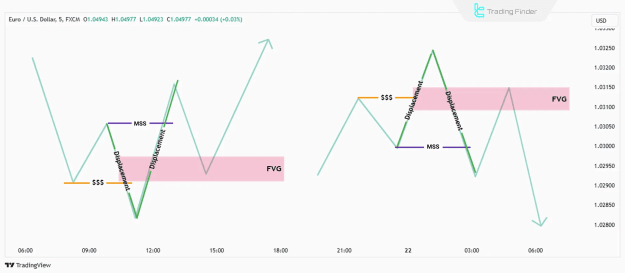
A strong directional move characterized by consecutive large-bodied candles, indicating institutional participation.
2. Fair Value Gap (FVG)
A price imbalance where inefficiency exists, often acting as a retracement zone for entries.
3. Order Blocks (OB)
Areas where large players (banks, institutions) place significant buy/sell orders, leading to potential reversals.
4. Balance Price Range (BPR)
A consolidation zone formed by overlapping FVGs, indicating equilibrium before a breakout.
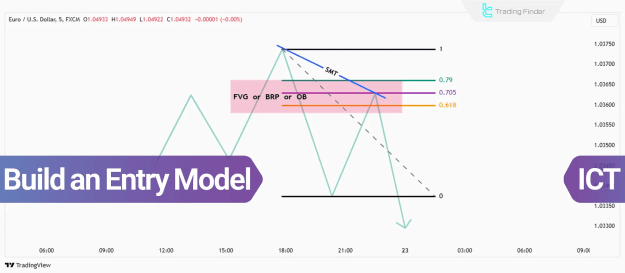
5. Optimal Trade Entry (OTE)
A Fibonacci-based retracement zone (62% - 79%) where price often reverses, aligning with FVGs for high-probability entries.
6. Internal Range Liquidity (IRL)
Liquidity pools within a price range, often targeted before a directional move.
Types of ICT Entry Models
ICT trading allows combining multiple concepts to create customized entry strategies. Below are the most effective models:
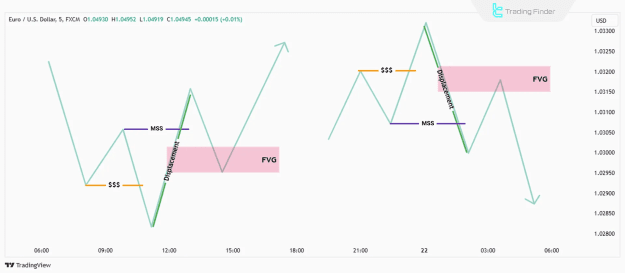
1. FVG-Based Entry Model
- Step 1: Liquidity grab at a key level, followed by a reversal.
- Step 2: Displacement move in the opposite direction (Break of Structure - BOS).
- Step 3: Price retraces to the FVG, offering an entry opportunity.
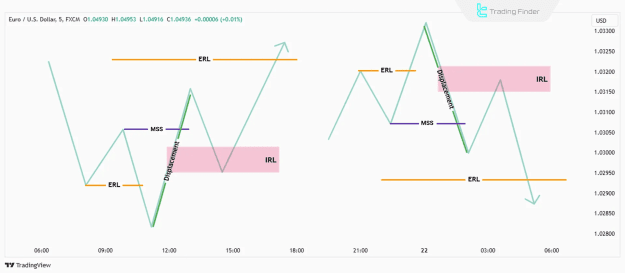
2. IRL-Based Entry Model
- Step 1: Price sweeps Internal Range Liquidity (IRL) before reversing.
- Step 2: Strong displacement move confirms trend continuation.
- Step 3: Price targets External Range Liquidity (ERL).
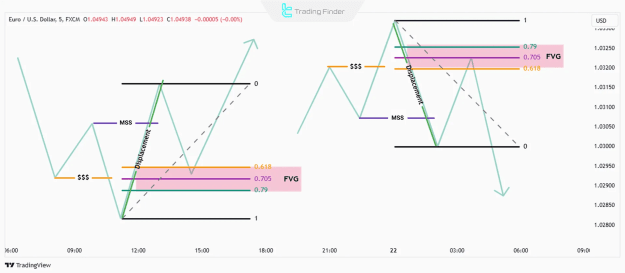
3. FVG Within OTE Setup
- Step 1: Liquidity sweep at a key level.
- Step 2: Displacement creates a BOS.
- Step 3: Price retraces to an FVG within the OTE zone (62%-79% Fib level).
4. Balance Price Range (BPR) Entry Model
- Step 1: Aggressive two-sided moves create overlapping FVGs.
- Step 2: The overlap forms a BPR, acting as an entry zone.
- Step 3: Entry at BPR with stop-loss beyond recent highs/lows.
Key Considerations for a Custom ICT Model
To optimize an ICT entry strategy, traders should:
- Define precise entry criteria (e.g., FVG + OTE + BOS confirmation).
- Maintain a strong risk-to-reward ratio (minimum 1:2).
- Test the model in different market conditions (trending, ranging).
- Combine multiple ICT concepts (e.g., OB + FVG + IRL).
Conclusion
A well-structured ICT trade entry model relies on key concepts like FVG, OB, BPR, and OTE, combined with strategic timeframe selection and kill zone awareness. By integrating these elements, traders can develop a high-probability system for consistent market success.
For best results, backtest the model across various assets and refine it based on real-market performance.