

TP & SL Tool: Risk Reward Ratio Calculator RRR MT4 | Prop Firm Protector: Trade Assist Prop Firm Plus TF Expert MT4 | Money Management + DrawDown Protector: Trade Panel Prop Firm Drawdawn Limiter Pro MT4 |Get a free Expert Advisor license via Telegram and WhatsApp
Typically, higher interest rates strengthen a currency, while lower interest rates weaken it. Additionally, market expectations about future rate changes also play a crucial role in shaping financial trends.
Why Are Interest Rates So Important?
Interest rates are vital because they influence inflation, economic growth, and unemployment rates. These factors, in turn, determine whether a currency appreciates or depreciates.
What Are Interest Rates?
In economic terms, interest rates represent the "cost of money"—the price borrowers pay to access funds. For example, if you borrow $1,000 at a 5% interest rate, you must repay $1,050, where the $50 is the borrowing cost.
To track interest rates across different economies, tools like TradingFinder’s interest rate monitor can be highly useful.
How Interest Rates Affect Economic Trends
Interest rate adjustments impact liquidity, consumer demand, and overall economic growth:
- Higher interest rates reduce inflation and slow economic growth by tightening liquidity.
- Lower interest rates stimulate economic activity but may lead to higher inflation.
Key Economic Indicators and Interest Rates
Inflation:
- Lower rates → Increased liquidity → Higher inflation.
- Higher rates → Reduced liquidity → Lower inflation.
Economic Growth:
- Lower rates → Boost in spending and investment → Faster growth.
- Higher rates → Reduced borrowing and spending → Slower growth.
Unemployment Rate:
- Lower rates → More business expansion → Lower unemployment.
- Higher rates → Reduced business activity → Higher unemployment.
For real-time economic updates, traders can refer to the TradingFinder economic calendar.
Interest Rates and Inflation: The Direct Link
When central banks cut interest rates, borrowing becomes cheaper, increasing liquidity and consumer demand. This surge in demand can lead to higher inflation.
Conversely, raising interest rates tightens liquidity, reducing spending and inflation.
Interest Rates and Economic Growth
Economic growth (GDP) is heavily influenced by demand, which includes:
- Consumer spending
- Government expenditures
- Investments
- Trade balance
Lower interest rates encourage borrowing and spending, fueling economic expansion. Higher rates restrict spending, slowing growth.
Interest Rates and Unemployment
Unemployment moves inversely to economic growth:
- Lower rates → More hiring → Lower unemployment.
- Higher rates → Business cutbacks → Higher unemployment.
Example
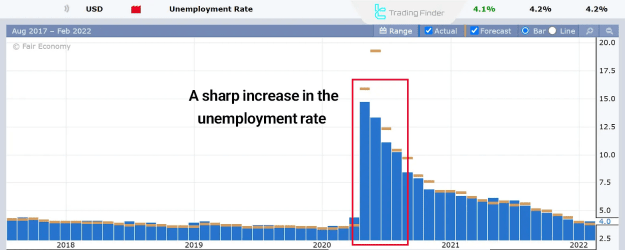
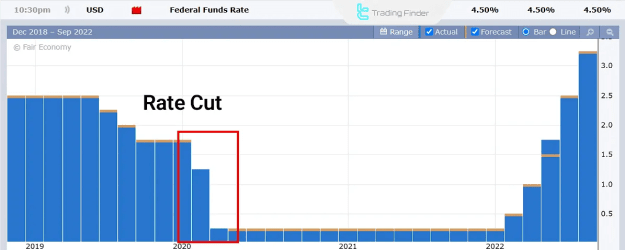
The 2020 US Unemployment Surge
During the COVID-19 pandemic, the US unemployment rate spiked sharply. In response, the Federal Reserve slashed interest rates to stimulate the economy and curb job losses.
What Drives Interest Rate Changes?
Central banks adjust interest rates based on economic data, focusing on:
- Inflation: Rising inflation prompts rate hikes.
- Unemployment: High unemployment leads to rate cuts.
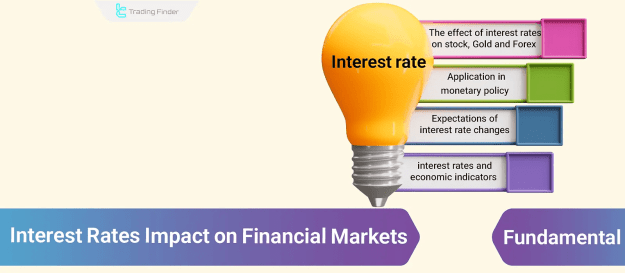
How Interest Rates Impact Financial Markets
1. Forex Market
- Higher rates → Stronger currency (less money supply).
- Lower rates → Weaker currency (more money supply).
2. Stock Market
- Higher rates → Reduced borrowing → Lower corporate profits → Bearish stocks.
- Lower rates → Easier credit → Higher earnings → Bullish stocks.
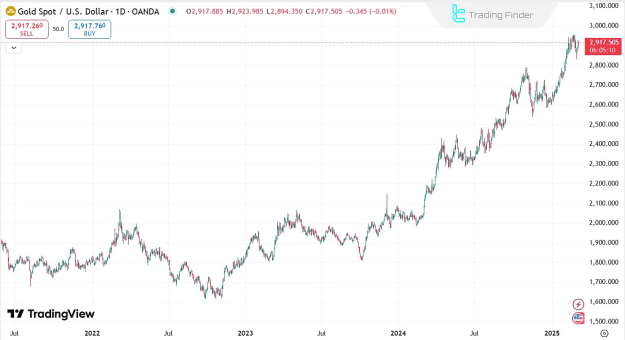
3. Gold Market
Gold often moves inversely to interest rates:
- Higher rates → Gold prices may decline (investors prefer yield-bearing assets).
- Lower rates → Gold prices may rise (safe-haven appeal strengthens).
However, other factors like geopolitical risks can override this trend, as seen in 2023-2024 when gold surged despite rate hikes.
Market Expectations and Interest Rates
Forex traders closely monitor rate hike/cut expectations:
- Expecting a rate hike → Currency strengthens.
- Expecting a rate cut → Currency weakens.
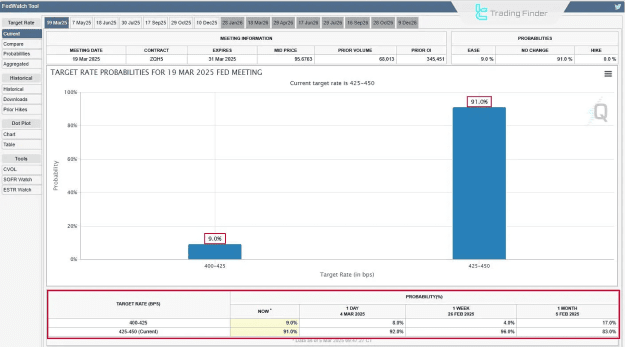
The CME FedWatch Tool helps gauge market expectations for Federal Reserve rate changes.
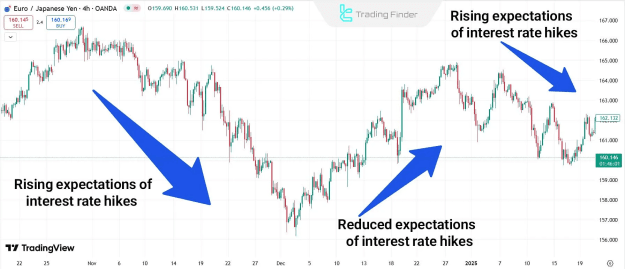
Example: BOJ Rate Expectations and the Yen
When traders anticipated a Bank of Japan (BOJ) rate hike, the Japanese yen strengthened. Conversely, when expectations faded, the yen weakened.
Conclusion
- Higher interest rates tighten liquidity, curb inflation, and strengthen currencies but may slow economic growth.
- Lower interest rates boost spending, stimulate growth, and weaken currencies but risk higher inflation.
Understanding these dynamics helps traders and investors navigate financial markets more effectively. For the latest interest rate insights, tools like TradingFinder’s economic calendar and rate tracker are invaluable.