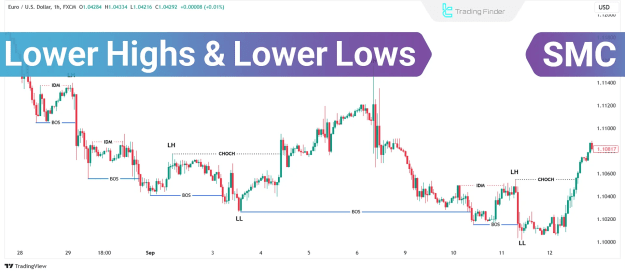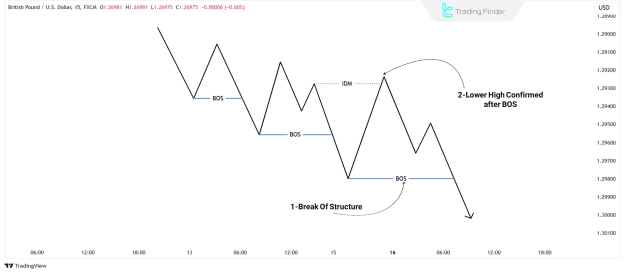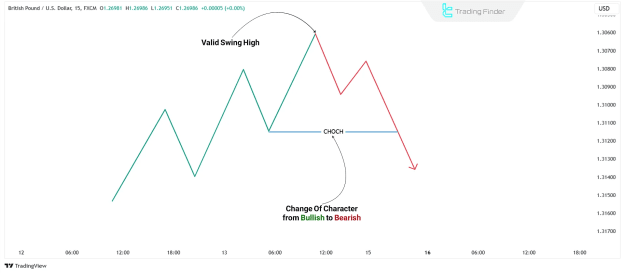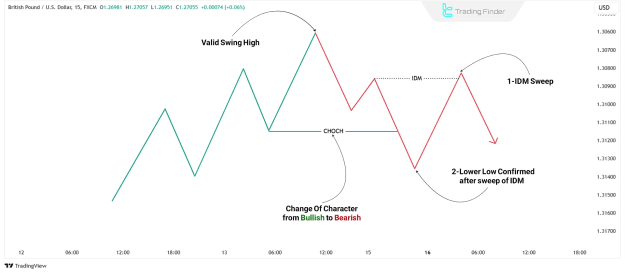


Mastering these structural patterns is critical for identifying optimal sell trade entry points and enhancing risk management strategies. An accurate assessment—especially within advanced Forex education—requires a solid understanding of Smart Money concepts such as Break of Structure (BOS), Change of Character (CHOCH), and Inducement (IDM).
What Are Lower Highs and Lower Lows?
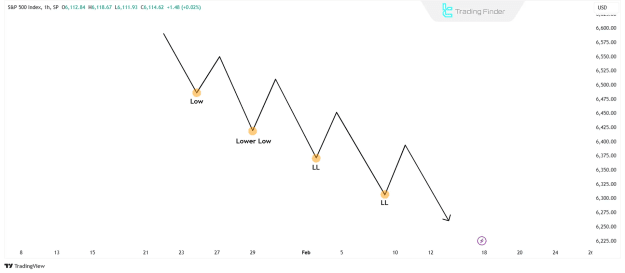
Lower Low (LL)
A Lower Low occurs when a new low is formed below the previous low. This reflects intensified selling activity and suggests a continuation of the downward momentum.
- Indicates weakness in demand
- Confirms seller strength
- Supports bearish continuation
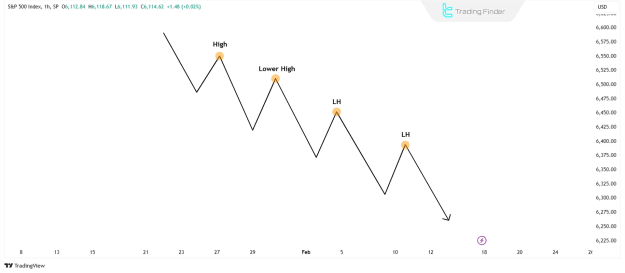
Lower High (LH)
A Lower High is established when the market makes a new high that is lower than the preceding high. This demonstrates a failed bullish attempt and validates the prevailing bearish trend.
- Suggests failed bullish retracement
- Strengthens bearish market structure
- Highlights ideal zones for short entries
These two structural elements construct a bearish price formation, emphasizing a clear imbalance in favor of sellers.
Identifying Lower Lows in a Bearish Trend
In a bearish trend, not every low represents a valid structural Lower Low. To determine a valid LL, follow a systematic approach:
Step-by-Step Process:
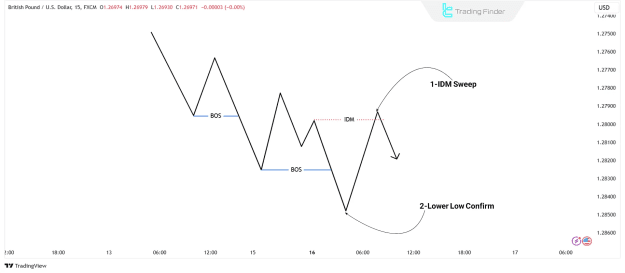
- Inducement (IDM) Identification: Recognize liquidity zones typically located above recent swing highs.
- Swing Low Formation: Following a Break of Structure (BOS), price often retraces, forming a temporary low.
- Lower Low Confirmation: When price revisits and sweeps liquidity during a pullback, that swing low is confirmed as a valid structural LL.
Tip: A valid LL is confirmed only after a downward BOS that is accompanied by liquidity inducement.
Identifying Lower Highs in a Bearish Trend
Like LLs, not every high is a structural Lower High. A precise methodology is needed for validation:
Steps to Confirm a Lower High:
- Retracement After BOS: After a downward BOS, price typically pulls back, forming a temporary high.
- Liquidity Zone Analysis: Identify liquidity sweeps just above recent highs.
- Confirmation of LH: If the retracement fails to break previous highs and the market resumes downward movement, breaking the last structural low, the temporary high is confirmed as a valid LH.
Note: Lower Highs are optimal for initiating sell positions due to their favorable risk-to-reward potential.
Identifying Structural Highs After a Bearish CHOCH
When the market shifts from a bullish to a bearish trend, a Change of Character (CHOCH) occurs. To identify the structural high in this transition:
- Mark the last Higher High before the CHOCH.
- This high becomes the starting point of the new bearish structure.
- Subsequent LLs and LHs should be evaluated from this point forward.
Identifying Structural Lows After a Bearish CHOCH
In a bearish CHOCH scenario, recognizing the first valid structural Lower Low is crucial:
- Identify an Inducement Zone and wait for a Swing Low to form.
- When price sweeps liquidity and breaks below the low, confirm it as the structural LL.
- Follow each BOS and liquidity sweep to validate further declines.
Key Considerations for Using Lower Highs and Lower Lows
- Liquidity is Crucial: Liquidity sweeps are among the strongest confirmation tools in bearish structures.
- Risk Management: Always place stop-loss orders slightly above the confirmed Lower High.
- Time Frame Matters: Use mid- to long-term time frames for greater accuracy in identifying structural changes.
Conclusion
Understanding and identifying Lower Highs (LH) and Lower Lows (LL) are fundamental for traders operating within a bearish environment. These patterns indicate a weakening market structure and ongoing selling pressure.
By integrating concepts such as Break of Structure (BOS), Change of Character (CHOCH), and Inducement (IDM) into your technical analysis, you enhance your ability to distinguish valid structural formations, manage risks effectively, and execute high-probability trades with confidence.