

What Is Intraday Bias?
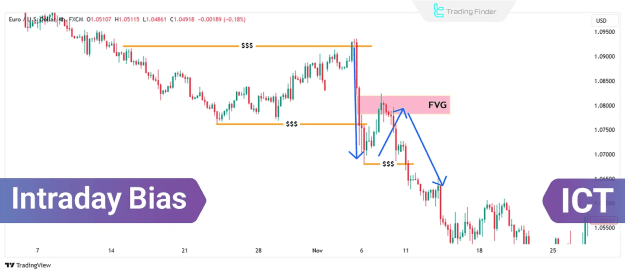
Intraday Bias refers to the directional tendency of price action within shorter timeframes. It helps traders anticipate whether the market will continue its current trend or reverse by examining:
- Market Structure Shifts
- Liquidity Zones
- Fair Value Gaps (FVGs)
By mastering these elements, traders can align their strategies with institutional order flow and improve their trading accuracy.
How to Apply Intraday Bias in Trading
To effectively implement Intraday Bias, follow this structured approach:
1. Identifying Key Liquidity Zones
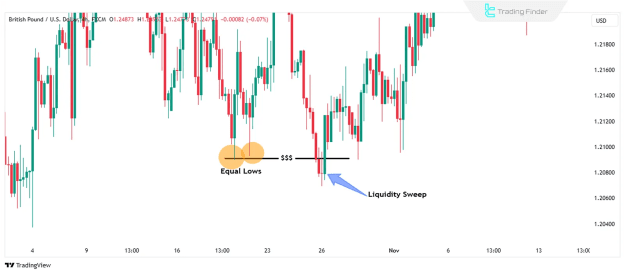
Liquidity zones represent areas where large market participants (smart money) place their orders. These zones are found near:
- Previous highs and lows
- Equal highs/lows
- Major support and resistance levels
Why It Matters:
Price often revisits liquidity zones to trigger stop losses or execute large orders before continuing in the intended direction.
2. Spotting Displacement Moves
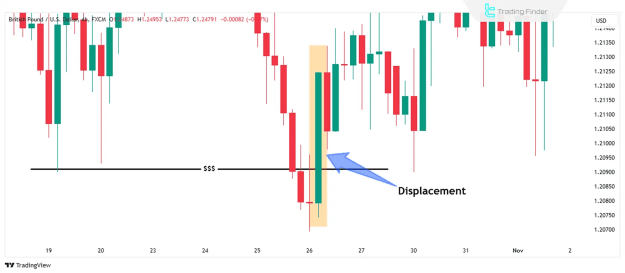
Displacement occurs when price makes a strong, impulsive move characterized by large candles. This indicates:
- A shift in market structure
- Liquidity being absorbed by institutional traders
- A potential start of a new trend
Key Insight:
Displacement confirms that smart money is active, increasing the likelihood of a sustained move.
3. Locating Fair Value Gaps (FVGs)
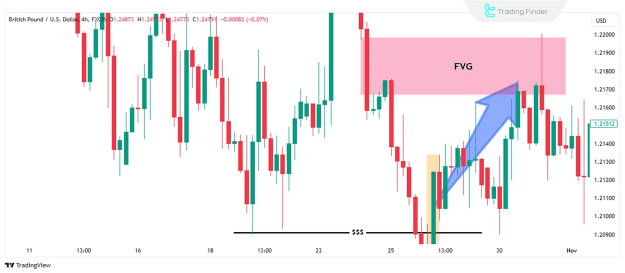
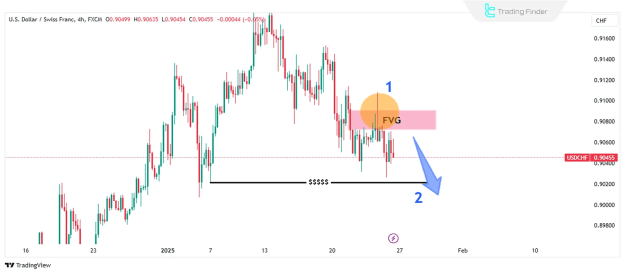
FVGs are price imbalances where buying or selling pressure creates a void. These gaps act as magnets, pulling price back to fill the inefficiency.
How to Trade FVGs:
- If price enters an FVG, expect a move toward the nearest liquidity zone.
- If liquidity is swept, price will likely seek the next FVG.
4. Analyzing Recent Price Action
The latest price behavior in the 1-hour and 4-hour charts reveals the market’s next likely move:
- If price enters an FVG: The next target is a liquidity sweep.
- If liquidity is taken: Price will likely move toward an FVG.
This step ensures traders align with the dominant intraday trend.
5. Transitioning to Lower Timeframes
Once the intraday bias is established, refine entries using the 5-minute or 1-minute charts:
- Entry & Stop Loss (SL): Set based on lower timeframe structure.
- Take Profit (TP): Align with higher timeframe liquidity zones or FVGs.
This multi-timeframe approach enhances trade precision.
Critical Tips for Successful Intraday Bias Trading
- Always confirm liquidity zones before taking trades.
- Trade in the direction of the higher timeframe trend for higher probability setups.
- Prioritize FVGs within displacement moves—they hold stronger significance.
- Avoid counter-trend trades unless clear reversal signals appear.
Final Thoughts
Intraday Bias is a robust framework for traders who rely on price action and institutional order flow. By mastering liquidity zones, displacement, and FVGs, traders can anticipate market movements with greater confidence.
Whether you're a scalper or swing trader, integrating Intraday Bias into your strategy can significantly improve your trading performance.
Key Takeaway: Always align your trades with the dominant intraday trend while respecting higher timeframe structures.