

By recording each trade and the reasoning behind it, traders can identify successful patterns, correct recurring mistakes, and make better data-driven decisions—especially in fast-moving and volatile markets.
Prop Firm DrawDown Protector : Prop Firm Capital Protection Expert MT5 | Forex Money Management: Forex Trade Management Expert MT4 | ICT Concepts Indicator MT5 |Smart Money Concepts Expert MT5 |Get a free Expert Advisor license via Telegram and WhatsApp
What Is a Stock Market Journal?
A stock market journal is a personalized record containing all details related to your trades and decision-making process. It usually includes:
- Time and size of each position
- Reason for entering or exiting
- Indicators and analysis used
- Market environment during the trade
- Emotional and psychological state
The main purpose is to build a personal database that can be analyzed over time to optimize performance and support better long-term results.
Why Trading Journals Are Used in Global Stock Markets
In global markets—where volatility is influenced by earnings reports, economic releases, central bank decisions, and geopolitical events—trading journals help traders:
- Maintain discipline
- Track strategy effectiveness
- Analyze emotional reactions
- Review performance across periods
Modern traders often use tools like TraderSync or Edgewonk, which automatically import data and generate detailed performance statistics.
Why a Stock Market Journal Is Important
A trading journal acts as a feedback loop that shows the logic behind each trade and the results that follow.
1. Reviewing Past Performance and Spotting Mistakes
Consistent recording helps traders evaluate strategies, identify weak points in timing or analysis, and notice behavioral patterns such as FOMO or premature exits.
2. Improving Discipline and Reducing Emotional Trading
Writing down your plan forces you to make decisions based on rules—not impulses—especially during market volatility.
3. Enhancing Risk Management
A journal reveals patterns of loss, helps fine-tune the risk-to-reward ratio, and highlights how external events impact outcomes.
4. Building a Personal Data Archive
Over time, the journal becomes a “performance memory” that exposes hidden tendencies and supports smarter long-term trading decisions.
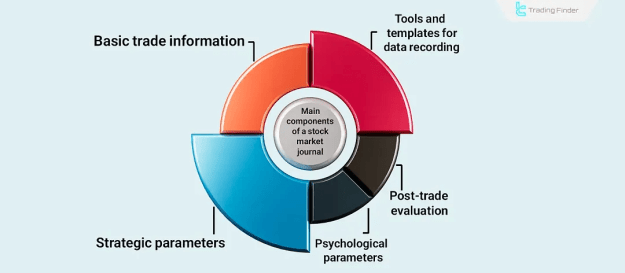
Core Components of a Stock Market Journal
To remain useful, a journal must follow a clear structure.
1. Basic Trade Information
- Date and time
- Symbol
- Buy or sell
- Entry and exit prices
- Trade size
- Profit or loss
These essentials help calculate performance metrics like win rate and average return.
2. Strategic Details
- Strategy type (technical, fundamental, algorithmic)
- Target (TP) and stop loss (SL)
- Timeframe
- Market environment (trend, volume, news)
This records the logic behind each decision.
3. Psychological Indicators
- Emotional state
- Confidence level
- Reactions to price changes
- Adherence to rules
This section helps identify emotional triggers and reduce irrational behavior.
4. Post-Trade Evaluation
- Did you follow the plan?
- What caused the trade to succeed or fail?
- What mistakes should be avoided next time?
- What did you learn?
This turns each trade into a learning experience.
5. Tools for Keeping a Journal
- Notebook
- Excel/Google Sheets
- Professional journaling software
Regardless of the format, consistency is the key.
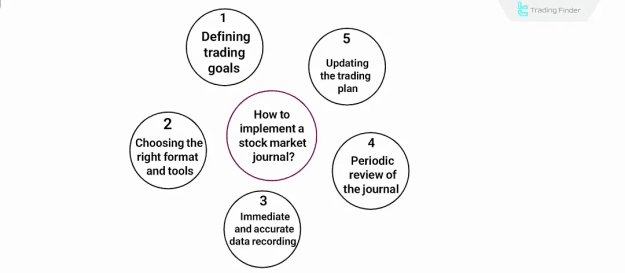
How to Apply a Stock Market Journal in Practice
Step 1: Define Your Trading Goals
Examples: improving risk-to-reward ratios, tracking strategy performance, reducing overtrading.
Step 2: Choose the Right Format
Beginners may start with notebooks or Excel, while advanced traders often use dedicated software.
Step 3: Record Data Immediately
Delays result in inaccurate information and weaker analysis.
Step 4: Review Performance Periodically
Weekly or monthly reviews help track progress and spot recurring issues.
Step 5: Update Your Trading Plan
Insights from your journal should directly shape your future strategies and rules.
Example of a Stock Market Journal in Action
A trader buys a stock at a breakout level of 4,500, sets a stop loss at 4,300, and a target at 5,000.
The target is reached in three days, achieving an 11% gain.
Three months later, after reviewing 25 recorded trades:
- 16 were profitable → 64% win rate
- The most common mistake: entering too early before confirmation
This insight helps improve timing and strategy discipline.
Conclusion
A stock market journal is a powerful analytical tool that helps traders make more consistent, data-driven decisions. By combining trade data, strategic notes, psychological observations, and regular performance reviews, traders can reduce errors, strengthen discipline, and steadily improve their trading performance.
Over time, the journal becomes a roadmap for growth—turning everyday trading activity into valuable long-term knowledge.