

Prop Firm DrawDown Protector : Prop Firm Capital Protection Expert MT4 | Forex Money Management: Forex Trade Management Expert MT4 |ICT Concepts Indicator MT4 | Smart Money Concepts Expert MT4| Smart Money Trap Scanner | Get a free Expert Advisor license via Telegram and WhatsApp
What is a Cryptocurrency Trading Journal?
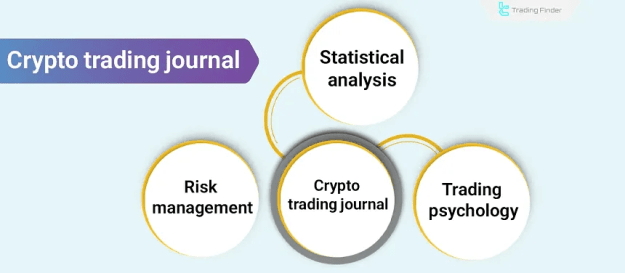
A cryptocurrency trading journal is a specialized tool that meticulously documents the specifics of each transaction, including the entry and exit prices, execution time, profit or loss metrics, and the underlying rationale for the trade decision.
The core purpose of this systematic recording is to enable the trader to:
- Analyze performance rigorously.
- Identify recurring behavioral patterns and past mistakes.
- Create discipline and control emotions.
- Purposefully optimize their overall trading strategies.
The journal is far more than a simple logbook; it is a strategic and analytical instrument essential for professional capital management and continuous performance improvement. By accurately recording data—such as market conditions, position size, strategy type, governing emotions, and final outcomes—a trader gains objective insights into their performance, facilitating the data-driven identification of system strengths and weaknesses. This continuous feedback and optimization cycle transforms an emotional trader into a professional, data-driven decision-maker.
Importance of Journaling in Crypto Trading
The role of journaling is vital, particularly in the volatile cryptocurrency market, as it reinforces mental organization, self-awareness, and accurate performance analysis.
- Strategy Improvement: Journaling allows traders to track decisions and later review the factors that led to success or failure, forming the foundation for strategy refinement.
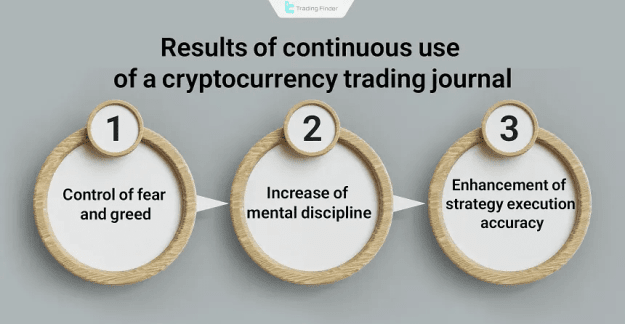
- Emotional Control: It serves as a framework for managing psychological factors like fear and greed, helping the trader maintain a long-term perspective.
- Data-Driven Learning: The journal acts as a bridge between raw experience and actionable data, converting every mistake into a lesson and every profitable trade into a repeatable pattern.
Regular analysis of journal data is crucial for strategy enhancement, allowing traders to identify recurring patterns, periods of peak returns, and less effective strategies. This data-driven approach is key to redesigning and improving the individual components of the trading system.
Journaling and its Impact on Emotional Control in Trading
Beyond statistics, the crypto trading journal is an analytical tool for scrutinizing the emotional layers influencing decision-making.
- By recording mental and emotional states before, during, and after a trade (e.g., fear of loss, excessive greed), a trader can identify damaging behavioral patterns.
- Reviewing this emotional data enhances self-awareness, effectively preventing impulsive and irrational decisions during high-pressure trading scenarios.
Data Recorded in a Crypto Trader’s Journal
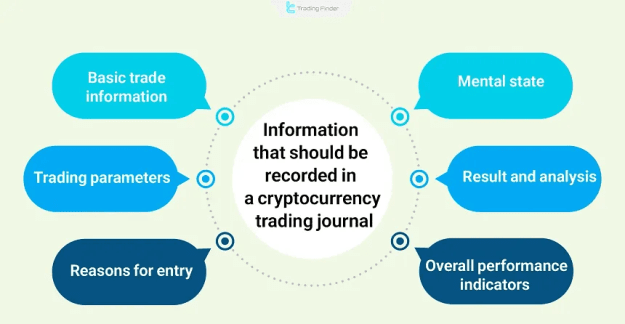
A comprehensive cryptocurrency trading journal records diverse data types to ensure accurate, measurable, and analytical evaluation of performance.
- Basic Trade Information:
- Date and time of entry/exit, trading pair, position type (Long/Short).
- Position size, entry/exit price, commission, and profit/loss metrics.
- Trading Parameters:
- Stop Loss and Take Profit levels, Risk-to-Reward Ratio (R/R).
- Order type (Market, Limit, Stop), and analysis timeframe.
- Reasons for Entry:
- Documentation of the rationale, based on technical analysis, fundamental analysis, or market sentiment.
- Mental State:
- Emotions recorded before, during, and after the trade (e.g., confidence, fear, regret) and reflective mental notes.
- Result and Analysis:
- Percentage profit/loss, qualitative decision quality assessment, adherence to risk controls.
- Overall Performance Indicators:
- Success Rate (Win Rate), Average Profit/Loss, Maximum Drawdown, Sharpe Ratio, and total portfolio return.
Format of Journaling in Crypto Trading
Journaling is typically executed in a structured table or form to ensure systematic, precise, and analyzable recording of each trade. This format can be implemented via tools such as Excel, Google Sheets, Notion, or specialized trading journal software.
- Date and Time: Time of entry and exit from the position
- Symbol/Pair: E.g., BTC/USDT, ETH/USDT
- Position Type: Long (buy) or Short (sell)
- Trade Volume: Amount of cryptocurrency or capital percentage
- Entry/Exit Price: Exact open and close prices
- Stop Loss/Take Profit: Defined risk control levels
- Risk-to-Reward Ratio: Risk level relative to potential profit
- Reasons for Entry: Technical/fundamental analysis or market sentiment
- Mental State: Emotions before, during, and after the trade
- Final Trade Result: Profit or loss (numerical and percentage)
- Post-Trade Analysis: Review of decisions, mistakes, or learning points
Professional Tips for Designing the Format:
- Design columns to facilitate filtering and statistical analysis (e.g., using functions in Excel).
- Use color coding (green for profit, red for loss) for immediate visual assessment.
- Integrate sections for performance charts in advanced tools (Notion/Sheets) to track monthly progress.
Essential Parameters in Trading Journal Writing
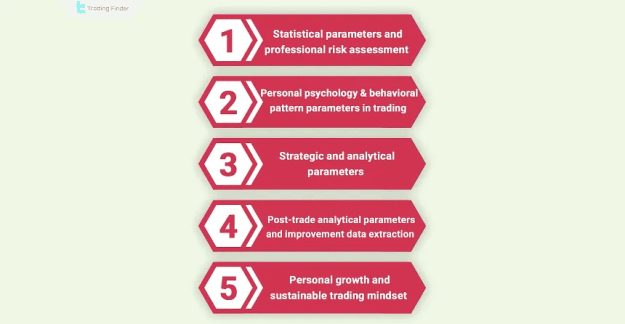
Professional journaling focuses on creating an analytical framework centered around five core parameter categories:
- Statistical and Professional Risk Assessment Parameters: Measures accuracy, stability, and risk management efficiency. Includes metrics like Expected Value (EV), Position Size %, and Maximum Drawdown (MDD).
- Psychological Monitoring and Behavioral Pattern Parameters: Analyzes the influence of emotions and cognitive biases. Tracks factors like Emotional Trigger, Confidence Level, and Discipline Score.
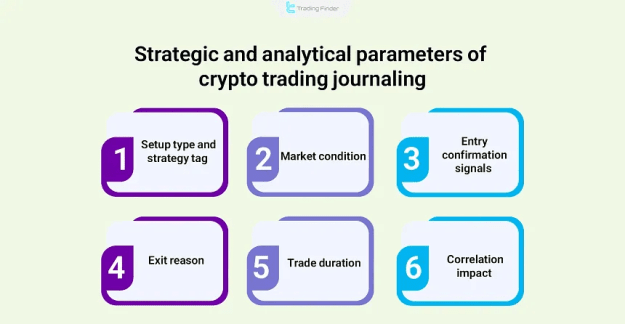
- Strategic and Analytical Parameters: Focuses on decision quality relative to market structure. Records Setup Type/Strategy Tag, Market Condition, Entry Confirmation Signals, and Exit Reason.
- Post-Trade Analytical Parameters and Improvement Data Extraction: Evaluates results to identify system strengths/weaknesses. Key metrics include Profit Factor (PF) and Setup Win Rate.
- Personal Growth and Sustainable Trading Mindset Management Parameters: Tracks skill development and adherence to the plan. Includes Plan Deviation, Learning Notes, and Improvement Goal.
Platforms for Trading Journal Writing for Cryptocurrency Trading
Modern specialized platforms significantly automate and enhance the journaling process:
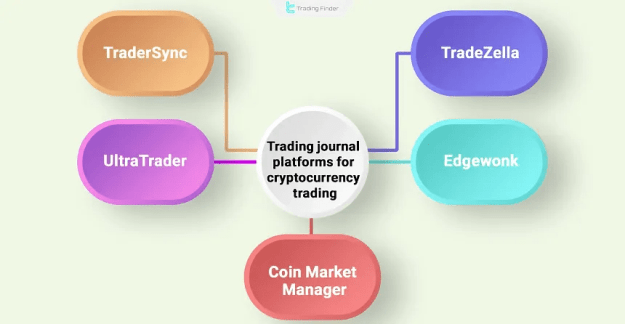
- Top Platforms: Tools like TraderSync, TradeZella, UltraTrader, Edgewonk, and Coin Market Manager offer automated trade logging, statistical analysis, and behavioral pattern evaluation.
- Advanced Features: Many platforms offer direct API connectivity to crypto exchanges for automatic logging, and some utilize Artificial Intelligence (AI) to detect behavioral errors and generate sophisticated performance reports.
Steps to Build a Cryptocurrency Trading Journal
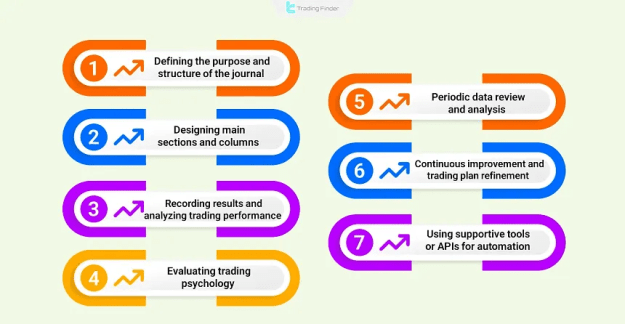
Regardless of the platform, the construction and use of a journal follows a structured process:
- Define Purpose and Structure: Establish clear goals for the journal.
- Design Main Sections: Create the necessary columns and fields (Date, Pair, R/R, etc.).
- Record and Analyze Results: Log every trade detail consistently.
- Evaluate Trading Psychology: Record and analyze emotional state during the trade.
- Review Data Periodically: Conduct weekly or monthly performance assessments.
- Continuous Improvement: Use analysis to refine and correct the trading plan.
- Use Supportive Tools: Employ automation tools or APIs (e.g., MetaTrader Expert Advisors) to ensure data accuracy and efficiency.
Conclusion
The cryptocurrency trading journal is an indispensable, specialized tool in the journey toward professional crypto trading. By demanding the precise, systematic recording of both quantitative and qualitative trade data, it creates a structured system for performance analysis and emotional management.
The journal transforms emotional, ad-hoc decision-making into a data-driven, measurable process, providing a consistent framework for evaluating trading results. Through the continuous review of trading history, traders gain profound insights into their behavior, decision patterns, and actual profitability. Ultimately, the trading journal cultivates mental discipline, directing a trader’s professional growth in the crypto market and turning sustainable profitability into a measurable, achievable goal.