



Prop Firm DrawDown Protector : Prop Firm Capital Protection Expert MT4 | Forex Money Management: Forex Trade Management Expert MT4 |ICT Concepts Indicator MT4 | Smart Money Concepts Expert MT4| Smart Money Trap Scanner | Get a free Expert Advisor license via Telegram and WhatsApp
What is a Forex Trading Journal?
A forex trading journal is an analytical instrument designed to document every detail of a trader's activity in the international currency market. Beyond simply logging entry and exit points, this journal encompasses vital information such as:
- The reasoning behind each trade
- Prevailing technical or fundamental conditions
- Trade volume and applied risk management parameters
- The trader's psychological state at the moment of execution
The core objective of maintaining such a journal is to inject transparency into the trading process and to generate a reliable dataset for conducting an honest and thorough trade performance analysis.
Advantages and Disadvantages of a Forex Journal
Research among active forex traders indicates that those who consistently utilize a trading journal can reduce repetitive mistakes by over 30% within a three-to-six-month period. However, this tool is not without its limitations.
Advantages:
- Enhanced Discipline & Consistency: Reinforces structured trading habits.
- Strategy Optimization: Clearly identifies the strengths and weaknesses of applied strategies.
- Psychology Management: Helps in controlling emotions and mitigating impulsive decisions.
- Long-Term Performance Improvement: Provides a data-driven foundation for refining decision-making.
Disadvantages:
- Time-Intensive: Requires dedicated time and attention to record details accurately.
- Risk of Inconsistency: Potential for irregular or incomplete data entry.
- Analysis Corruption: Can lead to misleading conclusions if data is recorded incorrectly.
- Perceived Restriction: May feel constraining to traders who prefer a less structured approach.
Essential Information to Record in a Forex Journal
A forex journal is only effective when key data points are recorded regularly and with precision. This information forms the bedrock for analyzing personal performance and making strategic adjustments.
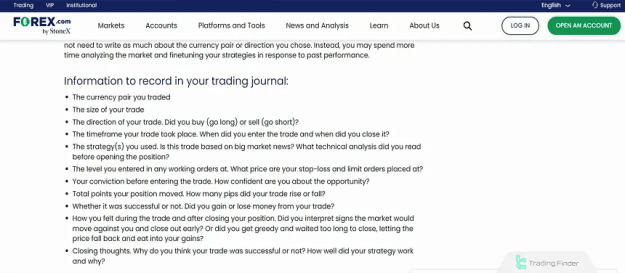
Crucial data points include:
- Date & Time: Identifies high-probability time frames and allows for review of specific market conditions.
- Traded Instrument (Currency Pair/Asset): Determines which assets perform best with your personal strategy.
- Trade Volume & Risk Level: Evaluates the effectiveness of capital management and position sizing relative to account size.
- Reason for Entry: Documents the technical, fundamental, or analytical rationale, helping to distinguish logical decisions from emotional ones.
- Trade Result (P&L): Recording both numerical and percentage-based profit/loss enables precise statistical evaluation of the strategy's expectancy.
- Emotions & Thoughts: Documenting psychological state is vital for managing trading psychology, as most errors stem from emotional pressures like excitement or fear.
Formats and Tools for Maintaining a Forex Journal
The efficacy of recording and analyzing trades is heavily dependent on selecting the appropriate format and tools, which should align with your trading style, volume, and analytical depth.
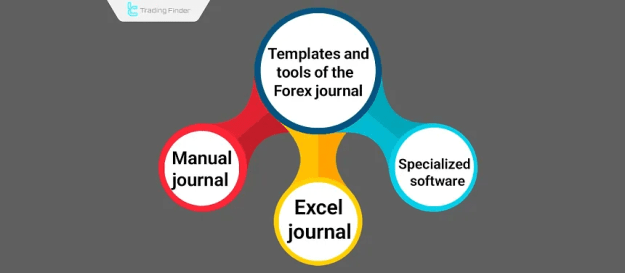
Forex Journal Templates and Tools:
1. Manual Journal (Notebook or Diary)
A traditional, detail-oriented method. The act of writing manually can enhance mental focus and reinforce discipline. The main drawbacks are the significant time required for data analysis and a higher potential for manual calculation errors.
2. Spreadsheet Journal (Excel or Google Sheets)
The most prevalent digital format among professional traders. By creating columns for date, symbol, volume, entry/exit, risk-to-reward ratio, and result, you build a precise and analyzable structure. Its key advantage is flexibility, allowing for the automatic calculation of critical statistical indicators like Win Rate and Expectancy.
3. Specialized Trading Journal Software
Platforms such as TraderSync, Edgewonk, and Myfxbook offer powerful solutions for performance recording, analysis, and visualization. These tools can often import trade data directly from your broker via API, automatically calculate complex metrics, and generate detailed reports on performance and behavioral patterns. Their primary benefit is automation; the limitation is typically a subscription cost or the need for a supported broker connection.
Strategies for Journal Optimization and Continuous Growth
A forex journal should transcend mere record-keeping to become an active feedback system for personal development. The goal of optimization is to transform raw data into actionable insights for superior decision-making and consistent profitability.
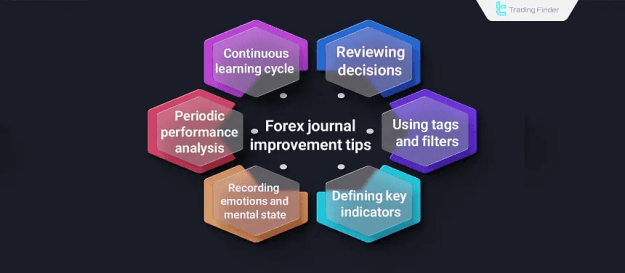
Key Improvement Strategies:
- Conduct Periodic Performance Reviews: Analyze your results weekly. Examine your Win Rate, Average Risk-to-Reward ratio, and account growth to detect behavioral patterns early.
- Document Pre-Trade Emotions: Consistently note your stress level, confidence, and mental state before entering a trade. Reviewing this data reveals the psychological conditions most linked to errors.
- Define Personal Key Performance Indicators (KPIs): Move beyond basic metrics. Track indicators like "Percentage of Trades Following Plan" or "Ratio of Disciplined to Total Trades" for a more accurate assessment of progress.
- Utilize Tags and Analytical Filters: Tag trades by strategy, timeframe, or market condition (e.g., "trending," "ranging"). Filtering data this way can uncover hidden patterns and show which conditions best suit your style.
- Isolate and Review Non-Systematic Trades: Scrutinize all trades executed outside your predefined strategy separately. This analysis is crucial for understanding and ultimately reducing emotional, impulsive behavior.
- Establish a Continuous Feedback Loop: Use journal insights to enact clear changes—adjust stop-loss rules, modify timeframes, or avoid certain setups. This cycle of analysis, action, and review is the foundation of substantive trading growth.
Conclusion
A forex trading journal is far more than a logbook; it is an analytical engine for engineering better trading behavior and refining decision-making. Traders who diligently document their activity gradually cultivate profound insight into their strategic flaws, psychological pitfalls, and decision-making architecture.
An effective journal yields transformative results only when treated as an integrated learning system. Through regular review of analyzed data, tracking of measurable KPIs, and the deliberate linking of outcomes to emotional states, trading evolves from a series of random actions into a systematic, controlled, and continuously improving process.
 What is a Forex Journal_ Recording Trading Information.pdf
2.2 MB
|
21 downloads
|
Uploaded Dec 5, 2025 5:53am
What is a Forex Journal_ Recording Trading Information.pdf
2.2 MB
|
21 downloads
|
Uploaded Dec 5, 2025 5:53am