

The methodology focuses on optimizing the risk-to-reward ratio and maximizing capital growth through the powerful effect of compounding.
When applied within high win-rate trading systems, the impact of this strategy can be exponential. However, without strict risk management, consecutive losses can quickly accumulate, potentially leading to severe account drawdowns.
Prop Firm DrawDown Protector : Prop Firm Capital Protection Expert MT5 |Forex Money Management: Forex Trade Management Expert MT5 | ICT Concepts Indicator MT5 |Smart Money Concepts Expert MT5 | Smart Money Trap Scanner | Get a free Expert Advisor license via Telegram and WhatsApp
What is the Compounding Strategy in Binary Options?
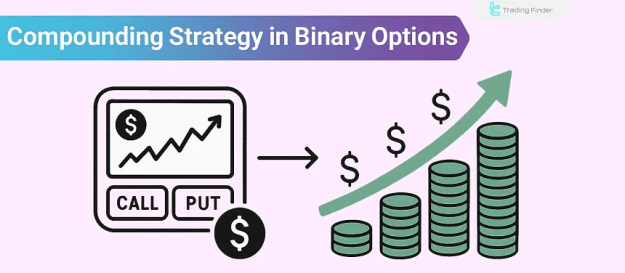
The Compounding Strategy in Binary Options is defined as a trading approach where a trader reinvests the profit generated after each successful trade.
This method leverages the concept of compound interest, facilitating exponential account expansion without requiring additional deposits of new external capital.
Key prerequisites for the successful application of this method include maintaining a consistent winning streak and demonstrating rigorous discipline in executing the predefined trading plan.
For detailed guidance and implementation steps for this strategy in binary options, traders can refer to the comprehensive tutorial article on the Compounding Strategy in Binary Options available on cyberfutures.com.
Advantages and Disadvantages of the Compounding Strategy in Binary Options
Under stable market conditions and with unwavering trading discipline, the use of a Compounding Strategy in binary options can yield substantial returns. Conversely, failure to adhere to the plan or entry into highly volatile markets can quickly reveal its negative consequences.
Here is a summary of the strategic advantages and disadvantages:
- Capital Growth:
- Advantage: Enables exponential capital growth.
- Disadvantage: Leads to exponential and rapid losses.
- Capital Management:
- Advantage: Provides a defined framework based on percentage risk allocation.
- Disadvantage: Shows high sensitivity to non-compliance with the trading plan.
- Profit Efficiency:
- Advantage: Generates additional returns via profit reinvestment.
- Disadvantage: Accumulated profits are exposed to the risk of subsequent trades.
- Flexibility:
- Advantage: Can be executed using conservative or aggressive models.
- Disadvantage: High complexity can arise in hybrid modeling.
- Trader Psychology:
- Advantage: Boosts confidence during periods of consecutive wins.
- Disadvantage: Imposes significant psychological pressure during periods of large, increasing losses.
- Market Fit:
- Advantage: Highly effective in established trending markets.
- Disadvantage: Inherently risky in highly volatile, non-trending markets.
- Risk Management:
- Advantage: Preserves the initial principal capital in the Net-Profit Compounding model.
- Disadvantage: Poses a risk of losing principal capital in more aggressive models.
- Long-Term Potential:
- Advantage: Offers higher overall returns over an extended time horizon.
- Disadvantage: Requires significant trading experience and strict behavioral discipline.
- Execution Complexity:
- Advantage: Simplicity in the fixed-percentage (Simple Compounding) model.
- Disadvantage: Prone to error in complex hybrid models.
Psychology and the Role of Mindset in the Compounding Strategy
Managing emotions and maintaining the correct trader’s mindset is fundamentally crucial for the successful implementation of compounding. As the size of trading positions incrementally increases, so does the corresponding psychological pressure.
A common pitfall is when traders, driven by the fear of relinquishing earned profits or the greed for rapid capital multiplication, violate the core principles of their established trading plan.
To effectively mitigate the effects of fear or greed, a trader should:
- Establish a predefined trading cycle (e.g., a cycle of 5 to 7 consecutive trades).
- Be ready to stop the cycle and revert back to the initial capital size immediately in the event of a loss.
- Utilize behavioral techniques such as journaling or daily note-taking to maintain control over emotions.
Types of Execution Methods for the Compounding Strategy in Binary Options
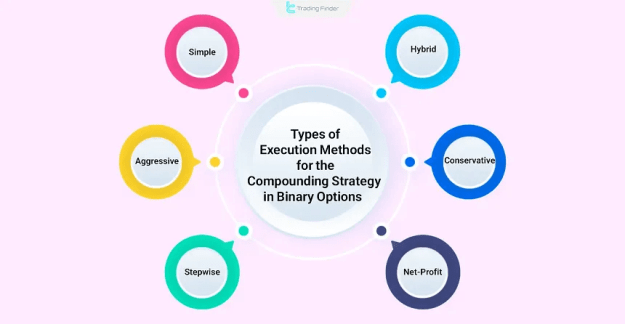
The Compounding Strategy, built upon the compounding effect, features several distinct execution variations, categorized primarily by risk tolerance:
- Simple Compounding Strategy (Fixed Percentage)
- Stepwise Compounding Strategy
- Aggressive Compounding Strategy
- Conservative Compounding Strategy
- Hybrid Compounding Strategy
- Net-Profit Compounding Strategy
Execution Methods for the Compounding Strategy in Binary Options
Simple Compounding Strategy (Fixed Percentage)
In this foundational structure, the trader consistently allocates a fixed percentage (e.g., $5\%$ or $10\%$) of the total equity to each trade. Following a successful trade, the profit is merged with the principal, and the investment amount for the next trade is calculated based on this new, larger balance.
Example of a Simple Compounding Strategy:
Using a fixed $10\%$ of the balance per trade, an initial $\$100$ capital with an $80\%$ payout rate can grow exponentially. The table below illustrates this over 10 consecutive wins, resulting in over $100\%$ growth, reaching a New Balance of $\$215.90$ by Trade No. 10.
Trade No.Investment AmountProfit per TradeNew Balance
110.008.00108.00
210.808.64116.64
............
1019.9915.99215.90
- Trade 1: Investment $\$10.00$, New Balance $\$108.00$
- Trade 5: Investment $\$13.61$, New Balance $\$146.94$
- Trade 10: Investment $\$19.99$, New Balance $\$215.90$
Stepwise Compounding Strategy
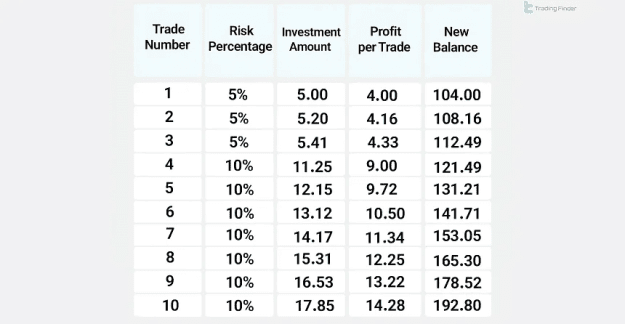
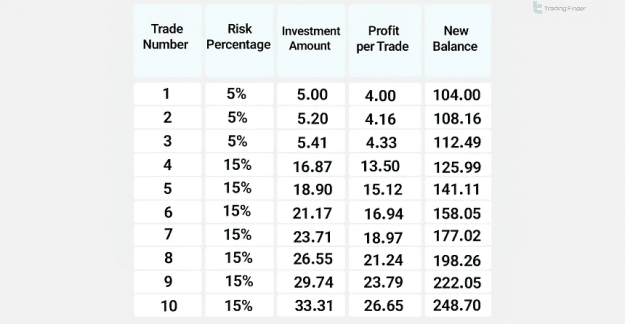
In the Stepwise model, capital allocation increases in predefined stages. For instance, the first three trades might use a $5\%$ allocation, and if all are successful, the percentage is then raised to $10\%$ from the fourth trade onward.
This model is particularly suitable for traders who wish to capitalize on consecutive winning streaks while maintaining a structured framework for psychological control.
Aggressive Compounding Strategy
This approach dictates allocating a high percentage of equity (such as $20\%$ or higher) to every trade. While a small number of consecutive wins can rapidly multiply the capital, a single losing trade is sufficient to wipe out a significant portion or even the entirety of the accumulated profits and principal.
This method is recommended only for professional traders with an extremely high-risk tolerance who can effectively manage heavy psychological pressure.
Example of an Aggressive Compounding Strategy:
Executing this strategy with a fixed $20\%$ risk per trade on an initial $\$100$ balance:
- Trade 1: New Balance $\$116.00$
- Trade 5: New Balance $\$210.04$
- Trade 10: New Balance $\$441.16$
Conservative Compounding Strategy
This model is built upon allocating a very small percentage (typically $1\%$ to $2\%$) of the capital to each trade. Although the speed of profit growth is slower, the principal capital remains highly protected against severe losses.
A Conservative Compounding Strategy is the ideal choice for traders with low-risk tolerance whose primary focus is long-term capital preservation.
Hybrid Compounding Strategy
The Hybrid approach strategically combines elements of both the conservative and aggressive styles. The trader may start conservatively with a small percentage (e.g., $2\%$), and if they achieve a set number of consecutive wins, they increase the risk level (e.g., to $8\%$ or $10\%$). Upon a loss, they immediately revert back to the initial low-risk level.
This strategy is appropriate for traders seeking a balance between risk and return who prefer not to be restricted to a single, absolute trading style.
Net-Profit Compounding Strategy
In this unique method, only the accumulated profits are allocated to subsequent trades, while the initial principal capital remains untouched. Even if a loss occurs, the base capital is safeguarded, thereby minimizing the overall account drawdown.
This model is perfectly suited for risk-averse traders who prioritize the preservation of their initial investment above all else.
Example of a Net-Profit Compounding Strategy:
With an initial Principal of $\$100$ and a fixed $\$10$ investment:
- Trade 1: Total Accumulated Profit $\$8.00$, Total Balance $\$108.00$
- Trade 5: Total Accumulated Profit $\$40.00$, Total Balance $\$140.00$
- Trade 10: Total Accumulated Profit $\$80.00$, Total Balance $\$180.00$
Comparison of Hybrid and Simple (Fixed Percentage) Capital Management in Binary Options
For enhanced clarity in choosing an approach, the features of the Hybrid and Simple Compounding strategies are compared below:
- Pattern:
- Simple Strategy: Fixed percentage of total capital in each trade.
- Hybrid Strategy: Variable percentage based on achieving wins or incurring losses.
- Risk:
- Simple Strategy: Fixed and consistently controlled risk.
- Hybrid Strategy: Variable risk (low at the start, increasing later).
- Capital Growth:
- Simple Strategy: Steady and gradual capital growth.
- Hybrid Strategy: Faster growth potential if consecutive wins are achieved.
- Complexity:
- Simple Strategy: Simple and highly executable for beginners.
- Hybrid Strategy: More complex, demanding greater mental discipline.
- Suitable for:
- Simple Strategy: Beginner traders.
- Hybrid Strategy: Experienced traders with robust risk management skills.
- Main Weakness:
- Simple Strategy: Slower overall profit growth.
- Hybrid Strategy: Higher chance of giving back profits at elevated risk levels.
Step-by-step Tutorial for Trading with the Compounding Strategy in Binary Options
Executing the Compounding Strategy in binary options is a precise process demanding a disciplined and structured approach to capital management.
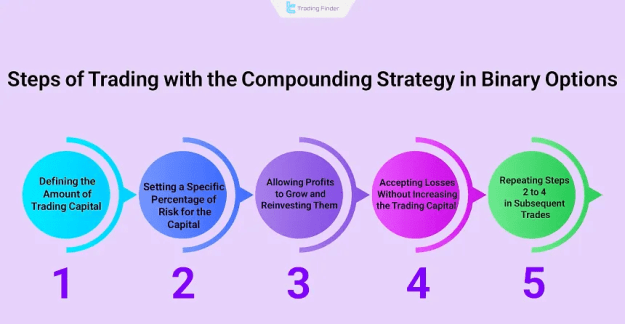
The following steps detail the process for executing trades using the Compounding Strategy in Binary Options:
#1 Define the Amount of Trading Capital
Before initiating any position, it is essential to establish a fixed amount of trading capital. This initial amount forms the foundation of the Compounding Strategy and creates a clear, manageable framework for all subsequent trades.
#2 Set a Specific Percentage of Risk for the Capital
Typically, the risk size is maintained within $1\%$ to $2\%$ of the total capital. However, in more aggressive methodologies, this amount can range from $5\%$ to $10\%$. This structure is critical for ensuring trading discipline and preventing excessively high-risk-taking.
#3 Let Profits Grow and Reinvest Them
If a trade concludes successfully, the profit generated is immediately returned to the trading capital. This action is what activates the Compounding effect, leading directly to the sought-after exponential profit growth. This process is recognized as the key element for maximizing returns and accelerating overall capital development.
#4 Accept Losses Without Increasing the Trading Capital
In the event of a loss, strict adherence to the trading plan is non-negotiable. Attempting to immediately recoup losses by disproportionately increasing the trade size introduces unreasonable risk and can dismantle the entire strategic structure. Discipline in accepting losses is a pillar of sustainable, long-term trading success.
#5 Repeat Steps 2 to 4 in Subsequent Trades
Consistency and persistence are the definitive keys to success with the Compounding Strategy in Binary Options. Continuously repeating the trade cycle while strictly observing the predefined risk percentages lays the essential groundwork for sustainable growth in the investment account.
Practical Example of a Compounding Cycle:
Assuming an initial capital of $\$100$ and a $10\%$ risk per trade over 3 trades:
- 3 consecutive wins: Final capital $\$133.1$ ($+33\%$ change).
- 2 wins – 1 loss: Final capital $\$108.9$ ($+9\%$ change).
- 1 win – 2 losses: Final capital $\$89.1$ ($-11\%$ change).
- 3 consecutive losses: Final capital $\$72.9$ ($-27\%$ change).
This example clearly demonstrates that consecutive wins drive exponential growth, and even with a $2:1$ win-loss ratio, the capital remains profitable. However, consecutive losses result in a rapid and significant decline in capital.
Difference Between Compounding and Martingale
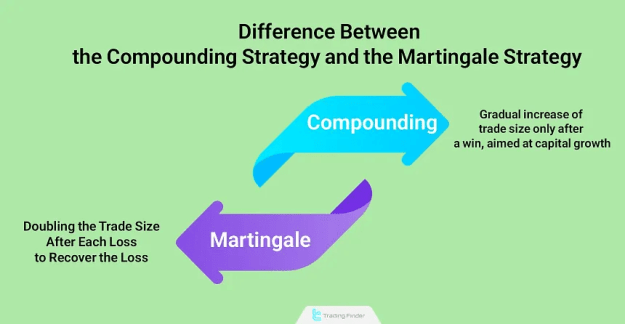
Many novice traders frequently confuse the Compounding Strategy with the Martingale strategy. The fundamental differences are outlined below:
- Operating Logic:
- Compounding: Increase position size after a win.
- Martingale: Increase position size after a loss.
- Objective:
- Compounding: Achieve gradual and sustainable capital growth.
- Martingale: Achieve rapid recovery of losses.
- Risk:
- Compounding: Risk is generally controlled and low.
- Martingale: Risk is excessively high.
- Capital Management:
- Compounding: Based on the principle of compound interest.
- Martingale: Based on doubling the size of the position.
- Trading Approach:
- Compounding: Conservative and sustainable.
- Martingale: Aggressive and high-risk.
While the Martingale strategy carries a very high risk, potentially wiping out the entire account in a few trades, the Compounding Strategy offers a significantly more conservative and measured approach to long-term capital growth.
Auxiliary Tools and Indicators for Executing Compounding
To enhance trade precision and avoid reliance on random entries, traders often integrate analytical tools alongside the Compounding Trading Strategy in binary options.
The most vital tools frequently used include:
- Relative Strength Index (RSI) and MACD: Used to identify potential overbought/oversold zones and confirm the prevailing trend direction.
- Price Action and Candlestick Patterns: Employed to detect high-probability, low-risk entry points.
- Moving Averages: Utilized to clearly identify medium-term market trends.
The strategic combination of these analytical tools with a structured compounding plan significantly increases the probability of success and the continuity of profitability.
Advanced Capital Management in Compounding
One sophisticated capital management technique is staggered profit withdrawal. In this method, the trader periodically withdraws a portion of the consecutive profits and only allocates a percentage of the remaining profit to the next trading cycle.
This approach serves to ensure that a portion of previously earned profits is secured, even if a subsequent cycle fails. Additionally, establishing a maximum cap for each compounding cycle (e.g., $30\%$ to $40\%$ account growth) helps to prevent excessive risk-taking.
Key Points in Implementing the Compounding Strategy in Binary Options
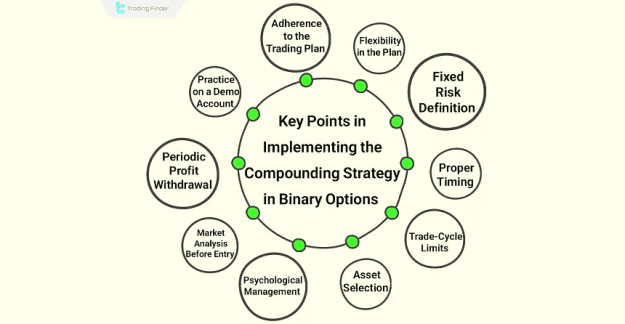
For the successful implementation of the Compounding Strategy, the following key points should be adhered to:
- Fixed Risk Definition: Allocate a controlled $2\%$ to $10\%$ of capital per trade to manage risk effectively and prevent heavy losses.
- Adherence to the Trading Plan: Clearly define the number of steps and the profit-taking point, and never deviate from this plan.
- Periodic Profit Withdrawal: Secure a portion of consecutive profits to minimize the risk of losing all accumulated gains.
- Asset Selection: Concentrate on major, highly liquid assets with stable volatility, such as EUR/USD or gold.
- Proper Timing: Utilize $5$- to $15$-minute timeframes to reduce market noise and avoid ultra-short-term trades.
- Psychological Management: Maintain strict mental discipline and emotional control as trade sizes and pressure increase at each step.
- Trade-Cycle Limits: Execute limited $5$- to $7$-step cycles to effectively balance capital growth with the risk of giving back profits.
- Market Analysis Before Entry: Employ Price Action, candlestick patterns, and confirmatory indicators (RSI, MACD) instead of relying on random entries.
- Practice on a Demo Account: Rigorously test the Compounding plan on a demo environment to identify and correct weaknesses before trading live capital.
- Flexibility in the Plan: Be prepared to stop the compounding cycle and revert to the initial capital size immediately in case of a loss to preserve the overall account structure.
Common Mistakes Traders Make When Using Compounding in Binary Options
Many beginner traders commit both behavioral and computational errors while attempting to implement the Compounding Strategy in Binary Options. Consciously identifying and avoiding these mistakes can significantly enhance the strategy's efficiency and a trader's long-term success rate:
- Starting with excessively high-risk percentages (over $15\%$ per trade) without sufficient experience.
- Attempting to quickly recover losses by suddenly increasing the trade size.
- Lacking a defined trading plan and making ad-hoc decisions based on emotion.
- Entering highly volatile markets that increase the probability of trade failure.
Conclusion
The Compounding Strategy in Binary Options represents one of the most sophisticated capital-management methods, operating on the principle of compound interest.
This strategy holds the potential to deliver exponential capital growth without the need for adding new capital. However, its success is strictly conditional upon precise planning, sound risk management, and robust psychological discipline.
Beginner traders are strongly advised to initiate their compounding journey with conservative approaches, whereas professional traders may capitalize effectively using hybrid or aggressive models.
Ultimately, success with this method is directly dependent on sustained adherence to the trading plan and the informed acceptance of calculated risk.