

Prop Firm DrawDown Protector : Prop Firm Capital Protection Expert MT4 |Forex Money Management: Forex Trade Management Expert MT4 |ICT Concepts Indicator MT4 | Smart Money Concepts Expert MT4| Get a free Expert Advisor license via Telegram and WhatsApp
What is a Point of Interest (POI)?
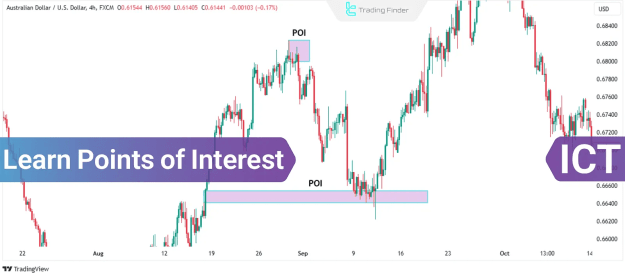
A Point of Interest (POI) is a specific area on a price chart where smart money activity is concentrated, making it a high-probability zone for a price reversal or continuation. These zones are not limited to a single type of market structure but can include:
- Support and Resistance Levels
- Order Blocks (OBs)
- Fair Value Gaps (FVGs)
- Any area indicative of institutional activity
By identifying these key zones, a trader can better understand the market's structure and forecast its most probable direction.
Identifying POIs in Higher Timeframes
The first step in a professional ICT analysis is to locate POIs on higher timeframes. Here are the five key elements to focus on:
- Highs and Lows: These act as powerful price magnets. Traders must determine which ones have been broken (Break of Structure) and which are the next logical targets for price action.
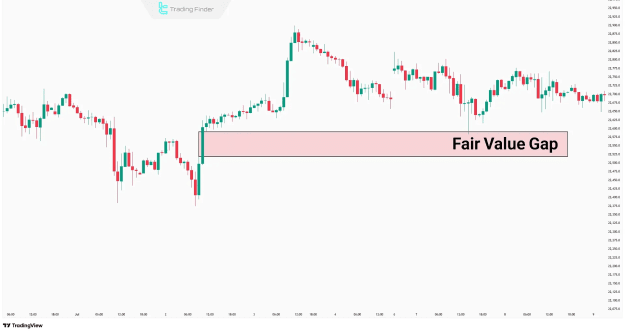
- Fair Value Gaps (FVGs): These gaps are formed during rapid price movements and often act as retracement or continuation zones. They are excellent POIs for anticipating a price reversal or a continuation of the trend.
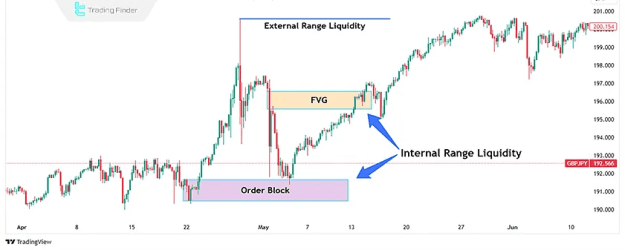
- Order Blocks (OBs): As zones where large financial institutions enter the market, OBs are critical POIs. They often lead to significant price reversals and serve as ideal entry or exit points.
- Optimal Trade Entry (OTE): This setup uses the Fibonacci tool to identify a sweet spot for a trade entry within the Discount Zone (below 50%) or Premium Zone (above 50%). A valid OTE is a powerful POI for entering a high-probability trade.
- Internal and External Range Liquidity: Internal Range Liquidity exists within the current price range and can act as a reversal point. External Range Liquidity, found outside the current range (e.g., previous highs or lows), often serves as a magnet for price, leading to major breakouts or trend reversals.
How to Use POIs for Entries in Lower Timeframes
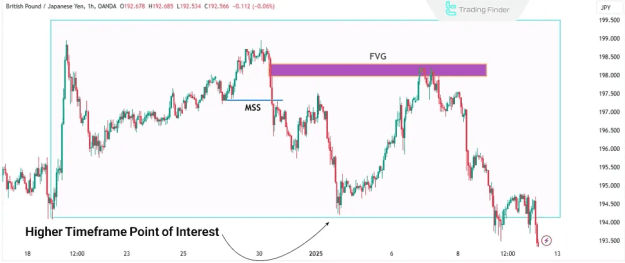
Once a major POI is identified on a higher timeframe, traders can drill down to lower timeframes to find precise entry points. This process involves a multi-step confirmation strategy:
- Evaluate Breaks of Highs or Lows: When the price approaches a POI, a break of a lower timeframe high or low can serve as a key signal for a potential trade entry.
- Search for Fair Value Gaps: Look for smaller FVGs within the POI zone. These gaps are highly probable entry points, as price often seeks to fill them.
- Identify Local Order Blocks: Smaller Order Blocks within the lower timeframes provide even more precise entry points. Professional traders often seek additional confirmations in these areas before executing a trade.
- Observe Market Structure Shifts: A shift in market structure on a lower timeframe is a powerful confirmation of a potential trend change within a POI.
- Utilize the OTE Tool: After a significant move is identified on the lower timeframe, the OTE setup can be used to find the most optimal Fibonacci levels for placing entry orders, take-profits, and stop-losses.
Conclusion
Mastering the ICT concept of Points of Interest (POIs) is a critical skill for advanced traders. By first identifying key POIs on higher timeframes and then using them as a roadmap for finding high-precision entries on lower timeframes, traders can align themselves with the movements of smart money. This strategy, which integrates market structure, liquidity, and key price areas, provides a powerful framework for forecasting future price movements and executing profitable trades.