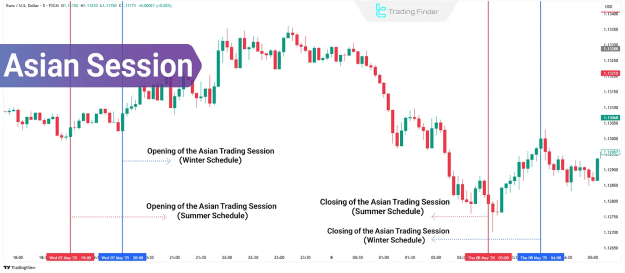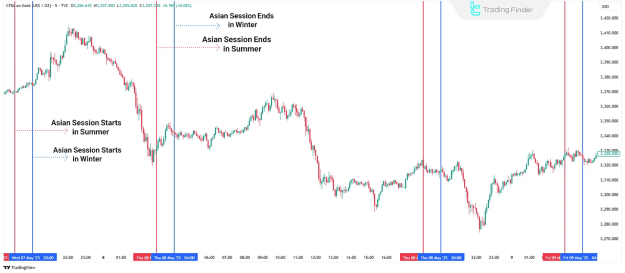


- Note: During New York summer time, these times shift back by one hour.
TP & SL Tool: Risk Reward Ratio Calculator RRR MT4 | Prop Firm Protector: Trade Assist Prop Firm Plus TF Expert MT4 | Money Management + DrawDown Protector: Trade Panel Prop Firm Drawdawn Limiter Pro MT4 |Get a free Expert Advisor license via Telegram and WhatsApp
Opening Hours of the Asian Session (New York Time)
- Sydney market opens: 8:00 PM
- Tokyo market opens: 9:00 PM
- Tokyo market closes: 4:00 AM
Key active cities include Tokyo, Sydney, Hong Kong, and Singapore. The highest trading volume is typically observed between 7:00 PM and 1:00 AM New York time, when the Japanese market is most active.
Characteristics of the Asian Session
Low Volatility
- Price movements remain limited in most currency pairs.
- The market typically forms range-bound structures with infrequent strong breakouts.
Relatively Lower Liquidity
- Liquidity is significantly lower compared to the London and New York sessions.
- Trading activity is concentrated within Japanese, Australian, and Hong Kong markets.
Higher Spreads at Session Start
- Especially during the early Sydney trading hours.
- Wider spreads result from insufficient order depth and reduced market participation.
Mild and Corrective Price Patterns
- Price action is predominantly corrective or neutral.
- Strong directional trends generally begin with the opening of the London session.
Price Behavior Analysis During the Asian Session
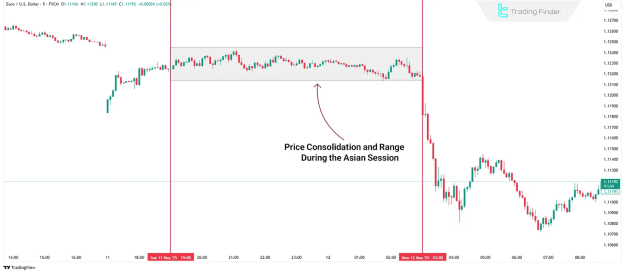
Range and Price Compression
- The market lacks strong trending movements.
- Currency pairs, especially non-Asian ones, often remain confined within narrow ranges which act as bases for entries or breakouts in the London session.
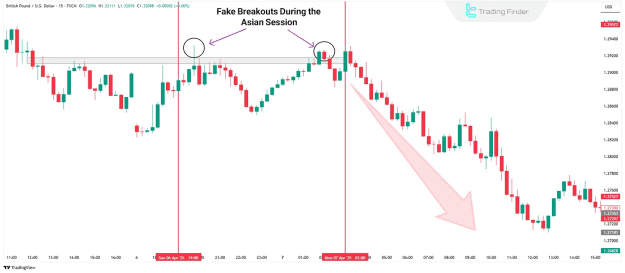
False Breakouts
- Due to low liquidity, breakouts often fail to sustain momentum.
- Prices frequently move beyond range boundaries only to reverse, trapping less experienced traders while providing liquidity for institutional participants.
Asian Sentiment Analysis and Psychological Impact
Despite lower volatility, economic data released during the Asian session, such as Bank of Japan interest rate decisions or Japanese CPI data, can influence market direction for the remainder of the day.
- The prevailing sentiment often shapes initial tendencies in the London session, particularly for safe-haven assets like the Japanese yen.
Important Tips for Trading During the Asian Session
Risk Management in Low Liquidity Conditions
- The early hours before Tokyo opens are characterised by low order depth, increasing the risk of irrational price spikes and slippage.
- High-volume trades without stop losses should be avoided during this period.
Choosing Brokers with Suitable Spreads
- Spreads for pairs other than USD/JPY and AUD/JPY are generally higher due to reduced volume.
- Brokers offering ECN accounts or fixed spreads are preferable to manage trading costs effectively.
Adjusting Trade Volume to Session Volatility
- Large trade volumes during low-volatility conditions lead to unfavourable risk/reward ratios.
- Position sizes should align with average movement ranges (e.g., ATR on M15 or M30 timeframes) to prevent overexposure.
Avoid Early Entries
- The initial minutes of the Sydney market typically exhibit high spreads, low liquidity, and false moves.
- It is advisable to wait until the Tokyo market opens and price action stabilises.
Correlation of the Asian Session with Subsequent Sessions
Price Structure Transfer to London Session
- Price movements during the Asian session, whether range-bound or weakly trending, create key levels for European traders.
- The high and low of the Asian session often act as critical breakout or reversal levels during early London hours, determining the dominant market direction for the day.
Price Behavior in the Tokyo-London Overlap
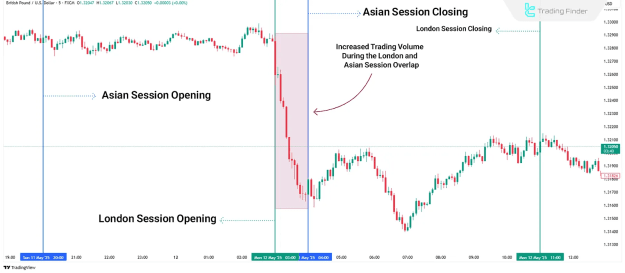
- The 3:00 to 4:00 AM New York time window overlaps the end of the Asian session and the start of the London session, increasing trading volume significantly.
- Limited volatility during Asia raises the likelihood of breakouts during this overlap, with trends either continuing or reversing at this stage.
Asian Impact on Gaps in Other Markets
- Performance of major Asian indices, such as Tokyo’s Nikkei or China’s SSE and Hang Seng, can cause gaps in European and American futures or stock markets.
- Key Asian economic data releases are often the primary drivers of such gaps.
Conclusion
The Asian session, with its orderly price structure and limited volatility, provides an optimal environment for scalpers and day traders. Despite lower liquidity compared to other sessions, it plays a critical role in shaping daily key levels and initial market direction.
Professional traders use the Asian session not for heavy entries but as a preparation phase for forming decisions during the London and New York sessions. Monitoring this session’s price ranges, reactions to economic data, and volatility characteristics remains essential in planning effective trading scenarios.