

TP & SL Tool: Risk Reward Ratio Calculator RRR MT5 | Prop Firm Protector: Trade Assist Prop Firm Plus TF Expert MT5 | Money Management + DrawDown Protector: Trade Panel Prop Firm Drawdawn Limiter Pro MT5 |Get a free Expert Advisor license via Telegram and WhatsApp
What Is a Forex Trading Session?
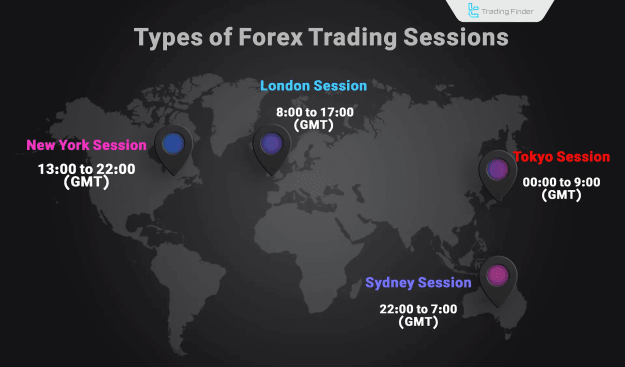
A Forex trading session refers to a specific timeframe during which market participants from different regions are actively engaged in trading. Each session aligns with the working hours of major global financial institutions.
For instance, during the Tokyo session, Japanese and Asian banks are operational, leading to increased liquidity and volatility in JPY currency pairs.
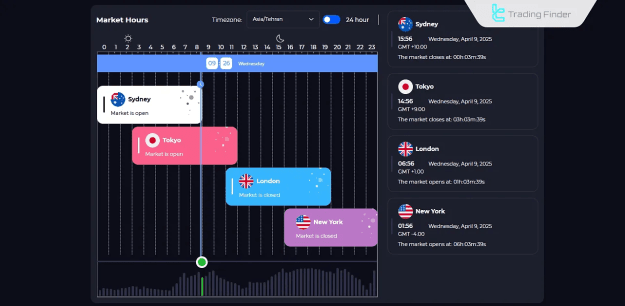
Breakdown of Forex Market Hours
Forex traders often use session monitoring tools—such as those found on TradingFinder—to track which markets are currently open or closed. This helps traders identify the best times to enter or exit the market.
Main Forex Trading Sessions
Sydney Session
- Represents the start of the global trading day
- Features the lowest volatility among all sessions
- Main focus on AUD and NZD currency pairs
- Favored for swing trading and low-risk strategies
Tokyo Session
- Begins with the opening of Asian markets
- Liquidity increases in JPY and AUD pairs
- Characterized by moderate volatility
- Ideal for range trading
London Session
- Known as the most active session globally
- Accounts for over 30% of daily Forex transactions
- Offers high volatility and liquidity
- Commonly traded pairs include GBP/USD and EUR/USD
- Supports scalping and day trading strategies
New York Session
- Overlaps with the London session, creating a peak in global liquidity
- Features tight spreads and high volatility
- Major U.S. economic reports are released during this session
- Best suited for day traders and news-based strategies
Why Trading Sessions Matter
Understanding the dynamics of different trading sessions is critical for traders, particularly those engaged in short-term strategies. Each session influences market behavior, trading volume, and price action, ultimately affecting profitability and risk.
Key Advantages of Session Awareness
- Optimal Entry Times: Higher liquidity during the London and New York sessions enables better execution and tighter spreads.
- Economic Events: Important indicators such as non-farm payrolls, inflation data, and central bank decisions are released during high-impact sessions.
- Trader Behavior: Market sentiment differs across sessions—Asian markets are typically cautious, while European and American markets exhibit aggressive price movements.
Comparison of Forex Sessions
Each session exhibits distinct features in terms of trading style, volatility, and key currency pairs. Here's a comparative overview:
- Sydney: Low volatility, AUD-focused, suitable for swing trades
- Tokyo: Moderate volatility, JPY pairs active, favors range strategies
- London: High liquidity, fast market moves, ideal for scalping
- New York: Sharp reversals, driven by U.S. data, supports news trading
Technical Patterns in High-Volatility Sessions
Certain technical patterns consistently emerge during high-activity periods such as the London and New York sessions. Recognizing these patterns can help traders anticipate trend reversals, false breakouts, and liquidity grabs.
New York Reversal Pattern
This is a well-known setup where the market reverses its direction during the second half of the New York session, often after a strong move earlier in the day.
Seek & Destroy Pattern
A deceptive setup common during session overlaps, this pattern involves liquidity sweeps and fake breakouts that are designed to trap inexperienced retail traders.
Conclusion
Understanding Forex trading sessions is fundamental for any trader seeking consistent performance. By aligning trading strategies with session-specific characteristics—such as volatility, volume, and economic events—traders can improve timing, reduce risk, and enhance profitability. Recognizing recurring patterns like the New York Reversal and Seek & Destroy can provide a further edge in volatile market conditions.