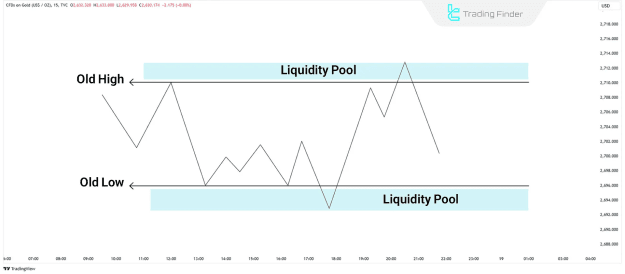


- Above previous highs (Buy Side Liquidity)
- Below previous lows (Sell Side Liquidity)
Institutional traders, commonly referred to as Smart Money, actively target these areas to trigger retail positions and enter or exit trades at premium or discount pricing.
Understanding Liquidity in Forex Education
In the context of forex education, liquidity describes the availability of buyers and sellers in the market at any given time. It reflects how easily an asset can be bought or sold without affecting its market price.
Retail traders typically transact at the current market rate, while institutional traders aim to:
- Buy below market value, in discount zones
- Sell above market value, in premium zones
This discrepancy creates areas of liquidity imbalance—also known as Liquidity Pools—which can be exploited through ICT strategies.
What Defines an ICT Liquidity Pool
Liquidity Pools in ICT methodology are market levels where trade volume surges due to concentrated orders from both buyers and sellers. These pools become ideal targets for Smart Money strategies that capitalize on price movement toward these high-liquidity zones.
Key features include:
- Temporary price displacement as orders are filled
- Reversals or continuations initiated after liquidity is absorbed
- Increased volatility around these levels
Bullish Liquidity Pool
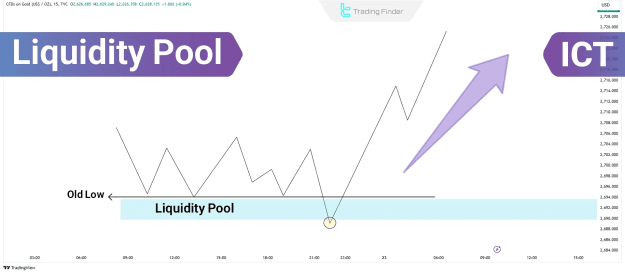
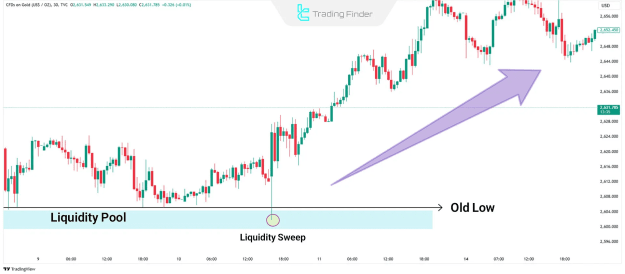
A Bullish Liquidity Pool forms beneath a prior market low. These areas accumulate Sell Stop orders from retail traders. As the market dips below this low, Smart Money activates long positions, expecting a price reversal upward.
To trade a bullish liquidity pool:
- Identify the Discount Zone during an uptrend
- Observe price dropping below an old low
- Enter a long trade as sell-side liquidity is consumed
- Target the next visible Buy Side Liquidity zone
These pools represent institutional accumulation and serve as a foundation for upward price movement.
Bearish Liquidity Pool
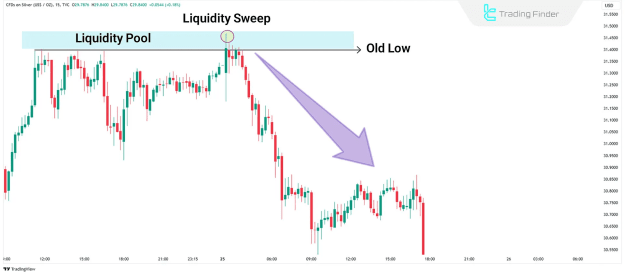
Bearish Liquidity Pools are located above old highs, where Buy Stop orders are positioned. In this case, institutional traders seek to trigger retail buy orders before entering short positions at premium pricing.
To trade a bearish liquidity pool:
- Identify the Premium Zone in a downtrend
- Wait for price to sweep above a prior high
- Execute a short position as liquidity is absorbed
- Aim for the next Sell Side Liquidity zone beneath the current market
These pools represent institutional distribution before downward price continuation.
Are Confirmation Tools Required?
In ICT-based trading, setups involving liquidity pools do not require confirmation from additional indicators. These trades are based on the understanding of order flow and market behavior. The effectiveness of such trades depends on recognizing liquidity shifts and institutional manipulation patterns.
Reliability of the Liquidity Pool Model
The ICT liquidity pool model is considered reliable among professional traders due to its basis in real market mechanics. By focusing on liquidity concentration zones and price reaction, this strategy offers clear entry and exit signals.
Success with this model depends on:
- Recognizing liquidity accumulation patterns
- Timing entries at optimal zones
- Managing risk with appropriate stop-loss and position sizing
Conclusion
The Liquidity Pool trading strategy within the ICT methodology highlights the importance of understanding how Smart Money exploits areas of concentrated retail orders. By mastering the concepts of premium and discount zones, liquidity behavior, and institutional order flow, traders can execute higher-probability setups.
Knowledge of liquidity mechanics—combined with disciplined execution and risk control—offers a significant edge in modern forex trading.