

Comparison with Traditional Financial Markets
The market capitalization of the crypto market, as of February 2025, stands at approximately $3.20 trillion. In contrast:
- Forex Market: $7 trillion in daily trading volume
- Global Stock Market: $120 trillion (2023)
- Global Bond Market: Over $130 trillion (2022)
- Gold Market: $19 trillion (February 2025)
This stark contrast illustrates the relatively low value of the crypto market, making it more vulnerable to manipulative practices by market makers.
Why Market Capitalization Matters
Low market capitalization allows for price manipulation with relatively small capital inflows.
- If an asset has a $1 billion market cap, an inflow of $1 billion can potentially double its price.
- Conversely, the same amount would only move a $100 billion asset by approximately 1%.
Key Insight:
The lower the market cap, the easier it is to manipulate prices, leading to increased volatility—especially in low-cap cryptocurrencies.
The Trap of Meme Coins
One of the most notorious pitfalls in cryptocurrency trading is meme coins—digital assets that lack credible utility or development but gain value purely through social media hype.
Case Study: Dogecoin and Elon Musk
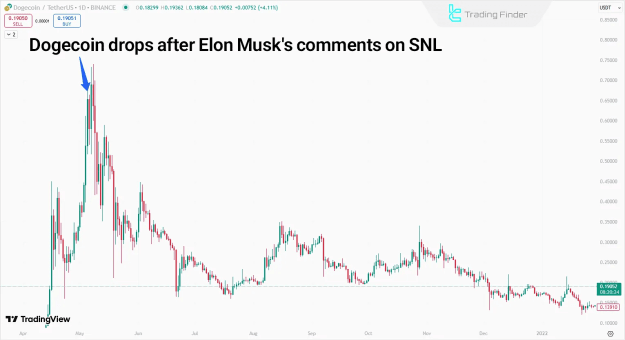
In 2021, Elon Musk, a highly influential figure in financial circles, promoted Dogecoin via social media. Anticipation built up around his scheduled appearance on a major TV show on May 5, 2021, where he was expected to discuss Dogecoin.
- Behind the scenes, Musk was reportedly liquidating his holdings.
- Following the show, Dogecoin’s price crashed, showcasing how meme coins are driven by emotion and speculation, not fundamentals.
Key Risks of Meme Coins
- Lack of underlying project or technology
- Driven by influencer activity rather than utility
- Vulnerable to pump-and-dump schemes
- High potential for retail investor losses
External Factors Influencing the Cryptocurrency Market
Macroeconomic Conditions
The cryptocurrency market is highly sensitive to macroeconomic indicators, including:
- Inflation rates
- Unemployment levels
- GDP growth
Economic reports can cause short-term volatility, while monetary policy decisions impact long-term trends.
Impact Example:
If U.S. inflation exceeds forecasts, it typically strengthens the U.S. Dollar and puts downward pressure on cryptocurrencies.
Monetary Policy and Liquidity Effects
Monetary Policy plays a pivotal role in determining the liquidity available for investment in risk assets like cryptocurrencies.
- Expansionary Policy (Rate Cuts): Increases liquidity and stimulates crypto market growth.
- Contractionary Policy (Rate Hikes): Reduces liquidity, prompting capital outflows and price corrections.
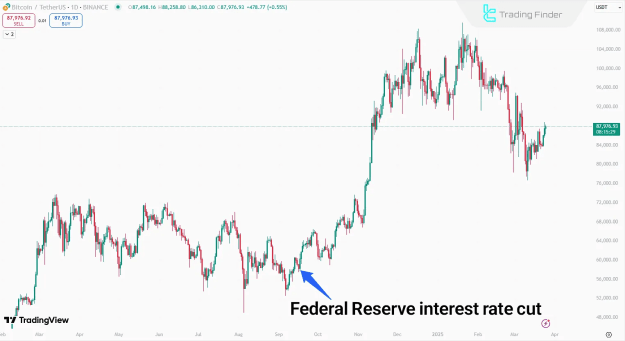
Case Example: Bitcoin Surge in September 2024
Following an interest rate cut by the Federal Reserve, Bitcoin began a notable upward trend, reflecting the market’s sensitivity to monetary easing.
Market Sentiment and Risk Appetite
Market sentiment significantly impacts price direction in the crypto space.
- Risk-on Sentiment: Increases demand for volatile assets like crypto.
- Risk-off Sentiment: Leads to selling pressure and capital flight.
Positive indicators like dovish policy decisions or strong economic data often boost investor confidence, fueling market rallies.
Essential Aspects of Successful Cryptocurrency Trading
The Importance of Risk Management
Due to the inherently volatile nature of cryptocurrencies, risk management is indispensable.
Key Risk Management Practices:
- Implementing stop-loss orders
- Defining profit targets
- Controlling position size
Recommended Risk Exposure:
- Limit risk per trade to no more than 1% of total trading capital
- Carefully calculate position sizes to align with your overall portfolio and risk tolerance
Trading Psychology: Managing Fear and Greed
Emotions often dictate irrational decisions in volatile markets. Successful traders learn to master fear and greed through structured systems.
Signs of Fear:
- Exiting profitable trades prematurely
- Poor decision-making during volatility
Signs of Greed:
- Overleveraging positions
- Ignoring exit strategies
- Increasing risk on winning trades
Emotional Control Techniques:
- Follow a predefined trading plan: Include clear entry/exit points and risk parameters
- Accept losses as part of the process: Use stop-losses to cap downside
- Avoid impulsive decisions: Base trades on analysis, not emotion
Conclusion
The cryptocurrency market offers high-reward opportunities, but its low market capitalization and extreme volatility make it equally high-risk.
To succeed in this environment, traders must prioritize:
- Fundamental analysis
- Risk management
- Emotional discipline
Avoid speculative traps like meme coins, stay informed about macroeconomic factors, and always protect your capital through structured strategies. Only then can you navigate the turbulent waters of crypto trading with confidence and resilience.